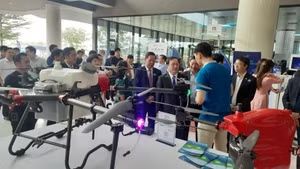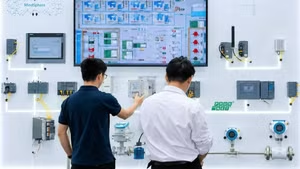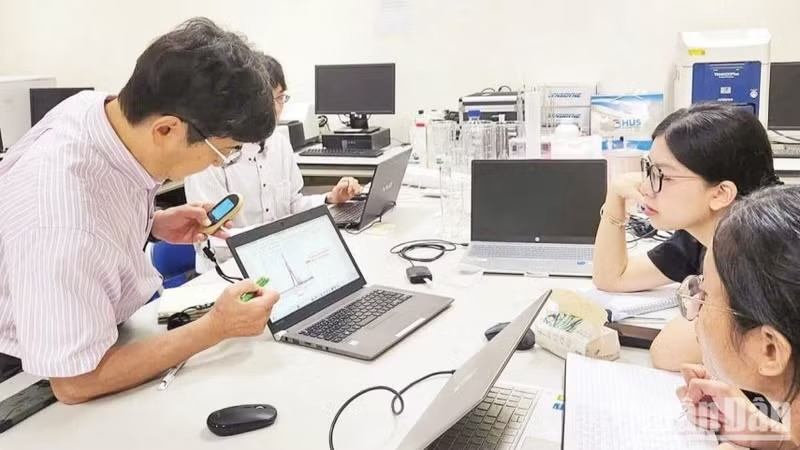
Reorganising infrastructure around shared use and closer links between research, testing, production, and the market is driving the need for new approaches to investment and operating mechanisms.
Building a shared-capacity system
To date, the state has invested in establishing 16 national key laboratories. The development of this system was a sound policy in the context of Viet Nam's initial efforts to build modern science and technology capacity, contributing to the formation of several strong research groups, the training of highly qualified human resources and the creation of a foundation for research in several priority technology fields.
However, according to an assessment by the Ministry of Science and Technology, the selection of fields and the list of key laboratories was carried out at a time when Viet Nam lacked a sufficiently clear national technology development strategy and had yet to formulate an overall master plan for national research infrastructure.
As a result, the key laboratory system has mainly focused on traditional research fields such as biotechnology, materials, chemistry, mechanics, and automation, while there is little or no presence of fields that currently determine national competitiveness, including artificial intelligence, semiconductors, high-performance computing, quantum technology, next-generation biotechnology, intelligent robotics, big data, and space technology.
As for the research and testing centre system, more than 1,000 laboratories have been established nationwide to carry out testing, calibration, certification, inspection, and accreditation activities. However, their distribution remains fragmented, while organisational and operational models have yet to establish clear tiers between national focal organisations, key technical centres, regional centres, and local centres.
In response to the need to strengthen research and development capacity and gradually master strategic technologies, Politburo Resolution No. 57/NQ-TW, issued on November 22, 2024, set out orientations for developing a system of research and testing centres and national key laboratories.
On that basis, the prime minister recently issued Decision No. 1483/QD-TTg to approve a scheme on developing a system of research and testing centres and national key laboratories focusing on strategic technologies.
According to experts, Decision No. 1483/QD-TTg shifts the approach from investing in individual pieces of equipment and standalone laboratories to building a nationwide system of shared capabilities. The capability chain has been defined in comprehensive terms, covering research into core and foundational technologies; development and integration; testing, measurement, inspection, and certification; pilot production; and product completion and commercialisation. The scale and urgency of the policy are reflected in the target of investing in, upgrading and putting into operation at least eight national key laboratories and four national research and testing centres by 2030, while mastering at least 10 core technologies.
Creating mechanisms to maximise infrastructure effectiveness
According to Professor Nguyen Huu Duc, former Deputy Director of Viet Nam National University, Ha Noi, organising a nationwide system of shared capabilities means affirming that innovation is an inter-organisational activity. Each centre and laboratory must be linked to at least one ecosystem or cluster comprising research institutes, higher education institutions, businesses, and management agencies.
Infrastructure must be made publicly accessible through a digital platform, providing information on equipment, services, access conditions, and availability. Businesses, especially small and medium-sized enterprises, start-ups, and science and technology enterprises, should be able to access the system to conduct research, testing, and product development.
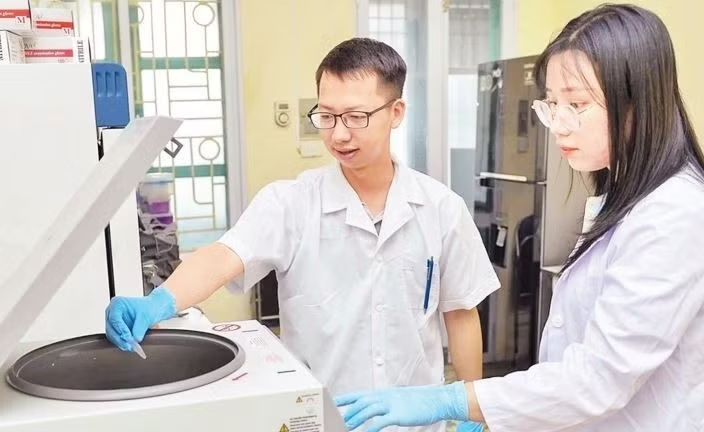
For the system to operate effectively and generate genuine research capacity, experts say a key factor is to focus on building a strong team of chief engineers and research team leaders, while applying special mechanisms and preferential policies to attract outstanding domestic and international experts and scientists to leadership positions at key laboratories. At the same time, research orientations must closely reflect the actual needs of the market and industry.
Many businesses expect investment in research and testing infrastructure to have a direct impact on the competitiveness and innovation capacity of Vietnamese enterprises.
Phan Thi Tra My, Founder and Chief Executive Officer of Viet Thao Company Limited in Ho Chi Minh City, said that for small and medium-sized enterprises, the system would serve as an important “lever” in encouraging them to invest more boldly in research and development (R&D) for high-value-added products. The system should have a central point of contact or a shared platform providing information on the capabilities of each laboratory, equipment lists, testing methods, available services, estimated costs, implementation timelines, and registration procedures, such that businesses do not have to search for and contact multiple organisations.
The state could consider mechanisms to subsidise part of the costs of testing, analysis, or equipment use for businesses with R&D projects, new products, products applying strategic technologies, or projects aimed at increasing the value of Vietnamese agricultural products. If access costs are too high, the shared system will struggle to deliver benefits to the very businesses that need support the most.
Businesses also want the system to share experts and research capabilities so that specific technological challenges can be addressed jointly. In addition, clear mechanisms are needed to protect confidential information and intellectual property, enabling businesses to confidently bring their formulas, test samples, and technological processes into the shared system. Regulations on data confidentiality, ownership of research results, and rights to commercial exploitation need to be clearly defined.
According to Prof, Dr Nguyen Van Noi, Chairman of the Viet Nam Association of Testing Laboratories, the key conditions determining the speed and feasibility of operating the system are the early completion and issuance of a set of criteria for selecting centres and laboratories, together with a set of performance indicators for assessing their operational effectiveness. Key laboratories should also be allowed to use revenue from testing, inspection, and technology transfer services to reinvest in equipment and provide remuneration.