According to a report from the Viet Nam People’s Navy, defence diplomacy is identified as a vital task that must be expanded and deepened substantively, contributing to the preservation of maritime peace and stability, enhancing the Navy’s standing and credibility, and creating a favourable international environment to protect the fatherland early and from afar.
In recent years, the Viet Nam People’s Navy has steadily broadened international cooperation, participating in numerous exchange mechanisms, exercises and professional interactions with foreign navies.
The Navy’s modern vessels, named after national heroes and military geniuses such as Tran Hung Dao, Dinh Tien Hoang, Ly Thai To and Quang Trung, have visited many countries in the region and beyond; they carry messages of peace, deepen mutual understanding, build trust and promote cooperation for maritime peace and stability.
The value of those activities lies in command and organisational professionalism, technical sustainment, human endurance and the degree to which a navy masters its equipment — all hallmarks of a modern naval force.
Defence diplomacy is identified as a vital task that must be expanded and deepened substantively, contributing to the preservation of maritime peace and stability, enhancing the Navy’s standing and credibility, and creating a favourable international environment to protect the fatherland early and from afar.
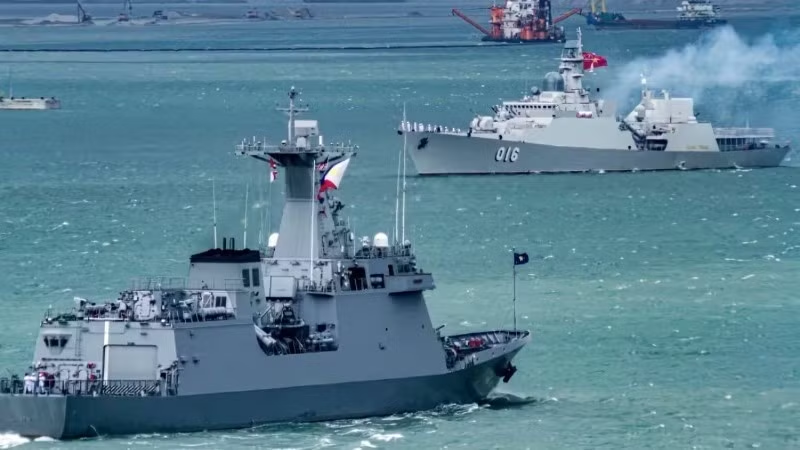
Colonel Mai Van Doanh, Political Commissar of Brigade 162, Naval Region 4, reported that recently, missile frigate 016 Quang Trung embarked on a voyage to Australia to join the International Fleet Review commemorating the 125th anniversary of the Royal Australian Navy (March 1, 1901–2026) and the multilateral Kakadu naval exercise 2026.
On a long voyage the ship must operate reliably under varied weather and ocean conditions. Every watch on the bridge, every technical check, every maritime safety drill is part of the mission.
That foundation fosters the Vietnamese Navy’s confidence as it integrates and builds trust among international partners. During his visit to the Viet Nam Naval Command in January 2026, Australian Chief of Navy Vice Admiral Mark Hammond expressed his hope to continue deepening good relations between the two navies.
Lieutenant Colonel Dang Van Do, Captain of 016 Quang Trung, Brigade 162, Naval Region 4, said that upon receiving orders for the ship and its detachment to participate in the International Fleet Review and the multilateral Kakadu naval exercise 2026 in Sydney, commanders and personnel regarded it as a highly important, demanding and complex task, but were confident of successful completion.
In recent years, the Navy’s defence‑diplomacy activities have not been mere social visits; they constitute exceptional training environments. Operating in the international arena requires personnel to meet higher standards of professional skills, foreign languages, military bearing and interoperability.
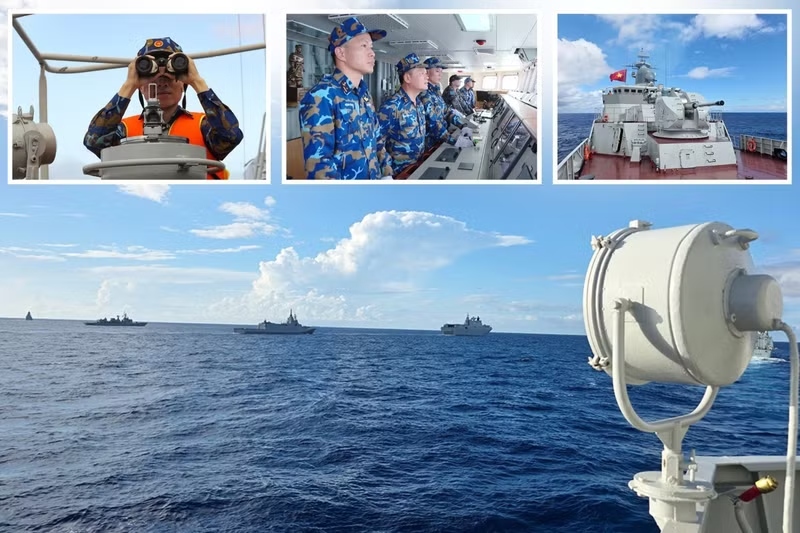
From that perspective, defence diplomacy and force development are complementary tasks, not separate ones, both aimed at building the Viet Nam People’s Navy into a force that is increasingly regular, elite and modern, capable of safeguarding maritime sovereignty and contributing to regional peace and stability.
When Naval Ship 016 Quang Trung steamed tens of thousands of nautical miles across the East Sea/South China Sea and international waters to call at Sydney, international partners saw more than a Vietnamese‑flagged ship. They saw naval personnel demonstrating professional bearing, confident communication and the capacity to operate seamlessly alongside foreign naval forces.
Through such voyages, the international community gains a deeper appreciation of Viet Nam – a country that values peace, cooperation and responsibility; one that persists in resolving differences peacefully and in accordance with international law. Viet Nam understands that preserving a peaceful environment requires a force that is both strong and capable of commanding the seas.
Vice Admiral Tran Thanh Nghiem, member of the Party Central Committee and Commander of the Viet Nam People’s Navy, emphasised that given continuing complexities in maritime affairs and the increasing intertwining of traditional and non‑traditional security challenges, building a sufficiently robust navy is not only an immediate requirement but a long‑term task to protect the peaceful, stable conditions necessary for national development.
Building a sufficiently robust navy is not only an immediate requirement but a long‑term task to protect the peaceful, stable conditions necessary for national development.
Vice Admiral Tran Thanh Nghiem, member of the Party Central Committee and Commander of the Viet Nam People’s Navy
In recent years, alongside strengthening combat readiness, the Viet Nam People’s Navy has stepped up defence diplomacy and military cooperation with other navies, especially in the region, to foster mutual understanding and trust, build strategic confidence, preserve peace and stability, and prevent the risk of war and conflict early and at a distance.
Behind friendly visits, international exercises and sea exchanges lies a continuous process of improving training quality, mastering military science and technology, enhancing command and coordination capabilities, and cultivating the professional conduct required in international settings.
Each encounter with foreign navies is an opportunity to promote the land and people of Viet Nam, exchange experience, learn organisational methods, raise professional standards and refine capabilities.
What remains after each voyage is more than the nautical miles covered; it is the trust created — the trust of international partners in a professional, responsible navy. Above all, it is the trust of the people in the sailors who worked on the front lines of the waves day and night to maintain peace for the fatherland.