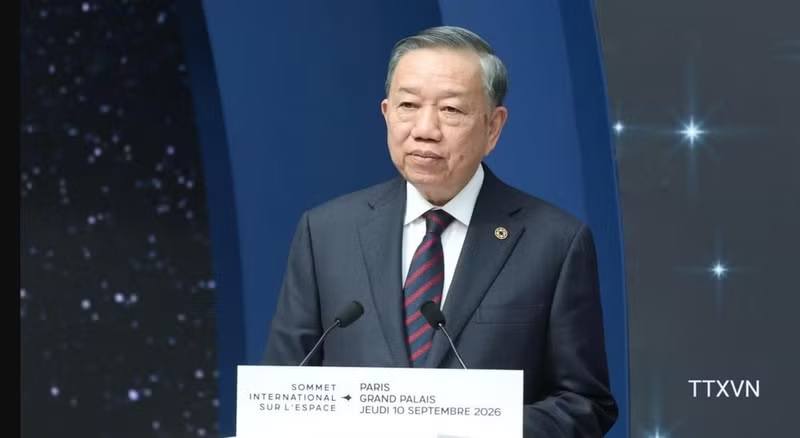
During Party General Secretary and State President To Lam's working trip to the Russian Federation and the French Republic in early September, several cooperation initiatives involving Vietnamese businesses have followed this direction. Petrovietnam and a Rosatom partner agreed to develop an additive manufacturing technology centre in Viet Nam linked to the transfer of materials and 3D printing technologies for the energy sector.
In France, the Viet Nam Vaccine Joint Stock Company (VNVC) and Sanofi announced a roadmap for producing several new-generation vaccines in Viet Nam, aiming to bring part of the international partner's production capacity to the domestic market rather than simply importing finished products.
In aviation, Vietjet and its French partners have expanded cooperation beyond operations and technical maintenance to AI, data, and cybersecurity — technological layers that are becoming increasingly important to modern aviation operations.
These agreements differ in scope, level of technology transfer, and implementation timelines, however, they all point to one common feature: international cooperation is being more closely linked to the development of capabilities in Viet Nam, from factories and technical teams to the capacity to research, operate, and develop technologies. The question, therefore, is not only how many agreements Vietnamese businesses sign but what capabilities are actually established, retained, and able to continue developing domestically after each cooperation partnership.
The requirement to move from commitments to capabilities and concrete results was also clearly raised at the Viet Nam-Russia Science and Technology Forum on September 9. Party General Secretary and State President To Lam said that Viet Nam-Russia science and technology cooperation in the coming period needed new thinking, new approaches, and higher goals. Accordingly, cooperation should not stop at exchanges of experts and personnel training; they should aim for joint technological mastery, joint product creation, and joint participation in the market.
Party General Secretary and State President To Lam proposed that the Viet Nam-Russia science and technology cooperation relationship should also be assessed through more substantive results, rather than simply the number of exchange delegations or documents signed. There must be a clear chain from commitments to results: agreements become programmes, programmes become projects, projects create technologies and products, and products with potential are brought to market.
This approach is not limited to Viet Nam-Russia cooperation. During the official visit by Party General Secretary and State President To Lam and his wife Ngo Phuong Ly to the French Republic from September 10 to 11, the two sides issued a joint statement on promoting the implementation of the Viet Nam-France enhanced comprehensive strategic partnership framework.
The joint statement affirmed the continued promotion of science and technology cooperation, a pillar of bilateral cooperation under the implementation of the action plan for the comprehensive strategic partnership, particularly through training and the development of joint research programmes; investment in research infrastructure development; and encouragement of cooperation with the private sector in areas of shared interest identified in the action plan, starting with artificial intelligence, semiconductors, quantum technology, digital technology, biotechnology, energy and marine technologies, and smart transport.
Cooperation to acquire knowledge and transfer technology
For technology businesses, the distance from a cooperation agreement to technological mastery is often a lengthy process. Access to experts, laboratories, or new technology platforms is only the starting point. That knowledge needs to be absorbed by domestic teams and developed into research capabilities, intellectual property, products, and ultimately commercialisation capacity.
FPT is one of the Vietnamese businesses pursuing this process. For many years, the group's international cooperation was mainly associated with market expansion and the provision of technology services. In recent years, alongside increased investment in strategic technologies, some cooperation relationships have expanded into joint research, human resource development, intellectual property, and co-development of products.
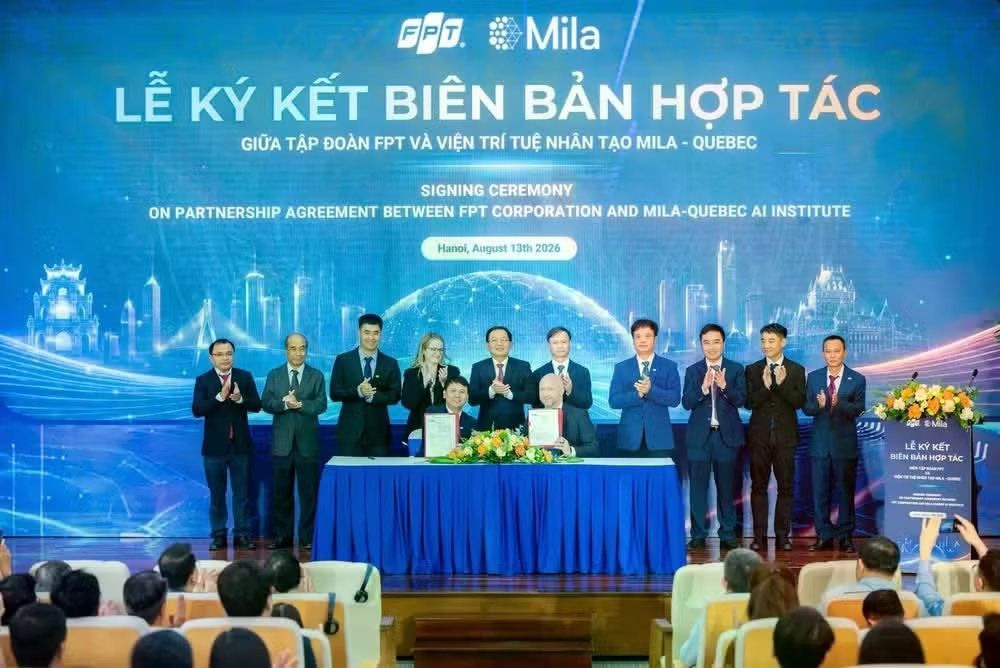
In 2020, FPT became Mila's first strategic partner in Southeast Asia. After six years, cooperation between the two sides has developed a chain of activities ranging from training young researchers and conducting joint research to developing intellectual property.
According to figures released by FPT in August 2026, the two sides had produced 162 scientific papers, including 126 published in leading conferences and journals worldwide; trained 80 young researchers; and had five patents accepted. The new agreement continues to expand cooperation in AI research, high-quality human resource development, and knowledge transfer.
The notable point lies in what is created after the cooperation. Rather than simply gaining access to existing technology for application, the business gains teams capable of conducting research, participating in the international scientific community, and creating intellectual property. This is a necessary shift if Vietnamese businesses want to move from using technology to participating in the process of creating technology.
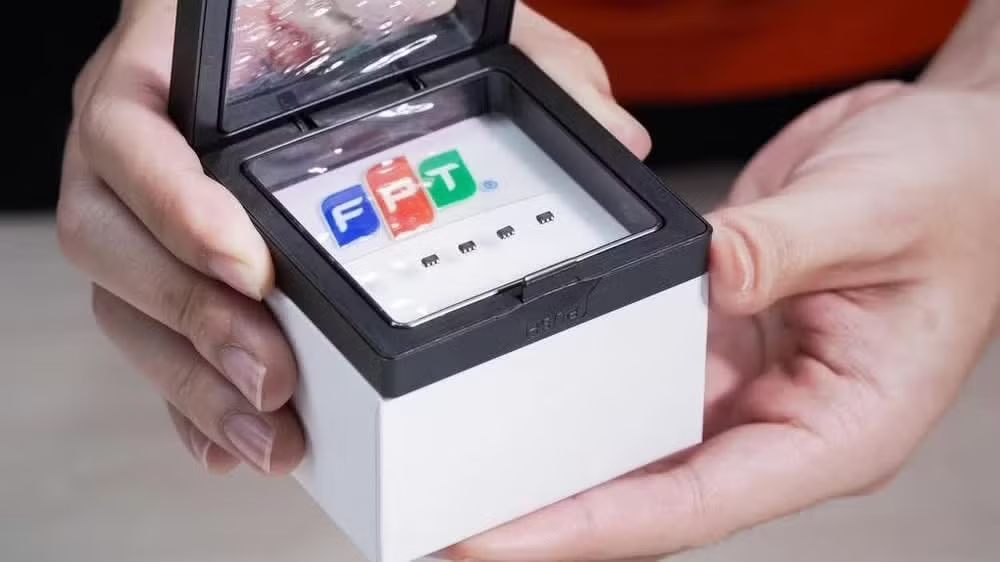
In semiconductors, the path is different. FPT focuses on developing power chip lines such as PMIC, LDO, BUCK, LED Driver, and Power MOSFET. These are groups of chips and semiconductor components that perform power management, conversion, and regulation functions, helping electronic devices operate stably.
At the end of 2025, the business delivered its first batch of commercial power chips to a Japanese electronics company through Restar, bringing FPT-designed chips into a market with high quality and reliability requirements. In early 2026, FPT continued to establish an Advanced Semiconductor Chip Testing and Packaging Factory.
Therefore, businesses do not necessarily have to develop the entire technology chain from scratch. International cooperation can help shorten the time needed to accumulate experience and gain access to technology and markets, while domestic resources can be focused on areas that businesses seek to develop over the long term, such as design, R&D, testing, packaging, and product development.
Opening the way for new research directions
Not all results of international cooperation can be seen immediately in a finished product. For new technologies, the initial value sometimes lies in opening a research direction, establishing a laboratory, building a technical team, or creating a capability that Viet Nam did not previously have.
In August 2026, FPT partnered with NARMA, a Korean technology company spun off from the Korea Aerospace Research Institute, to research, develop, and commercialise a new generation of UAVs.
The two sides divide responsibilities according to their respective strengths: NARMA has expertise in eVTOL hardware, while FPT focuses on AI, autonomous flight software, and obstacle detection and avoidance technology. FPT plans to integrate AI into the AF100 platform and develop a “mission computer” to serve as the device's processing brain.
At the same time, FPT is mobilising resources in other strategic technology areas. The group has established a specialised unit for railway technology, researching digital technology, data, and AI for railway and metro operations, while also investing in cybersecurity and Quantum AI & Cybersecurity to research new security challenges amid the development of AI and quantum technology.
In its cooperation with France, FPT has also proposed increasing undergraduate and postgraduate training programmes, exchanges of experts, engineers, and scientists; expanding cooperation between businesses and universities and research organisations; and promoting technology transfer in transport and railway engineering.
In other technology fields, several new cooperation initiatives established during Party General Secretary and State President To Lam's working trip to Russia and France also show a trend towards turning international cooperation into concrete capabilities in Viet Nam.
The agreement between Petrovietnam and a Rosatom partner on developing an additive manufacturing technology centre in Viet Nam is another example. The centre is expected to be equipped with metal 3D printers, as well as heat-treatment, mechanical processing, and laboratory analysis equipment, aiming not only to conduct research but also to address specific challenges in the oil and gas-energy sector, from manufacturing complex components to equipment restoration and repair.
Thus, the technology brought to Viet Nam will go beyond the acquisition of equipment and be placed in an environment where it can continue to be researched, tested, and applied in production.
In France, another direction has emerged from cooperation between the University of Science and Technology of Ha Noi and the Viet Nam Academy of Science and Technology with the French Alternative Energies and Atomic Energy Commission (CEA). The cooperation agreements focus on training, research, and technology transfer in areas such as nuclear energy, new energy, hydrogen, semiconductors, and materials.
These are fields that require a long-term process of accumulating research capacity and human resources, showing that international cooperation is not only aimed at bringing technology in for application but also at opening further space for Viet Nam to participate in new research directions.
Mastering technology is a lengthy process of accumulation, in which international cooperation can shorten research and development timelines and reduce challenges, however, the capabilities retained domestically depend on how deeply Vietnamese teams are involved in research, design, integration, and product development.
Therefore, the measure of international technology cooperation lies not only in the number of partners or memoranda of understanding. More importantly, after each cooperation cycle, the key question is which teams Vietnamese businesses will retain, what additional research capabilities they will develop, what intellectual property they will own, and what products they create that can continue to be developed using their own capabilities.
This is also how international cooperation can go beyond technology acquisition: from connecting with external resources to building people, R&D capabilities, products, and new positions for Vietnamese businesses in global technology value chains.