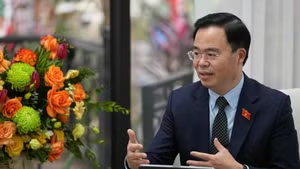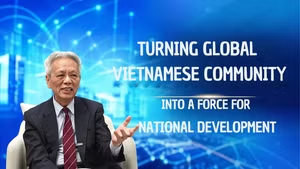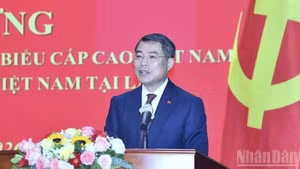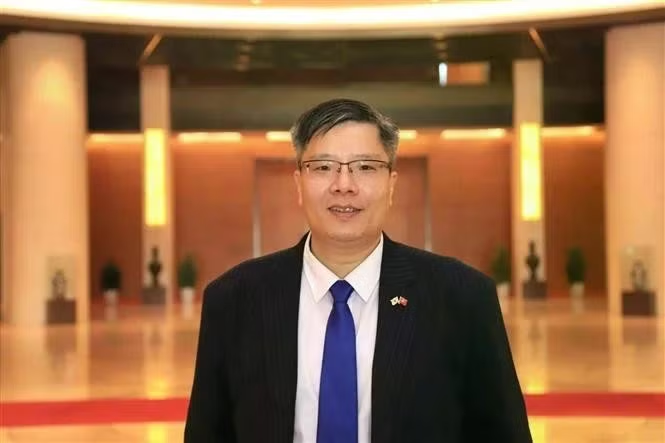
In an interview with the Viet Nam News Agency, Linh said that the Party and State have consistently regarded overseas Vietnamese (OV) as an inseparable part of the nation and a vital development resource, as reflected in major policies such as Resolution No. 36-NQ/TW, Directive No. 45-CT/TW, and Conclusion No. 12-KL/TW.
Over the past four decades of Doi moi (renewal), overseas Vietnamese have become a strategic resource, contributing to national development across multiple fields. Economically, remittances have remained high and stable, supporting livelihoods and macroeconomic stability, he said.
Many OV entrepreneurs have bridged international corporations with Viet Nam, bringing investment into manufacturing, technology, logistics, e-commerce, tourism, and high-quality services, thereby enhancing competitiveness and economic restructuring, he said.
Vietnamese intellectuals and experts abroad have also made practical contributions to science and technology, innovation, and education, through research cooperation, technology transfer, start-up support, and policy advice, while helping link Viet Nam with global knowledge networks.
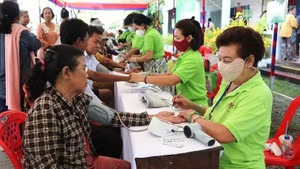
In addition, overseas Vietnamese play an important role in people-to-people diplomacy and promoting Viet Nam’s image as a dynamic, friendly, and responsible country. Their humanitarian, charitable, and social welfare activities further strengthen national unity and reflect their deep bonds with the homeland. These contributions confirm that overseas Vietnamese are not only an inseparable part of the nation but also an important resource for Viet Nam’s development in the new stage, Dr Linh stressed.
As the knowledge-based economy and the Fourth Industrial Revolution are reshaping the global development order, the intellectual resources and international networks of the overseas Vietnamese community have become more strategically valuable than ever.
With more than 6 million overseas Vietnamese, including hundreds of thousands of experts working in key fields such as AI, biotechnology, health care, finance, clean energy, and logistics, Viet Nam possesses a valuable pool of global talent. Beyond expertise, overseas Vietnamese bring international experience, global mindsets, and strong links with technology centres, research institutes, and multinational corporations worldwide. They also help connect Viet Nam with global markets, supply chains, and investment flows, enhancing national competitiveness and integration into global value chains, while contributing to the country’s soft power and international credibility, he added.
Looking ahead, Dr Linh expressed his hope that the 14th National Party Congress will introduce breakthrough policies to facilitate OV contributions in economy, science and technology, education, and culture.
He stressed that overseas Vietnamese should be positioned not as a supplementary resource but as strategic partners in all national development policies.
Overseas Vietnamese should be regarded as one of the country’s strategic resources on par with natural resources, labour, and capital, especially in terms of “brain capital, connectivity capital, and social capital,” he said, adding they should be viewed as partners in knowledge, investment, and people-to-people diplomacy, with clearly defined roles based on their capabilities to maximise effectiveness.
Positioning overseas Vietnamese as strategic partners and bridges of knowledge, capital, and markets will enable Viet Nam to mobilise intellectual power more effectively and accelerate development in the digital and knowledge era, he concluded.