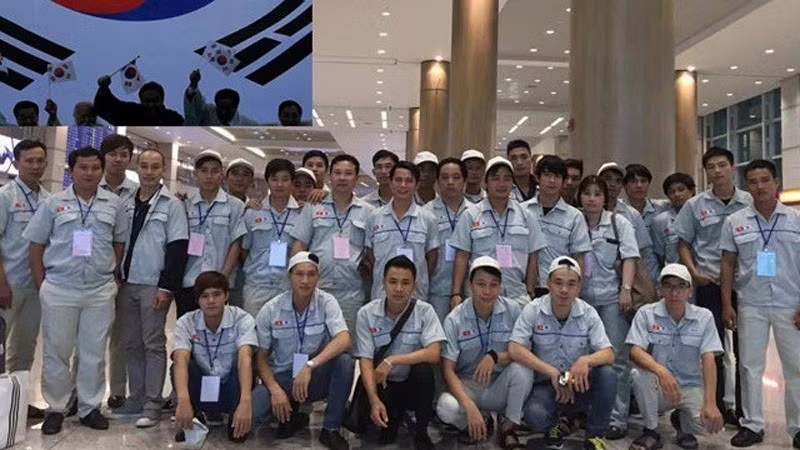
Subproject 2, “Supporting workers to take up contracted employment overseas”, under the 2021–2025 National Target Programme on Sustainable Poverty Reduction, which is being implemented in poor districts (according to former administrative divisions), is approaching its final stage.
The initial objective of this subproject was to strengthen the overseas employment of workers living in poor districts, extremely disadvantaged communes in coastal, riverside, and island areas (according to former administrative divisions); to support training activities to improve foreign-language skills and vocational skills for workers before taking up overseas employment under contract; and to contribute to job creation, income enhancement, and sustainable poverty reduction, especially for workers from poor households, near-poor households, newly escaped-poor households, and workers in poor districts and extremely disadvantaged communes in coastal, riverside, and island areas.
According to Dang Duc Thuan, Deputy Director of the Department of Overseas Labour Management (Ministry of Home Affairs), after nearly four years of implementation, supporting contracted overseas employment for workers in poor districts (according to former administrative divisions) under the 2021–2025 National Target Programme on Sustainable Poverty Reduction has fulfilled the core tasks of Subproject 2, supporting nearly 4,400 workers nationwide. Several localities have emerged as strong performers in implementing this programme, such as Nghe An, Ha Tinh, Quang Binh, and Lao Cai.
The inclusion of Subproject 2 as part of the National Target Programme on Sustainable Poverty Reduction for 2021–2025 provided a clear legal and institutional foundation for implementation.
For many consecutive years, Nghe An has been the leading province nationwide in the number of workers going abroad for employment. In 2024 alone, the province sent more than 20,000 workers abroad, reaching over 124% of its target. Importantly, in these localities, labour export is clearly identified as a key pathway to poverty reduction. In practice, many families once classified as poor have, after only a few years of having a relative take up overseas employment under contract, gained sufficient economic capacity to escape poverty, build better homes, and improve their living standards.
Quang Binh (former administrative unit) is another locality that demonstrates the clear effectiveness of sending workers abroad and reducing poverty. People in the area genuinely view overseas employment as an opportunity to eliminate hunger, reduce poverty, and improve their livelihoods. The average monthly income of workers ranges from 20–40 million VND — a highly meaningful figure that helps families in disadvantaged areas break through economic hardship.
In the northern region, not only coastal provinces but also several mountainous provinces, where many poor districts existed under former administrative divisions, have emerged as success stories. In Lao Cai, reports show that sending workers abroad has created dual benefits that advance development goals. This indicates that the province has effectively leveraged the policy to both resolve employment needs and contribute to socio-economic development and poverty reduction.
According to the Department of Home Affairs of Thanh Hoa Province, the province has sent more than 60,000 workers abroad in the 2021–2025 period (an average of around 12,000 annually), surpassing 114.3% of the target. Workers from Thanh Hoa account for about one-tenth of the total number of Vietnamese workers going abroad each year. The province consistently ranks among the top nationwide in sending workers abroad. Each year, workers from Thanh Hoa remit an estimated 345 million USD (equivalent to 8,250 billion VND), enabling households with relatives working overseas to escape poverty and move towards prosperity.
Thus, the key highlight of Subproject 2 under the 2021–2025 National Target Programme on Sustainable Poverty Reduction is that localities have successfully linked overseas employment with the goals of poverty reduction and new-style rural development, where remittances have become a major driver reshaping local socio-economic landscapes.
According to Dang Duc Thuan, during the implementation of Subproject 2 and efforts to support contracted overseas employment, the greatest advantage has been the attention of the Party, the National Assembly, the Government, and the engagement of the entire political system. As part of the 2021–2025 National Target Programme on Sustainable Poverty Reduction, Subproject 2 has created a clear legal and administrative framework for implementation. In addition, there has been strong public participation and support. Management agencies have actively applied new technologies, providing direct, transparent, and free information channels, thereby helping workers, especially those in remote areas, to access full information before joining the programme.
Localities have successfully linked overseas employment with the goals of poverty reduction and new-style rural development, where remittances have become a main driver reshaping local socio-economic landscapes.
However, in practice, the implementation of Subproject 2 has faced several challenges. For example, delayed issuance of guiding documents has caused difficulties and confusion at the local level. The capacity and qualifications of some implementing staff remain limited, especially at the grassroots level (commune and village). Administrative restructuring at the provincial and communal levels, including organisational changes and personnel shifts, has also disrupted programme progress. In addition, a portion of the population still holds a mindset of reliance on and passive expectation of state support.
From these realities, the Department of Overseas Labour Management has outlined several solutions and proposals for the next phase:
First, continue reviewing and completing the system of legal documents to ensure consistency and ease of implementation.
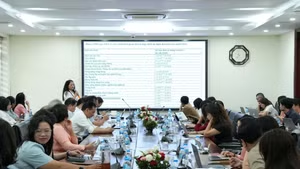
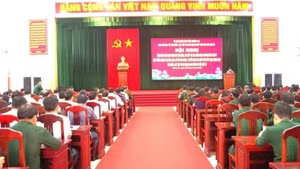
Next, strengthen capacity-building for staff at all levels, especially at the grassroots level. This is also the aim of training conferences conducted by the Department of Overseas Labour Management to meet local practical needs.
Additionally, promote decentralisation and empower local authorities, especially at the grassroots level, while upholding the principle that the central level designs while the local levels decide and implement, with active participation from the people.
At the same time, integrate the three national target programmes into a single national target programme for the 2026–2035 period to optimise resources and avoid overlap or fragmentation.
Furthermore, enhance the application of information technology and digital transformation (such as the DOLAB–JICA overseas employment application) to manage, monitor, and ensure transparency of information.