Continuing to lead the country in attracting FDI
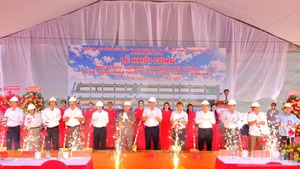
According to the Ho Chi Minh City Department of Finance, in 2025 the total value of registered FDI capital in the city, including newly licensed projects, capital increases, capital contributions, share purchases, and capital acquisitions, was estimated at nearly 8.37 billion USD, up 24.2% compared with the same period in 2024. Ho Chi Minh City continues to maintain its position as the country’s leading locality in attracting FDI, with total valid foreign investment capital reaching 141.9 billion USD, corresponding to 20,310 active projects.
In 2025, investors from 89 countries and territories invested in Ho Chi Minh City. Among them, Singapore remained the largest investor with 2.1 billion USD, accounting for 25% of total registered capital. The Republic of Korea ranked second with 635.2 million USD (8%), followed by Hong Kong (China) in third place with 482.2 million USD (6%). Other investors came from China, Japan, the British Virgin Islands, Thailand, the US, Taiwan (China), among others.
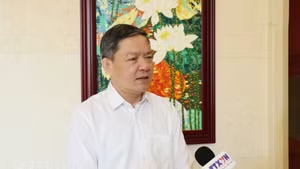
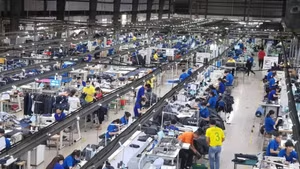
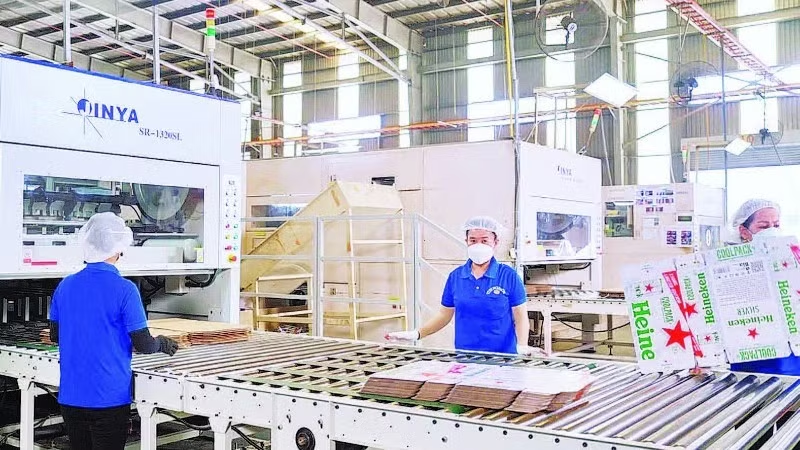
Analysing the strong FDI attraction of Ho Chi Minh City, Truong Van Phong, Deputy Head of the Management Board of Ho Chi Minh City Export Processing Zones Authority (HEPZA), said that after the merger, Ho Chi Minh City has become a “mega city” playing a role in connecting the southern key economic region. On that basis, the city is shaping three main development poles: Ho Chi Minh City as the economic centre; Dong Nai–Binh Duong as the industrial satellite area; and Ba Ria–Vung Tau as the seaport and supporting industry hub. With the advantage of this network, in 2025 Ho Chi Minh City achieved fairly good investment inflows. In the industrial park sector alone, from the beginning of 2025 to date, the city has attracted occupancy of around 5.3 million square metres of industrial land. Currently, industrial parks in the city have an occupancy rate of about 75%, which is assessed as a very positive result.
According to HEPZA Deputy Head Truong Van Phong, the city is currently reviewing its planning with the aim of ensuring appropriate land funds for the coming period. Overall, Ho Chi Minh City is expected to have around 150 industrial parks with a total area of about 50,000 ha. In the 2026–2030 period alone, the city will develop an additional land fund of around 16,000 ha to be ready to attract new investors.
Improving policies, ready to welcome a new investment wave
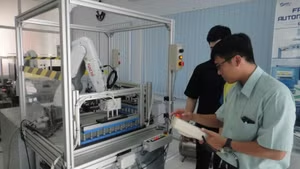
According to representatives of the Ho Chi Minh City Department of Finance, in order to move towards higher added value, the city is orienting selective investment attraction, focusing on high-tech and innovation-driven sectors. At the same time, the city will upgrade and renew investment–trade–tourism promotion programmes, especially those linked with economic diplomacy, in a focused and targeted manner, while effectively mobilising private capital as well as FDI.
To remove difficulties for investors, Ho Chi Minh City is accelerating the improvement of planning, infrastructure development, and reform of mechanisms and policies to attract FDI in line with international competitiveness, linking incentives with project effectiveness. The city continues to cut administrative procedures, improve the Provincial Competitiveness Index (PCI), the Provincial Governance and Public Administration Performance Index (PAPI), and the Public Administration Reform Index (PAR) scores, strengthen digitalisation, apply post-inspection models, and effectively implement the one-stop-shop and interlinked one-stop-shop mechanisms.
Phong added that to date, most procedures have been integrated under the “one-stop-shop” mechanism, minimising the need for businesses to deal with multiple agencies. The city is completing the process of fully digitalising dossiers, enabling enterprises to process documents remotely without having to visit authorities in person. More importantly, procedures will be made more transparent, helping to save time, reduce unofficial costs, and create a transparent environment for businesses. According to HEPZA leaders, with advantages in infrastructure, land potential, and increasingly effective coordination among departments, sectors, and local authorities, Ho Chi Minh City expects to continue affirming its position as a strategic investment destination of the southern key economic region.
Nguyen Ky Phung, Head of the Sai Gon Hi-Tech Park Management Board (SHTP), affirmed: “The Ho Chi Minh City Hi-Tech Park Management Board is committed to continuing to improve the investment environment, support policies, promote innovation and digital transformation, and accompany enterprises towards the goal of sustainable and effective development.”