Of the total, agricultural products accounted for around 3.6 billion USD, soaring 41.8%; livestock products reached 47.5 million USD, up 20.2%; seafood earned 940 million USD, a rise of 21.5%; while forestry products brought in 1.72 billion USD, up 13%.
Asia remained the largest export market, absorbing 45.3% of Viet Nam’s agro-forestry-fishery exports. It was followed by the Americas with 22.7% and Europe with 13.4%. Africa and Oceania accounted for more modest shares of 2.6% and 1.4%, respectively.
Compared with the same period last year, export value to Asia in January rose by 41.1%, to the Americas by 22.4%, to Europe by 11.2%, to Africa by 21.6%, and to Oceania by 32.3%.
China, the US and Japan were Viet Nam’s three largest export markets, with respective market shares of 22.6%, 20.4% and 7%. Exports to China surged 66.1% year-on-year, while shipments to the US and Japan increased by 21.6% and 19.6%, respectively.
Key agricultural exports recorded strong growth in January, including coffee, rubber, tea, rice, fruits and vegetables, cashew nuts and pepper, with increases in both volume and value.
Coffee and rubber continued to play a leading role. Coffee exports reached an estimated 180,000 tonnes worth 981 million USD, while rubber shipments totalled about 220,000 tonnes valued at 416 million USD, both posting sharp year-on-year increases. Average export prices remained stable, with major markets in Europe and Asia.
Tea and rice also saw solid growth. Tea exports stood at around 14,000 tonnes worth 23 million USD, while rice exports reached about 600,000 tonnes valued at 370 million USD. Although average tea prices edged down slightly, higher volumes helped lift export value. Meanwhile, rice export prices rose about 4% to an average of 616.6 USD per tonne.
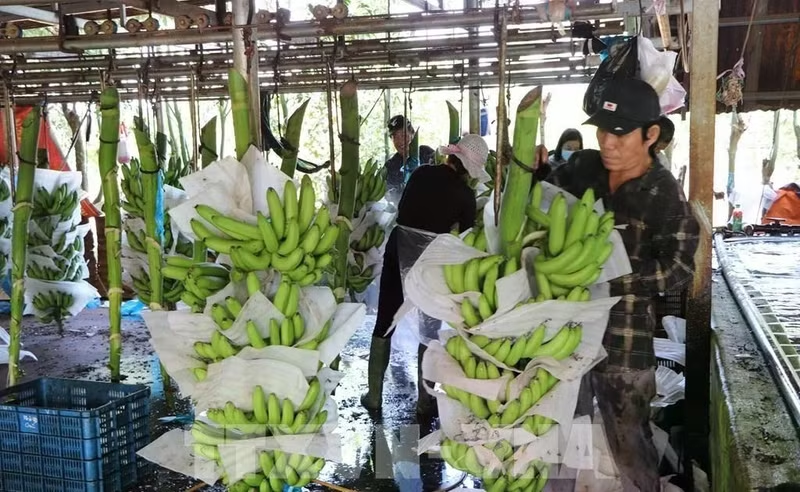
Fruits and vegetables remained a standout performer, with export turnover in January estimated at around 750 million USD, doubling year-on-year. China continued to be the largest market, alongside strong growth in the US.
Cashew nuts and pepper maintained robust momentum. Cashew exports reached roughly 65,000 tonnes worth 434 million USD, while pepper exports totalled about 20,000 tonnes valued at 133 million USD, both up more than 50% year-on-year despite a slight decline in average export prices.
The ministry noted that market development and promotion of agricultural consumption remain a core solution for the sector. Relevant agencies will continue to closely link production with market demand, step up trade promotion and product branding, and support businesses and cooperatives in expanding both domestic and international markets.
At the same time, the sector will continue agricultural restructuring towards higher value addition and sustainable development, with a focus on food safety and traceability. This restructuring will be carried out across crop production, livestock, fisheries and forestry, as well as throughout the entire value chain from production and processing to distribution, in order to adapt flexibly to the requirements of different export markets.