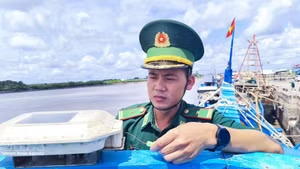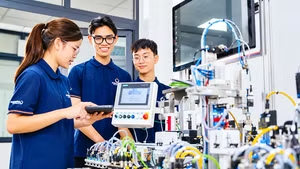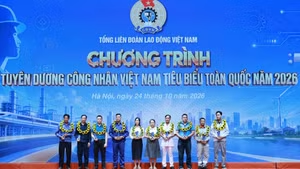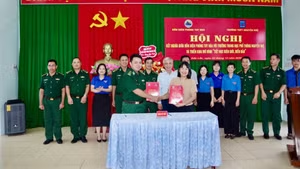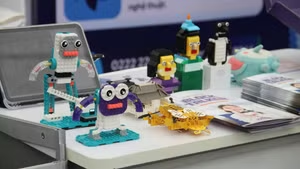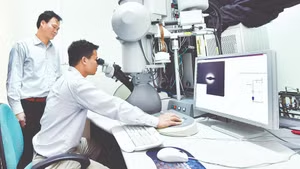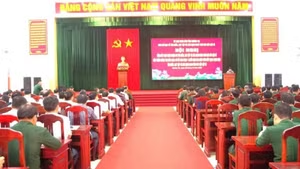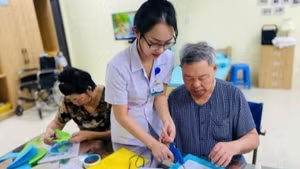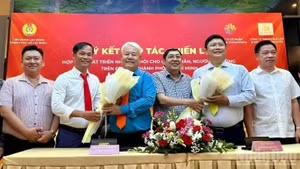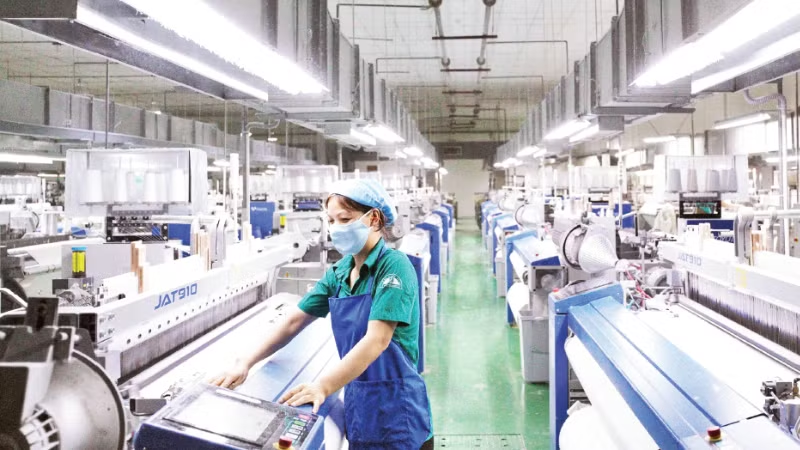
The movement, initiated by the Military Trade Union, has been met with enthusiastic participation from agencies, units and enterprises throughout the armed forces. From training, combat readiness, scientific research, production and technical support to culture, education and healthcare, countless valuable initiatives and research projects have emerged.
Between 2023 and 2025 alone, the armed forces recorded nearly 20,800 initiatives and technical improvements applied in practice, saving almost 1 trillion VND for the national defence budget.
Fuel for creativity
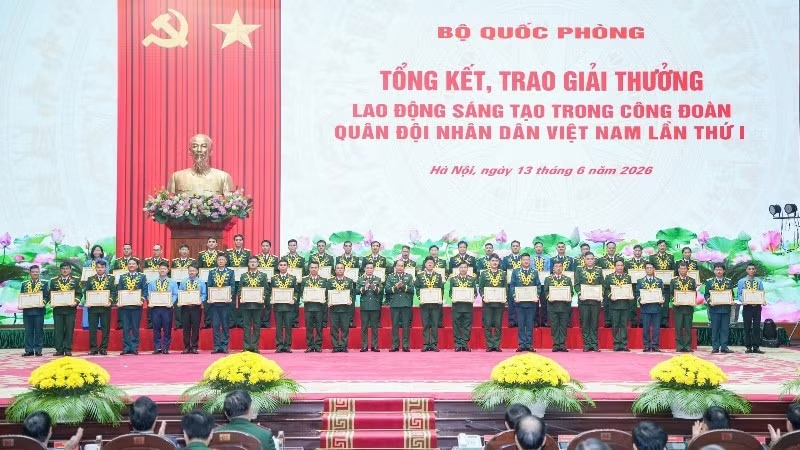
A landmark in the movement’s development was the launch of the first Creative Labour Award within the Military Trade Union, which became a genuine forum for intellect, aspiration and dedication among officers, union members and workers across the armed forces.
Colonel Nguyen Van De, Standing Vice‑Chairman of the Award Council, explained that in production and technical‑support work, front‑line workers are closest to the realities of the tasks. Improvements to production lines, process optimisation or initiatives that enhance the efficiency of operating technical equipment often arise directly from daily work.
Yet, in the past, many innovations remained localised, lacking systematic mechanisms for evaluation, recognition and wider dissemination. The Creative Labour Award has provided fresh impetus to the emulation movement across the armed forces.
The Award attracted 208 entries, including 56 research projects and 152 initiatives from 775 participants representing 11 of the 39 units. Entries spanned ten key fields, including information technology; chemistry and environment; education and military training; weapons and ammunition; electronics, telecommunications and automation; mechanics, propulsion and military engineering; logistics; and military medicine and pharmacy.
Many of these initiatives delivered tangible benefits for defence, security and socio‑economic development, showcasing the research capacity, technological mastery and innovative spirit of the armed forces’ workforce.
Many of these initiatives delivered tangible benefits for defence, security and socio‑economic development, showcasing the research capacity, technological mastery and innovative spirit of the armed forces’ workforce.
Notable contributions came from the General Department of Defence Industry, the Air Defence‑Air Force, the General Department of Logistics and Engineering, Corps 20 and Military Region 4.
One standout winner was the Rehabilitation Department of Military Hospital 354, under the General Department of Logistics and Engineering.
Each day the department treats large numbers of patients with electro‑acupuncture. Dr An Thi Ngoc Cham identified a persistent problem: the electric leads of the machines often tangled into a “web”, creating not only an untidy appearance but also medical and safety risks.
Cham devised a solution by applying physical principles to medical practice, designing a product using 3D printing with durable ABS plastic suitable for healthcare environments. The effectiveness was immediate. Each session saved more than three minutes of manual operation, equating to nearly 10 hours of labour saved daily across approximately 150 sessions. This reduced technicians’ workload and freed them to provide better patient care and pursue professional research.
Crucially, the cost of each device set is modest while the benefits are long‑lasting. According to Dr Cham, the greatest value lies in creating a safer, more professional and patient‑friendly treatment environment.
Winning the Creative Labour Award was not only recognition of a specific product but also a spark that fuelled creativity among all staff at Military Hospital 354.
Digital transformation in action
Another striking example of innovation within the armed forces is the project to apply electronic documents in container handling at Tan Cang‑Cat Lai Port, developed by Lieutenant Colonel Luong Duc Gia of Corps 20 and his colleagues.
Previously, manual container handling involved numerous steps, leading to long vehicle waiting times, risks of lost documents, difficulties in storage and retrieval, high printing costs, environmental waste and congestion.
In 2024 the team introduced the initiative “Application of electronic delivery documents at the port”, digitising the entire handling process on an electronic platform with centralised storage in a digital database. After three months of testing, the system was rolled out comprehensively at Tan Cang‑Cat Lai, rapidly delivering significant economic and social benefits.
By 2025 the system had successfully processed more than four million electronic delivery documents; throughput via the port gate reached 364,000 tonnes — the highest level to date; thousands of hours of vehicle waiting were eliminated; operational efficiency increased; and over 1.5 billion VND per year was saved in printing costs.
Lieutenant Colonel Luong Duc Gia remarked: “We believe that even the most modern machines and equipment are merely foundational tools; improvement initiatives are the lever that optimises performance and delivers breakthrough value to the unit. Our award‑winning initiative is just one of dozens of innovations applied each year across Tan Cang Sai Gon Corporation.”
The contributions of officers, soldiers and workers across the armed forces are forging new strength, making a worthy contribution to building a revolutionary, regular, elite and modern People’s Army, firmly advancing into the country’s new era of development.
Colonel Nguyen Van De added that in the coming period, the Military Trade Union will continue to drive the creative emulation movement, enhance the application and mastery of science and technology, actively pursue digital transformation in units and enterprises, and expand activities to apply and transfer technology to union members and workers.
Efforts will also focus on training, building creative models, and developing clubs of scientists and technicians to help members quickly access new technologies, accelerating their integration into unit and enterprise operations.
The contributions of officers, soldiers and workers across the armed forces are forging new strength, making a worthy contribution to building a revolutionary, regular, elite and modern People’s Army, firmly advancing into the country’s new era of development.