Q: How do you assess the significance of this ASEAN-Russia Summit in the current global context?
A: The world is witnessing major changes in the global economy and politics, along with growing instability in many regions. In that context, the ASEAN-Russia Summit carries special significance.
The event shows that even in a divided world, countries can still seek consensus, build trust and promote cooperation on the basis of respect for each other’s interests. This is an important message not only for Russia and ASEAN, but also for the international community.
In my view, the summit will contribute to consolidating the foundation for peace, stability and sustainable development, while demonstrating a model of cooperation based on dialogue.
Q: What concrete outcomes does Russia expect from this summit?
A: First of all, Russia expects political outcomes. It hopes the summit will continue to affirm its friendly and trusted relations with Southeast Asian countries, as well as the closeness of views on many important international issues.
At the same time, an important task now is to translate the sound foundation of political trust into concrete results in economic cooperation. This remains an area with great room for development.
A number of promising cooperation projects between Russia and ASEAN countries have emerged, such as railway cooperation with Indonesia, a nuclear power project with Viet Nam, and energy cooperation programmes with several other countries in the region. These projects show that the cooperation potential between the two sides is gradually being realised.
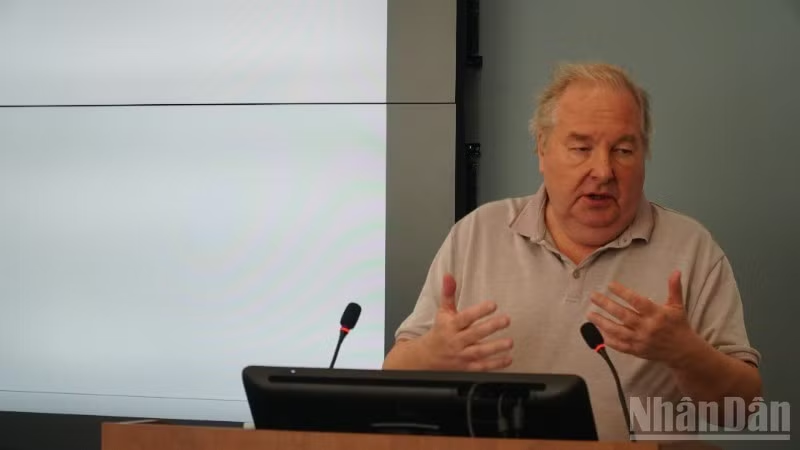
Q: What position does ASEAN hold in Russia’s pivot-to-the-East strategy?
A: ASEAN is one of Russia’s most important partners in Asia. When talking about Russia’s pivot to the East, many people often think only of China. In fact, however, Southeast Asia and India are also important pillars of this policy.
Russia highly values ASEAN’s role in the Asia-Pacific regional architecture and considers ASEAN a partner capable of making positive contributions to building a stable, balanced and rules-based regional order.
Q: In your opinion, what are the obstacles to the development of ASEAN-Russia relations?
A: In my view, the biggest obstacle at present is not geographical distance or logistics, as many people may think. The greatest difficulty lies in secondary sanctions and risks related to international payments. This has made many businesses cautious when implementing cooperation projects with Russia.
Therefore, expanding payments in local currencies, building independent financial mechanisms and strengthening connectivity between the business communities of the two sides will be important tasks in the coming period.
If these issues are resolved, trade and investment turnover between Russia and ASEAN countries can grow strongly.
Q: How do you assess Viet Nam’s position in Russia’s foreign policy in Southeast Asia?
A: Viet Nam has always held a special position in Russia’s foreign policy in Southeast Asia. In Russia, the public and scholars always remember the history of traditional friendship between the two countries, while highly appreciating the positive attitude and goodwill that Viet Nam has shown towards Russia over the past decades.
Viet Nam is not only one of Russia’s most important political and economic partners in Southeast Asia, but also plays an active role in promoting relations between Russia and the region.
It can be said that over the years, Viet Nam has been one of the countries helping Russia strengthen its presence and expand cooperation in the Asia-Pacific region.
Q: In your opinion, which areas have the potential to become new drivers of Russia-Viet Nam cooperation in the coming period?
A: First of all, energy, including oil and gas and nuclear power. These are areas where the two sides have extensive experience in cooperation and still hold great development potential.
In addition, there are high technology, electronics, industrial production, fisheries, tourism and logistics. Viet Nam is no longer merely a traditional manufacturing economy, but is also strongly developing modern technology sectors. This opens up many new cooperation opportunities with Russia.
I believe that if financial and payment barriers are removed, economic cooperation between Russia and Viet Nam in particular, and between Russia and ASEAN in general, will enter a new stage of development, more commensurate with the potential and the sound political relations the parties have built over the years.
Reporter: Thank you very much.