Kashbraziev, a doctor of economics and professor at the Financial University under the Government of Russia, stressed that the Association of Southeast Asian Nations (ASEAN) possesses several important institutional characteristics, including a flexible model of regional integration that enables it to maintain balance in external relations while fostering cooperation with centres of power.
The expert noted that foreign direct investment (FDI) inflows into ASEAN rose 8% year-on-year to 226 billion USD in 2024 despite a global decline in FDI, underscoring the bloc’s position as one of the world’s most attractive investment destinations.
Against the backdrop of Western sanctions imposed on Russia and its efforts to broaden its trade and investment, ASEAN’s institutional characteristics could create more opportunities for Moscow to access new markets and strengthen its economic relations beyond the Western sphere, he said.
Kashbraziev described the summit as one of the most anticipated events in ASEAN-Russia relations, saying that the selection of venue is also symbolic. Kazan has successfully hosted major international gatherings, including the 2024 BRICS Summit, and is widely regarded as a city of intercultural, interethnic, and interfaith dialogue, he elaborated.
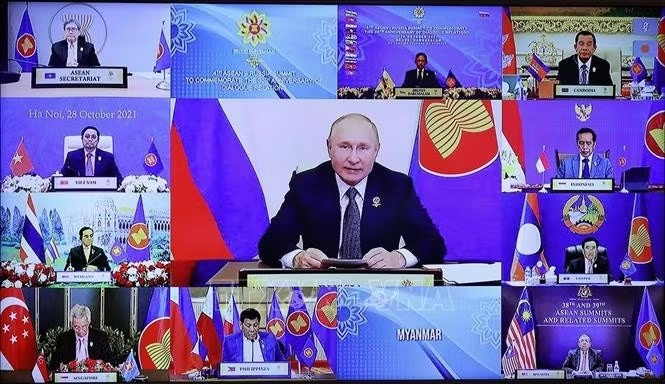
According to the expert, previous ASEAN-Russia summits have delivered tangible outcomes. Following the 2018 summit, the two sides elevated their ties to a Strategic Partnership, while the 2021 summit adopted the Comprehensive Plan of Action for the implementation of the ASEAN-Russia Strategic Partnership for 2021-2025.
Trade between Russia and ASEAN reached 18.1 billion USD in 2024, up 13.2% from the previous year, while Russia’s investment in ASEAN countries increased by 20.8%. In this context, the expert said new agreements are expected to be signed at the summit this year in the areas of trade, investment, energy, transport and logistics connectivity, digital economy, scientific and technological cooperation, tourism, and payment and settlement infrastructure. Agreements will also include a broader use of national currencies and more sustainable financial channels between Russia and ASEAN member states.
Russian Deputy Minister of Foreign Affairs Andrey Rudenko has also expressed expectations that the summit could adopt a declaration reaffirming the legal foundations of the ASEAN-Russia partnership, and joint statements on promising areas of practical cooperation currently under discussion.
According to Rudenko, the agenda will focus on global and regional security, sustainable development, and joint responses to contemporary challenges. After 35 years of dialogue, the summit could mark a shift toward a more action-oriented phase of cooperation, with concrete agreements in trade, investment, science and technology, culture, and humanitarian exchanges expected to play a central role.