Cash “hotspots” gradually cool down
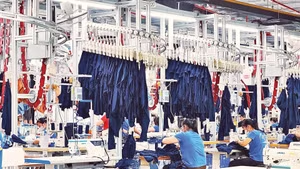
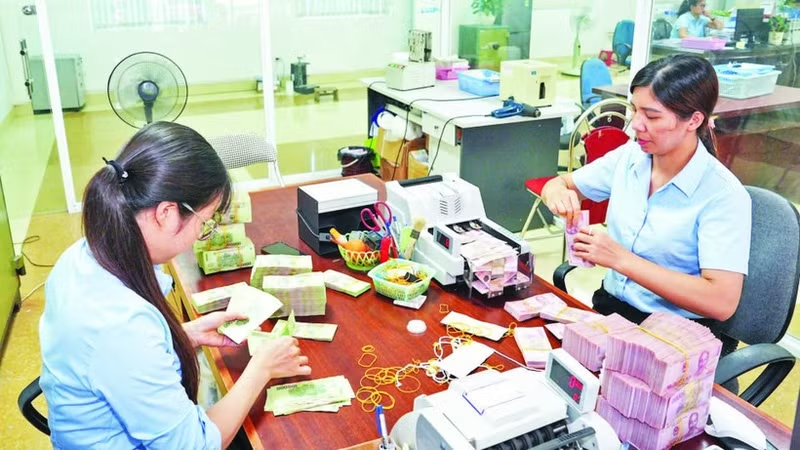
For many years, the Lunar New Year has been regarded as the peak season for cash usage. At times, withdrawal demand has surged to between five and 10 times the normal level, forcing the banking system to mobilise substantial resources for cash transportation, ATM replenishment and vault security, particularly in industrial zones and areas with large concentrations of workers. In many industrial parks in Bac Ninh, Ho Chi Minh City or Dong Nai, the days leading up to Tet once saw long queues of workers lining up from early morning at ATMs to withdraw money to take home.
Nguyen Van Hung, a worker at an electronics company in Yen Phong Industrial Park (Bac Ninh), said that in some years he had to wait more than an hour to withdraw cash due to overloaded ATMs. “Tet means having cash to give to parents, to give lucky money to children, so even if you know withdrawing earlier helps avoid crowds, waiting is still unavoidable,” Hung shared. This year, however, that picture is changing markedly as workers like Hung gradually alter their habits. “Salaries and bonuses are now paid into accounts, and transferring money to relatives is very convenient. I only withdraw enough cash for the first few days of Tet,” he added.
These small changes in user behaviour, when multiplied on a large scale, have helped ease year-end cash pressure. According to statistics from the National Payment Corporation of Viet Nam (NAPAS), ATM cash withdrawal transactions fell by more than half during the 2020–2025 period. While withdrawals declined only slightly by 7–8% in 2020–2021, the reduction reached nearly 30% in 2024–2025. In contrast, cashless payments continued to grow strongly, with more than 40 million transactions processed through the NAPAS system each day, valued at over 200 trillion VND, equivalent to nearly 9 billion USD.
According to NAPAS, during the 2020-2025 period, ATM cash withdrawal transactions decreased by more than half. While the decline in 2020–2021 was modest at 7–8%, it reached nearly 30% by 2024–2025.
Notably, during Tet, the volume of digital payment transactions increases by only around 30–40% compared to normal days — far lower than the multiple-fold surge in cash withdrawal demand in the past. “This shows that digital payments have become part of everyday life, no longer a seasonal peak like cash transactions. From people queuing at ATMs during Tet to now simply scanning QR codes at traditional markets, small shops and even in remote areas, cashless payments have truly taken root. This is the foundation that allows the banking sector to confidently ensure safe and smooth payments, contributing to a full and joyful Tet for the public,” said NAPAS Deputy General Director Nguyen Hoang Long.
Nevertheless, despite the rapid growth of digital payments, cash — especially small denominations and new banknotes — continues to play a certain role in Tet cultural practices. Customs such as giving lucky money, visiting temples and pagodas, and making offerings increase demand for small-denomination notes. As a result, the informal money-changing market becomes lively every Tet season. Many websites and Facebook or Zalo accounts publicly post price lists with high fees ranging from 10 to 20%, depending on denomination. Tran Thi Ha, an office worker in Hoan Kiem Ward (Ha Noi), said she planned to exchange around 5 million VND in small notes this year for lucky money and temple visits. Searching on social media, the exchange fees shocked her. “Notes of 1,000, 2,000 or 5,000 VND are charged fees of up to 15–20%. Exchanging just a few million can cost hundreds of thousands in fees,” she said.
Although aware of the high costs, the Tet mindset of having new money still causes many people to hesitate. Not a few, due to year-end busyness and lack of time to visit banks, choose home-delivered exchange services. In return, they face risks: transferring money but not receiving it, receiving old or damaged notes, or even being blocked immediately after the transaction. Such risks often become apparent only when it is too late. Under Decree No. 88/2019/ND-CP, illegal money-changing for profit can result in fines ranging from 20 million to 40 million VND. In addition to legal risks, online money exchange carries a high risk of fraud. Providing personal information to unknown parties also exposes users to the risk of data theft.
Despite the rapid growth of digital payments, cash — especially small denominations and new banknotes — continues to play a certain role in Tet cultural practices. Customs such as giving lucky money, visiting temples and pagodas, and making offerings increase demand for small-denomination notes.
Digital technology reshapes Tet transactions
Giving lucky money at the start of the year is a beautiful custom, carrying more spiritual than material value. In the digital era, this tradition is taking on new forms: lucky money via banking apps, e-wallets, and bank transfers accompanied by personalised wishes. In recent years, opening a banking app on New Year’s Eve to give online lucky money has become familiar. Quoc Phuong, who has two children studying abroad, shared that for many years his children have been unable to return home for the Lunar New Year. “At the exact moment of New Year’s Eve, I send digital lucky money with wishes to my children. It is still lucky money, but the whole family still feels the Tet atmosphere,” he said. For many young urban families, online lucky money also significantly reduces the pressure of preparing cash. Thanh Mai (Ngoc Ha Ward, Ha Noi) said she no longer rushed to exchange new notes this year. “I prepare a small amount of cash for grandparents, and for the rest I give lucky money through banking apps — fast and worry-free,” she shared.
The trend towards reduced cash usage extends beyond personal spending to spiritual spaces. At sites such as Phu Tay Ho (Ha Noi), QR codes placed at donation areas allow visitors to make offerings transparently and conveniently. According to Pham Van Toan, who has overseen donation boxes for many years, QR codes have significantly reduced the scattering of small notes across altars. This change not only eases cash supply pressure on the banking system but also enhances the solemnity of spiritual spaces.
In recent years, as the state management authority for monetary activities in Ha Noi, Nguyen Quoc Huy, Deputy Director of the State Bank of Viet Nam – Region 1, said the agency has implemented comprehensive measures to both meet peak Tet payment demand and strongly promote cashless payments while ensuring system safety and security. Cashless payment infrastructure continues to be expanded; by the end of 2025, the number of POS devices reached nearly 400,000, while ATM numbers declined, reflecting the growing popularity of digital payments. “During this Tet, we will continue to direct credit institutions to ensure a reasonable cash supply, while strengthening communication and coordination with departments, especially the Department of Culture, to encourage QR code use at religious and festival sites. This will gradually form a civilised habit of money use, safe and modern payments, contributing to the digital economy and digital society, and ensuring convenience for the public every Tet season,” Huy affirmed.