In 2025, Viet Nam upgraded relations with 16 countries and signed more than 300 cooperation agreements, with economic, trade, investment, science and technology cooperation, as well as new growth drivers placed at the centre—double the number recorded in 2024.
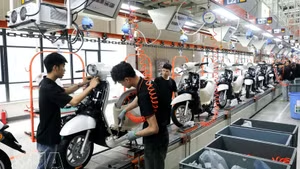
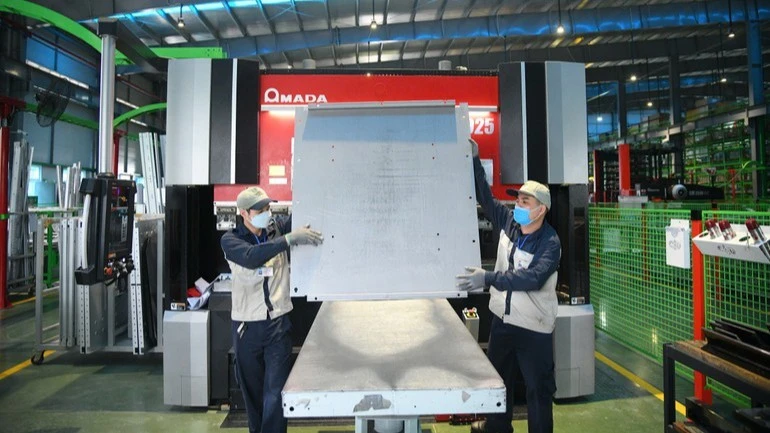
A key highlight was the proactive attraction of investment from leading global economic and technology conglomerates, with a focus on sectors such as processing and manufacturing, professional services, and science and technology, yielding significant achievements. In the first 11 months of 2025 alone, total foreign direct investment (FDI) into Viet Nam reached 33.69 billion USD, up 7.4% year-on-year. This included 3,695 newly licensed projects with registered capital of 15.96 billion USD, representing a 21.7% increase compared to the same period in 2024.
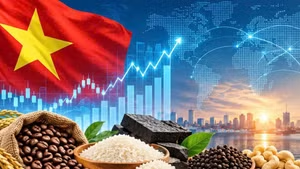
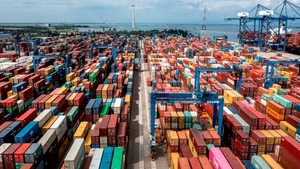
2025 marked the first time Viet Nam’s total import-export turnover surpassed the 900 billion USD threshold (exports reached 470.59 billion USD, up 15.9% compared to 2024, with a trade surplus of 21.2 billion USD). This milestone underscores a significant stage of economic development, as the country’s trade scale has expanded nearly ninefold in just 18 years since joining the WTO.
Notably, 2025 marked the first time Viet Nam’s total import-export turnover surpassed the 900 billion USD threshold (exports reached 470.59 billion USD, up 15.9% compared to 2024, with a trade surplus of 21.2 billion USD). This milestone underscores a significant stage of economic development, as the country’s trade scale has expanded nearly ninefold in just 18 years since joining the WTO.
These achievements not only expanded Viet Nam’s political and diplomatic space but also laid a stable foundation for long-term economic cooperation. They reflect the country’s consistent approach of prioritising the quality of partnerships, closely linking economic diplomacy with sustainable development goals, and focusing on partners that deliver high added value in capital, technology, and market access, rather than dispersing resources.
However, Viet Nam has yet to fully and effectively capitalise on the outcomes of upgrading and elevating relations with partners and countries to generate strong economic breakthroughs.
Although progress has been made in implementing international commitments and cooperation agreements, the pace remains slow. Many enterprises have not fully leveraged opportunities offered by new-generation free trade agreements (FTAs) and strategic partnership frameworks, leading to continued dependence on foreign supply chains.
In some cases, research, forecasting, and policy advisory work has lacked proactiveness and has not kept pace with evolving developments. In addition, insufficient coordination among ministries, sectors, and localities in implementing economic diplomacy has resulted in fragmented resource allocation, undermining overall effectiveness.
For economic diplomacy to serve as a true “lever” for achieving sustained double-digit growth in 2026 and beyond, Viet Nam must continue to renew traditional growth drivers while vigorously promoting new ones based on innovation, digital transformation, the digital economy, the green economy, and sustainable development. This should be pursued through science and technology diplomacy and green diplomacy, which must be regarded as key breakthroughs of economic diplomacy in the new era.
At the same time, existing FTAs need to be exploited to their fullest and most effective extent, while emerging potential markets in the Middle East, Africa, and Latin America should be expanded and actively engaged to diversify supply chains and mitigate risks stemming from global geopolitical tensions.
Most importantly, the entire political system must effectively implement Resolution No. 59-NQ/TW dated January 24, 2025, of the Politburo on international integration in the new context, while strengthening close coordination among ministries, sectors, localities, and the business community in carrying out external economic activities. This coordinated effort is essential to delivering tangible results, contributing substantively to economic development, boosting exports, and attracting high-quality FDI.