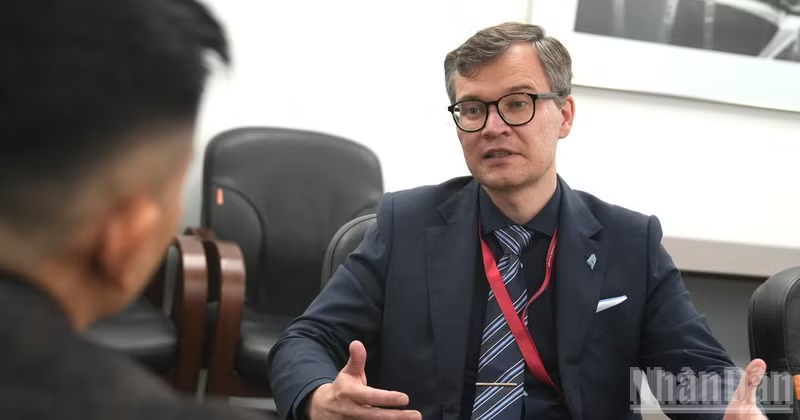
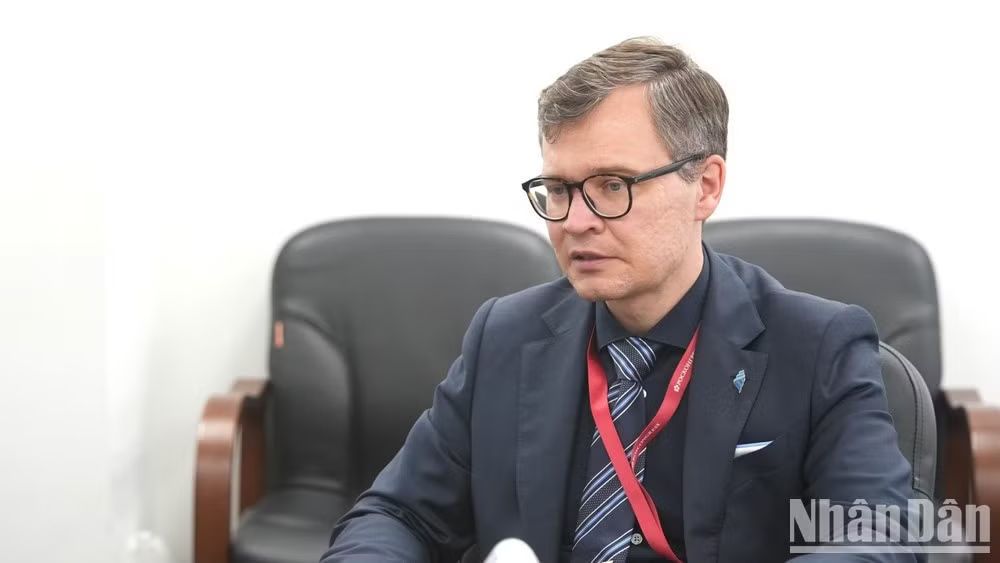
This was the evaluation of Evgeny Vlasov, President of the Russia–Viet Nam Friendship Association in the Primorye region, Vice President for International Relations at Far Eastern Federal University (FEFU), and Director of the Institute for Oriental Studies at FEFU’s School of Regional and International Studies.
Speaking to a Nhan Dan Newspaper correspondent based in Russia on the occasion of his participation in the ongoing Eastern Economic Forum in Vladivostok, Vlasov emphasised that Viet Nam and Russia’s Far East have favourable conditions for strengthening cooperation. Among these, their geographical advantages and positions within regional economic networks are particularly noteworthy.
Vladivostok is an pivotal transport and logistics hub in the Far East, with connections to other regions of Russia. Meanwhile, Viet Nam enjoys a favourable location in Southeast Asia and is an active member of ASEAN.
According to Vlasov, if Viet Nam can regard Russia as a “gateway” to the Eurasian Economic Union (EAEU) market, Viet Nam can also become a nexus for Russian businesses seeking access to the ASEAN market.
Maritime transport routes between Vladivostok and Viet Nam also provide a foundation for expanding trade. Vlasov alluded to the Vladivostok–Hai Phong and Vladivostok–Ho Chi Minh City routes. He said the existing transport links and logistics system create favourable conditions for businesses from the two countries to expand cooperation.
From logistics to technology and healthcare
According to the FEFU leader, opportunities for cooperation between Viet Nam and the Far East transcend the exchange of goods. The two sides are beginning to expand into new areas, including information technology, information security, healthcare, and medical services.
These are areas that Vlasov perceives as possessing strong potential for development in the coming years. He said the Far East’s abundant natural resources, combined with Viet Nam’s strengths, could open up new avenues for cooperation in pharmaceutical research and development.
The Far East has diverse forest and marine resources, providing a basis for scientific research and the development of pharmaceutical and healthcare products. Viet Nam, meanwhile, also possesses abundant biological and marine resources. According to Vlasov, the two sides could intensify exchanges of experience, joint research, and the development of products serving healthcare needs.
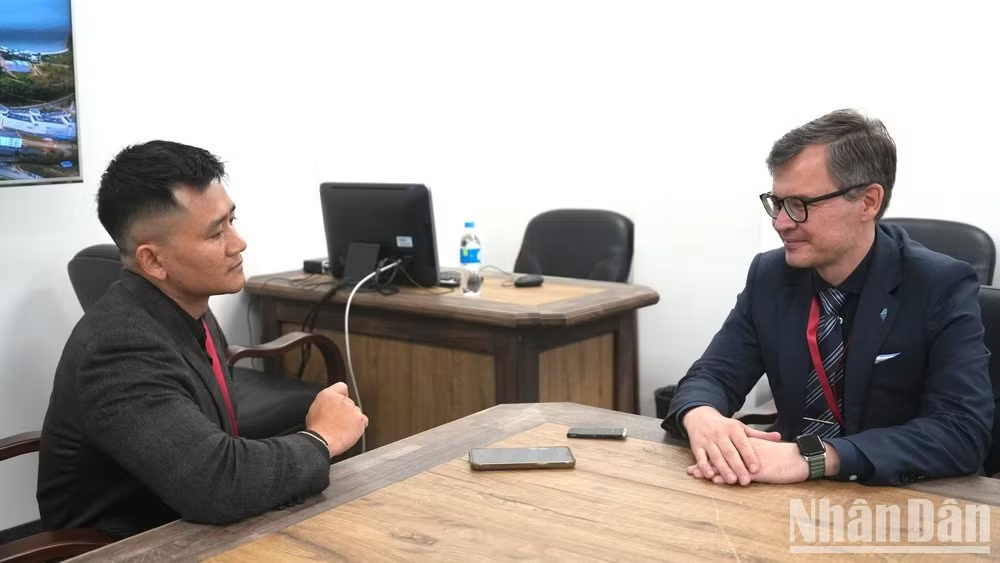
Information technology is also regarded as a promising area for cooperation. According to Vlasov, unlike traditional physical products, technology products and digital services are less dependent on geographical distance and physical infrastructure. This creates conditions for Vietnamese and Russian businesses to investigate new forms of cooperation.
He noted that the Far East has a number of incentive mechanisms directed at attracting investment, including in the information technology sector.
Vietnamese community an pivotal bridge
According to Vlasov, another asset in relations between Vietnamese localities and the Far East is the presence of the Vietnamese community in the region.
The Vietnamese business community in the Far East has materialised, with a number of businesses operating relatively successfully. At the same time, the Vietnamese community is also playing an active role in local life.
Many Vietnamese people who once studied in Vladivostok later became entrepreneurs and now play an active role in the Vietnamese business community in the region. Vlasov said this furnishes a favourable foundation for establishing further economic links.
Notably, FEFU has a tradition of research and training on Viet Nam dating back to 1979. According to Vlasov, Vietnamese studies programmes not only supply personnel for state agencies but are becoming increasingly important to the development of economic and business ties between the two countries.
At FEFU, Russian students studying Vietnamese and conducting research on Viet Nam have opportunities to engage with the Vietnamese community and businesses. Some students have participated in cooperation projects with Vietjet and FPT Corporation.
According to Vlasov, personnel with knowledge of the language, culture, and market of both countries can function as a bridge between businesses from Viet Nam and Russia. Such human resources are increasingly in demand as businesses expand into each other’s markets.
Careful preparation required before entering the market
Drawing on his experience of working with businesses, Vlasov said one of the challenges facing Vietnamese enterprises endeavouring to enter the Russian market in general and the Far East in particular is limited access to information and insufficient understanding of the market.
According to him, businesses need not only capital but also personnel capable of analysing the market, understanding business culture, remaining conversant with legal regulations, and building relationships with local partners.
Therefore, rather than simply seeking interpreters, businesses need personnel who can engage directly in project implementation, from market research and strategy development to execution.
Vlasov said experienced businesses typically conduct surveys and develop strategies before entering a new market. After the research stage comes resource preparation, particularly human resources, followed by the gradual rollout of business operations. In this context, universities can play an instrumental role in providing human resources suited to businesses’ needs.
In the coming years, according to Vlasov, relations between Viet Nam and Russia’s Far East could continue to proliferate on the basis of their advantages in geography, logistics, natural resources, business communities, and human resources. Connecting these advantages with the development needs of both sides will determine their ability to establish new cooperation projects, not only in trade but also in technology, healthcare, and training.