




Viet Nam’s benchmark VN-Index rose by 0.77% to 1,750.00 points on April 10.
Prime Minister Le Minh Hung has stressed that 2026 will be a decisive year to comprehensively address longstanding institutional bottlenecks, as the Government pushes for rapid and sustainable growth.
Amid increasingly complex global geopolitical developments disrupting supply chains and driving up raw material prices and transportation costs, businesses are facing mounting pressure on their production and business activities.
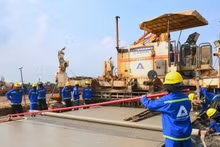
The year 2026 marks the first year of the 2026–2030 medium-term public investment plan and also features the largest-ever scale of public investment capital. Accelerating disbursement effectively from the early months of the year is therefore expected to create momentum for subsequent quarters, with the goal of achieving 95% of the annual plan.

The Agency for Private Enterprise and Collective Economy Development under the Ministry of Finance, in coordination with the International Labour Organisation (ILO) in Viet Nam, organised a training course on enhancing capacity for SME support organisations through digital and green transformation towards Improved productivity and decent work in Ha Noi on April 9.

A thematic seminar titled “Orientations for the smart factory sector and supporting industries in Viet Nam” held in Ha Noi on April 9 brought together policymakers, leading experts and business representatives to discuss development pathways, challenges, and opportunities for breakthroughs in Viet Nam’s industrial sector in the digital era.

According to the Ministry of Finance, by the end of 2024 the country had 843 enterprises with state capital, with total assets exceeding 4.33 quadrillion VND and equity surpassing 1.94 quadrillion VND. Compared with around 12,000 state‑owned enterprises at the start of the 1990s, the number has fallen sharply after years of restructuring and reorganisation.
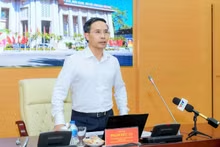
The State Bank of Viet Nam held a meeting in Ha Noi on April 9 to implement banking sector tasks, chaired by Governor Pham Duc An.

The third National Cooperative Forum took place in Ha Noi on April 10, focusing on linkages and complementarities between cooperatives and private enterprises, particularly in high-tech agriculture, processing, exports and agricultural logistics.

A policy dialogue with the Republic of Korea (RoK)’s enterprises in the automotive parts industry was held at the Viet Nam Exhibition Centre (VEC) in Ha Noi’s Dong Anh commune.
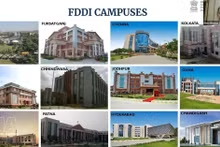
Viet Nam and India are seeking to deepen cooperation in the footwear industry by promoting sustainable value chains, enhancing business connectivity, and leveraging complementary strengths, heard an online seminar held on April 9.
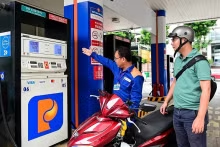
In the latest price adjustment, at 3:30pm on April 9, domestic fuel prices were cut across the board, with diesel posting the steepest decline, falling by nearly 10,000 VND per litre.
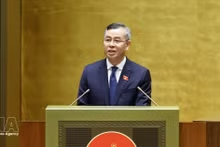
The National Assembly on April 9 afternoon heard a Government proposal and a appraisal report on a draft resolution introducing special tax measures for petrol, oil and aviation fuel, including environmental protection tax, value-added tax (VAT) and excise tax.

Viet Nam’s Jet A-1 aviation fuel supply is showing positive signs, ensuring availability through the end of April and meeting passenger demand as well as airlines’ operational plans during the upcoming April 30–May 1 holiday peak.
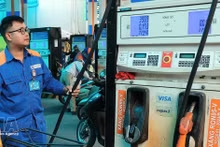
The 16th National Assembly (NA) continued its first sitting on April 10 with group discussions on a wide range of socio-economic issues, alongside draft laws and resolutions, including a proposal on tax measures for petroleum products and aviation fuel.
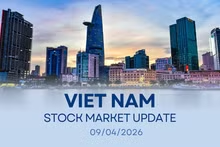
Viet Nam’s benchmark VN-Index fell by 1.13% to 1,736.68 points on April 9.

Ha Noi’s housing market enters 2026 with clear signs of recovery, while also recording a trend towards upgrading the quality of supply and shifting development space beyond the inner city. Growth drivers come not only from genuine housing demand but are also linked to infrastructure expansion and long-term urban planning orientation.

The Index Governance Board of FTSE Russell has confirmed the roadmap to upgrade Viet Nam’s stock market from Frontier Market to Secondary Emerging Market status. The inclusion of Vietnamese equities into FTSE index baskets will officially commence from Monday, September 21, 2026.

Interest rates are currently at a relatively high level in the short term, but this is a cyclical development in the economy. As macroeconomic conditions gradually stabilise, the property market will continue to play its role as a sustainable store of wealth for the public.

The Vietnamese economy expanded by 7.83% in the first quarter of 2026. But the escalating conflict in the Middle East is increasing pressure on macroeconomic management, directly affecting the full-year growth and inflation targets. In this context, a range of measures have been implemented to curb inflation and support growth.