Wood and textile industries remain cautious
In 2024, Viet Nam’s exports of wood and wood products to the US reached nearly 9.1 billion USD, a 24% increase compared to 2023. This marked the first time the industry surpassed the 9 billion USD threshold, signalling a significant milestone in bilateral trade between the two countries.
The US continues to be the largest export market for Vietnamese wood products, accounting for approximately 55.5% of total wood export turnover in 2024. This growth reflects the strong demand for wooden furniture in the US and the flexibility of Vietnamese enterprises in adapting to technical requirements and consumer preferences.
Nevertheless, the proposed 46% countervailing tariff from the US has caused considerable concern for many companies in the sector, even though the policy has been temporarily suspended for 90 days starting from 9 April to allow for negotiations.
Nguyen Anh Tuan, head of a wood product export company in Binh Duong, revealed that he had to revise down his 2025 revenue and profit targets in light of declining export demand, particularly in key markets such as the US and EU. The company’s 2025 revenue target has been adjusted from 35 million USD and 11 billion VND in profit to 30 million USD and 9 billion VND. This decision was made in April, after five months of confidently maintaining a 10% growth projection compared to 2024.
Data from the Viet Nam Timber and Forest Product Association (Viforest) also showed that exports of wood and wood products in the first quarter of 2025 totalled only 3.1 billion USD, down more than 10% year-on-year. The US market, which accounts for nearly 60% of total wood exports, continues to shrink due to consumer spending cuts and the looming threat of countervailing duties of the US.
A Viforest representative noted that many businesses had been forced to scale down operations, cut staff or temporarily suspend production due to a lack of orders. “Some US importers have cancelled or delayed contracts, concerned about rising costs from new tariff policies. Meanwhile, domestic firms are finding it difficult to access preferential loans to sustain operations,” the representative said.
Similarly, several textile and garment enterprises have proactively lowered their growth plans for this year, as these products are also among Viet Nam’s top exports to the US.
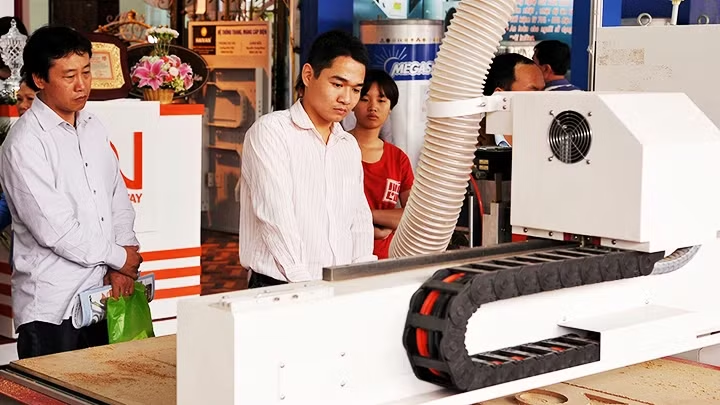 |
| Wood manufacturers invest in machinery to meet technical requirements. (Photo: SONG ANH) |
Real estate, banking, and non-essential consumer goods expected to thrive
On a more positive note, according to a report from SSI Research, large listed companies remain optimistic despite the volatile business environment, including risks stemming from countervailing tax policy of the US.
Specifically, the total revenue target for 2025 among 104 major companies (representing around 70% of market capitalisation) is projected to increase by 13.6% compared to actual performance in 2024. In terms of profit, 67% of these firms aim for growth, with total planned profits expected to rise by 13.3%.
By sector, industries anticipated to see profit growth in 2025 include real estate, banking, non-essential consumer goods, information technology, basic resources, construction and building materials—mainly sectors serving the domestic market and benefiting from government support policies.
Real estate is the main growth driver, with profit projected to rise by 139%, contributing up to 63% of overall profit growth. According to SSI, this is primarily due to businesses within the Vingroup ecosystem such as VIC, VHM, VEF, and VRE, which are expected to see a 157% increase in gross profit, accounting for 87% of the sector's total growth.
The banking sector remains a key profit pillar for the market, contributing around 45% of total profits, although its growth rate has slowed to 14% compared to the fourth quarter of 2024. Credit growth has reached 3.4% since the start of the year, signalling a positive recovery.
State and enterprise-level efforts
According to SSI, several structural factors continue to support the market: the Government’s flexible economic policies, strong commitment to growth, and the stable operation of the new KRX trading system, which paves the way for upgrading Viet Nam’s stock market status.
However, in the current challenging context, businesses are calling for more substantial and effective government policies.
The Ministry of Finance announced that in 2025, the Vietnamese Government would implement multiple policies to help enterprises recover and grow sustainably amid global market challenges and economic volatility.
The Ministry has introduced a support package worth 900 trillion VND, including initiatives such as a continued 2% VAT reduction on many goods and services in the first half of the year, with a proposal to extend this to the second half; a 100% registration fee exemption for battery-powered electric vehicles until 28 February 2027; ongoing environmental tax cuts for petrol, oil, and lubricants; and reductions of 10–50% on various administrative service fees for online public services until the end of 2025. Additionally, a 30% reduction in land rent for 2025 is proposed for land users (excluding those with unpaid rent from previous years or late payments).
The Ministry of Finance also aims to cut at least 30% of administrative procedures for businesses in 2025 to facilitate investment and operations. It is also developing targeted policies to support small and medium-sized enterprises (SMEs), including proposals for corporate income tax reductions and easier access to financing, in a bid to boost the private sector. At the same time, it is working to amend the Law on Corporate Income Tax to remove constraints, simplify compliance, and stimulate investment.
Besides state policies, experts recommend that businesses make full use of the free trade agreements (FTAs) Viet Nam has signed—such as the EVFTA, CPTPP, and UKVFTA—to expand exports to markets like the EU, Japan, Australia, ASEAN, the Middle East, and Africa. This would reduce reliance on the US market while taking advantage of tariff preferences.
Furthermore, firms should restructure operations to increase added value, invest in modern production technologies, and develop environmentally friendly products. These efforts not only help businesses meet international standards but also enhance competitiveness in the global marketplace.
At present, the Vietnamese Government is actively negotiating with the US to lower countervailing duties. Enterprises are urged to closely coordinate with authorities, provide transparent export data, and comply with international regulations to support the negotiation process. Businesses must ensure traceability of raw materials, adhere to rules of origin, and avoid trade fraud. These measures help build credibility and mitigate the risk of trade defence actions from international partners.
In the face of export difficulties, developing the domestic market is a strategic direction. Businesses should focus on researching domestic consumer demand, improving products, and expanding distribution channels to boost local sales.