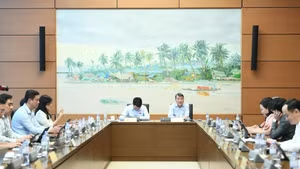
The Politburo requested continued thorough understanding and decisive implementation of the tasks and solutions outlined in Resolution No.19-NQ/TW; and at the same time, focused leadership and guidance on effectively implementing several key tasks.
In this context, agriculture, farmers, and rural areas continue to be identified as having a long-term strategic position, serving as a crucial foundation for ensuring macroeconomic stability and sustainable growth. Farmers are at the centre, acting as the driving force and resource of the innovation process.
The goal of building a modern, prosperous, beautiful, and sustainable new-style rural area is placed within the overall task of developing and implementing urban and rural planning systems, ensuring close connectivity, harmonious and rational complementarity, environmental protection, linking domestic and international value chains, aligning with national cultural identity, and opening up new space and resources for development.
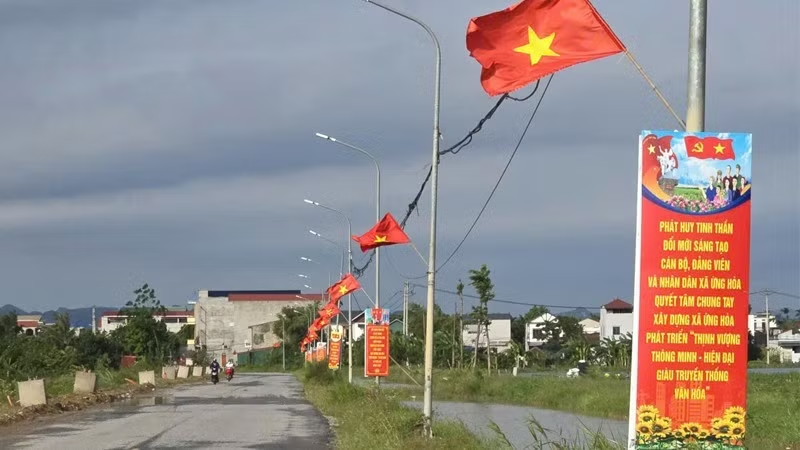
In Ung Hoa commune, Ha Noi City, building a model of a distinctive, green, and smart rural area has been chosen as a breakthrough in this term, with specific solutions aimed at comprehensively developing a modern green agricultural economy, linked to digital transformation, for the goal of prosperity and sustainability.
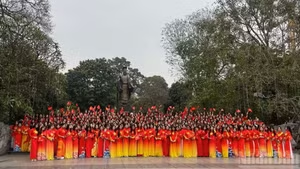
After the merger of 8 administrative units, Ung Hoa commune has a natural area of 67.8 km² and a population of over 63,800 people. This area is rich in revolutionary traditions and long-standing culture, with many heritage sites such as Chong Pagoda – once a safe zone for the Northern Party Committee in 1942; it is home to 7 communes (formerly) awarded the title of Hero of the Armed Forces, along with centuries-old craft villages such as Trach Xa village specialising in making ao dai (traditional Vietnamese dress), Dao Xa village known for its musical instrument making, and Than village specialising in leather shoe making…
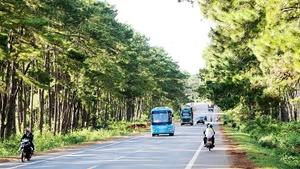
In terms of location, Ung Hoa also has the advantage of transportation, being the southern gateway to the capital, connecting the centre of Hanoi with the provinces of the Northern Delta.
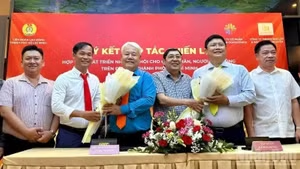
According to Nguyen Tien Thiet, Municipal Party Committee member, Party Secretary, and Chairman of the People’s Council of Ung Hoa commune, thanks to the effective restructuring of the agricultural sector towards increasing value and environmental friendliness, with the area of high-quality rice cultivation currently reaching over 90%, sustainable farming models such as organic lotus and carbon credits have also been implemented in production, both reducing emissions and opening up new value.
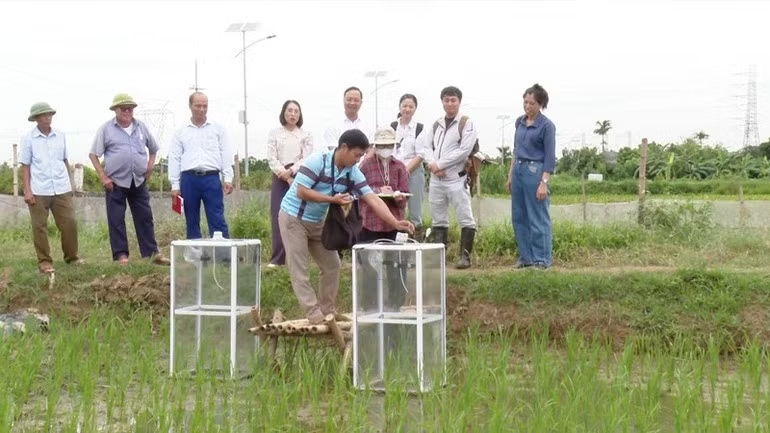
In livestock and aquaculture, many households and cooperatives have boldly applied VietGAP, Biofloc, and RAS processes… A prime example is the Tram Long Aquaculture Cooperative, which has built a collective brand, expanded its market, and established its brand on e-commerce platforms.
Many specialised farming areas linked with processing and consumption businesses have been formed, gradually bringing Ung Hoa agricultural products to domestic and international markets. To ensure the achievement of goals and orientations for green, sustainable, and modern agricultural development, Ung Hoa considers digital transformation as a crucial driving force.
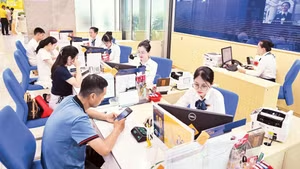
Accordingly, “smart fields” with software-based crop management systems, automatic irrigation, water environment monitoring, automatic aeration, and automatic feeding in aquaculture have been piloted. The digital government model, online public services, and “digital copies” have helped shorten administrative procedures, creating favorable conditions for people and businesses. Digital infrastructure is gradually bringing Ung Hoa's agricultural products to e-commerce platforms, labeling them with QR codes for traceability, and expanding their consumer markets.
Leveraging the advantages of its culturally rich rural areas and unique agricultural products such as grass-fed ducks, lotus, and snakehead fish, Ung Hoa has developed experiential tourism models. The harmonious combination of historical and cultural heritage, traditional crafts, and ecological landscapes has contributed to increasing income, while spreading traditional values and fostering pride among local people.
To realise its development aspirations in the next phase, Ung Hoa has identified three strategic breakthrough directions. First, it aims to build a comprehensive planning framework linked to investment in inter-regional transportation infrastructure, creating unique development spaces, along with a system of processing, preservation, and tourism service infrastructure…; and to develop a green and smart economy, with ecological agriculture and high-tech agriculture integrated with tourism services.
In particular, special attention will be paid to surveying and treating soil and water resources, addressing pollution, increasing the use of organic matter and biological products to restore soil, creating a foundation for agricultural products to meet standards; gradually building a closed value chain of production - processing - consumption, with close coordination with research institutes and universities to apply science and technology to practice.