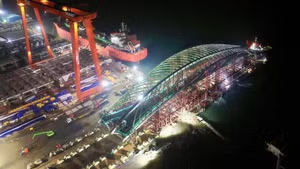
This is considered an urgent project designed to shorten travel time between Ho Chi Minh City and Long Thanh International Airport, and to improve connectivity across the Southeast region.
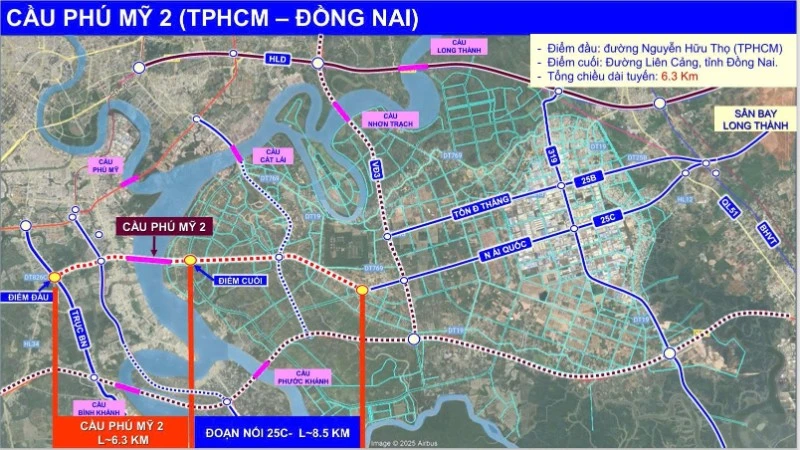
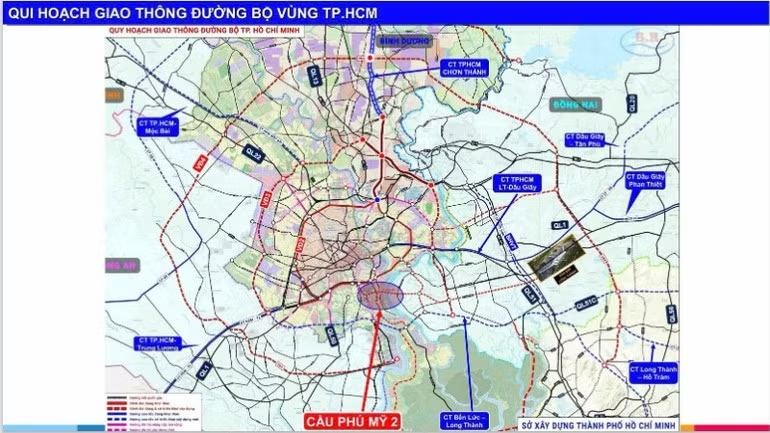
According to a report by the Department of Finance, since August, Ho Chi Minh City and Dong Nai have held continuous meetings to agree on a coordination mechanism and determine the lead agency for each project. For Phu My 2 Bridge, a strategic route linking Cat Lai and Phu My with the Ho Chi Minh City–Long Thanh–Dong Nai Expressway, both localities have agreed to assign Ho Chi Minh City as the authorised body to implement the project under the PPP model. This arrangement enables proactive coordination, the proposal of special mechanisms, and mobilisation of resources for inter-regional projects.
Planning reviews, route updates, and the alignment and positioning of the bridge and connecting roads have been jointly carried out by the Departments of Construction of both localities to ensure synchronisation in related planning schemes.
Departments and sectors have also been tasked with urgently preparing investment policy dossiers to ensure progress, enabling groundbreaking works to begin before the first quarter of 2026, in time to serve direct access to Long Thanh Airport when it is expected to commence operations in Q1/2026.
The Phu My 2 Bridge project, with a total length of around 14.8 kilometres, is being developed to provide a direct connection between Ho Chi Minh City and Dong Nai Province. Its starting point intersects Nguyen Huu Tho Street (Ho Chi Minh City), while its terminus links to Road 25C (Dong Nai). The estimated investment cost is about 16.445 trillion VND. Once completed, the project will form a strategic transport corridor, shorten the route to Long Thanh International Airport, ease pressure on existing bridges such as Phu My, Long Thanh, and Dong Nai, and open up new development space for southern Ho Chi Minh City, as well as industrial and logistics zones in southern Dong Nai.
Other projects, including the Long Hung Bridge and a nearly 12km-long connecting road between Ho Chi Minh City and Dong Nai, with Long Hung Bridge spanning over 2.3 kilometres, are also under development. The route begins at the Ring Road 3–Go Cong junction (Ho Chi Minh City) and ends at National Highway 51 (An Phuoc Commune, Dong Nai).
The Cat Lai Bridge project alone comprises three main components, with a total investment of more than 20.5 trillion VND, financed through a combination of local budget sources and the PPP model, aiming to improve Ho Chi Minh City–Dong Nai connectivity and reduce congestion on existing routes.
According to conclusions by the leaders of Ho Chi Minh City and Dong Nai in Notice 349/TB-UBND, Cat Lai Bridge, Long Hung Bridge, and Phu My 2 Bridge are all urgent projects that play a crucial role in shortening the link between central Ho Chi Minh City, Long Thanh Airport, and the Ba Ria–Vung Tau development corridor. Both localities have agreed to accelerate progress to begin construction in Q4/2025 or, at the latest, Q1/2026, to avoid delays when Long Thanh Airport enters operation.
At a recent meeting on the progress of investment research for the Can Gio Bridge and Phu My 2 Bridge projects, Vice Chairman of the Ho Chi Minh City People’s Committee Bui Xuan Cuong stressed that the two infrastructure projects — to be developed by Masterise Group under the PPP model — must finalise dossiers to ensure the scheduled groundbreaking date of January 15, 2026.
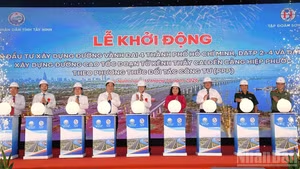
Recently, three major projects financed with non-budget capital — Can Gio Bridge, Phu My 2 Bridge and the Rach Chiec Sports Complex — with total funding of over 117 trillion VND, are expected to break ground on January 15, 2026. These projects, combining State budget and investor capital, are listed in a submission by the Ho Chi Minh City People’s Committee to the Standing Committee of the Party Committee of the municipal People’s Committee regarding major groundbreaking and inauguration ceremonies ahead of the 14th National Party Congress.