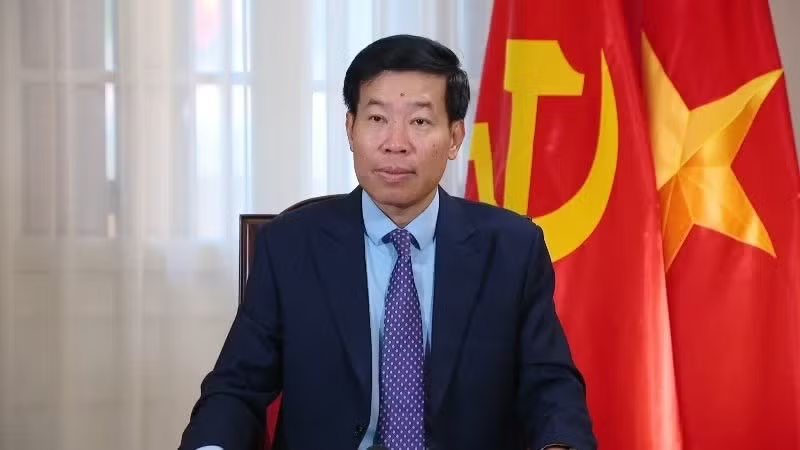
Q: Looking back on more than half a century of Viet Nam-Singapore relations, in your view, which areas of cooperation are the most symbolic and strategically profound between the two countries?
A: Viet Nam and Singapore are two countries with a highly dynamic, substantive, and effective friendship and cooperation in Southeast Asia. Over more than half a century of development, bilateral relations have been continuously consolidated, expanded, and deepened, becoming a successful model of cooperation within ASEAN.
The establishment of the strategic partnership in 2013 and its upgrade to a comprehensive strategic partnership in 2025 marked a highly important development, reflecting a high level of political trust, increasingly deep convergence of interests, and a shared strategic vision between the two countries in the new context.
The most prominent bright spot in Viet Nam-Singapore relations is the economic, trade, and investment cooperation. Singapore is currently one of Viet Nam’s leading economic partners as well as the second-largest investor in Viet Nam, with more than 4,500 valid projects and total registered capital of nearly 97 billion USD. Singaporean projects cover many sectors, including processing and manufacturing, infrastructure, logistics, real estate, finance, high technology, and modern services, making positive contributions to economic growth, job creation, and the promotion of Viet Nam’s economic restructuring.
Singapore is currently one of Viet Nam’s leading economic partners, as well as the second-largest investor in Viet Nam, with more than 4,500 valid projects and total registered capital of nearly 97 billion USD.
Deputy Minister of Foreign Affairs Nguyen Manh Cuong
A typical symbol of success in bilateral cooperation is the network of Viet Nam-Singapore Industrial Parks (VSIPs). Since the first VSIP was established, the VSIP network has expanded to many localities across the country. VSIPs are not only an effective model of economic cooperation, but have also become a symbol of the trust, long-term vision, and strategic connectivity between the two countries. In the new period, VSIPs are moving towards greener, smarter models with higher technological content and stronger links to sustainable development.
Another very important highlight is cooperation in emerging and in-depth areas. Singapore is a leading country in ASEAN in innovation, digital transformation, the digital economy, finance, modern governance, and high-quality human resources development. Viet Nam and Singapore are now promoting extensive cooperation in areas such as artificial intelligence, big data, semiconductor technology, clean energy, green transition, and the development of financial centres.
In particular, the two countries are promoting technology and innovation connectivity initiatives to link their technology ecosystems, innovation centres, technology enterprises, and high-quality human resources. This is a direction of cooperation with long-term strategic significance, matching Viet Nam’s development needs and Singapore’s strengths.
Cooperation in human resources training and governance capacity building is also an area of strategic depth. Over the years, Singapore has supported Viet Nam in training leaders, managers, and high-quality human resources through many practical cooperation programmes. These forms of cooperation not only bring direct benefits but also help strengthen strategic connectivity and mutual understanding between the two countries.
Political and diplomatic relations between the two countries have also become increasingly close. The two sides regularly maintain delegation exchanges, high-level contacts, and close coordination at regional and international forums, especially within ASEAN. Viet Nam and Singapore share common interests in maintaining a peaceful and stable environment, open trade, freedom of navigation, and ASEAN’s central role in the regional architecture.
It can be said that Viet Nam-Singapore relations today are no longer limited to traditional economic cooperation but are developing in strategic depth towards future-oriented areas, making positive contributions to each country’s sustainable development and to ASEAN connectivity.
Q: Could you tell us about the key areas of cooperation and major expectations from General Secretary and President To Lam’s state visit to Singapore, especially regarding technology, innovation, and new-generation economic connectivity?
A: General Secretary and President To Lam’s state visit to Singapore is of special importance in continuing to implement and concretise the framework of the comprehensive strategic partnership between the two countries.
The visit takes place as bilateral relations are developing very well, while both countries are also facing the need to renew their growth models, enhance competitiveness, and adapt to rapid shifts in the global economy.
First of all, the visit is expected to further consolidate political trust and elevate strategic coordination between the two countries. Amid many changes in the regional and global situation, it is very important for Viet Nam and Singapore to maintain regular high-level exchanges, share development visions, and strengthen coordination at multilateral forums.
Economically, the two sides are expected to further promote cooperation in investment, trade, finance, and supply chain connectivity. Singapore has strengths in technology, finance, logistics, and modern governance, while Viet Nam has a dynamic market, abundant human resources, and a high growth rate. This complementarity creates great room for the two countries to develop together in the new period.
An important focus of the visit is to promote deeper and more substantive cooperation in science and technology, innovation, and digital transformation. The two sides are expected to expand cooperation in artificial intelligence, big data, semiconductor technology, smart cities, the digital economy, digital government, and green transition. These are all areas of strategic significance for Viet Nam’s long-term development.
Technology and innovation connectivity initiatives such as “Tech Connect” are also expected to create a new platform for cooperation among the three groups of stakeholders of the two countries — the state, scientists, and businesses — including management agencies, research institutes, universities, technology enterprises, and innovation centres. This is a direction of cooperation with long-term strategic significance, helping form a deeper technology cooperation space in areas such as artificial intelligence, semiconductors, big data, green technology, and high-quality human resources training, in line with current trends in the digital economy and green transition.
The visit is also expected to create new momentum for next-generation VSIPs towards greener, smarter, and more sustainable models, in line with global development trends and the sustainable development goals of the two countries.
Q: During the visit to Singapore, General Secretary and President To Lam will deliver a keynote address at the Shangri-La Dialogue. Could you tell us about the significance and important messages of this speech for the region and the international community?
A: The Shangri-La Dialogue is the leading security forum in the Asia-Pacific region, organised annually in Singapore by the International Institute for Strategic Studies (IISS). It brings together many leaders, defence ministers, scholars, and leading strategic experts from around the world. This is a prestigious and influential forum on issues related to peace, security, and regional architecture.
The world is currently undergoing profound changes, with issues such as strategic competition among major powers, regional conflicts, supply chain disruptions, maritime security, technological transformation, and non-traditional security challenges drawing particular attention from the international community.
The invitation for General Secretary and President To Lam to deliver the keynote address at the Shangri-La Dialogue — the forum’s most important speech — demonstrates the international community’s respect for and appreciation of Viet Nam’s growing role, position, and prestige, as well as the role and prestige of General Secretary and President To Lam. This also reflects countries’ interest in Viet Nam’s foreign policy of independence, self-reliance, peace, cooperation, and development.
Viet Nam is now seen as an economy that is deeply integrated into the world while firmly maintaining strategic autonomy; a dynamic developing country with strong aspirations to rise; and an active and responsible member of the regional and international community.
The address by the General Secretary and President is expected to convey Viet Nam’s views and messages to other countries on how to address emerging strategic challenges, for the sake of peace, stability, and sustainable development in the evolving regional architecture.
It can be said that the General Secretary and President’s keynote address at the Shangri-La Dialogue affirms Viet Nam’s increasingly important role, position, and contributions to peace, cooperation, and development in the region and the world.
Reporter: Thank you very much!
![[In Pictures] General Secretary and President To Lam and his spouse visit and present books to Royal Library of Belgium](https://en-cdn.nhandan.vn/images/3NY4Z6Du1Md1PrS_s0ZZOrwc5xDfq4rRua69depr-TBkwatGjBcD9lagzrI2BmGDo4nKYA9qjKDjuB3-yYloL_1KbNBr00klMZQFyHQxQ6Jq6GzFfAiY0m5agKw6jNtArN4QnVntX8RQeUmD7pdCq7nwvn3e235v3kufpokBN_s/1-tong-bi-thu-chu-tich-nuoc-va-phu-nhan-tham-tang-sach-cho-thu-vien-hoang-gia-bi.jpg.avif)