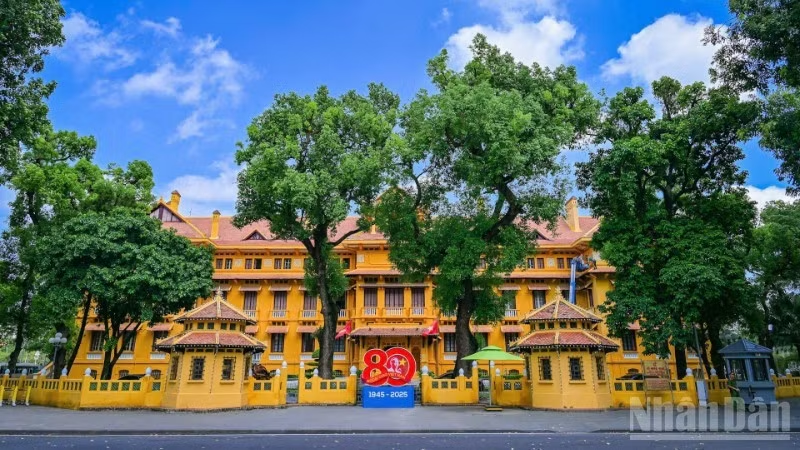
2025 is a pivotal year in preparation for the 14th National Congress of the Communist Party of Viet Nam, taking place amidst profound, complicated, and intertwined international and domestic situations and many new challenges. It also marks the 80th anniversary of the formation and development of Viet Nam’s diplomatic sector (1945–2025).
Under the comprehensive leadership of the Party, the decisive and effective direction of the Government, and the synchronised involvement of the entire political system, local foreign affairs are proactively implemented, playing a constructive, leading, and integrated role in serving rapid and sustainable development in Viet Nam’s provinces and cities.
In this overall achievement, the diplomatic sector affirms its pioneering position in expanding the development space and effectively mobilising external resources to serve national development from a local foundation.
2025 — A strategic turning point for local foreign affairs in the integration process
In 2025, alongside the restructuring and streamlining of the state administrative apparatus, the reorganisation of provincial-level administrative units, and the implementation of a two-tier local government system, local foreign affairs will undergo a significant transformation in terms of thinking, approach, and implementation methods. Moving beyond its traditional supporting role of exchanges and connections, foreign affairs will become more closely linked to the development pace of each economic region and locality; participating more directly and substantively in expanding development space, attracting resources, promoting cooperation, and building trust. The concrete results of local foreign affairs reflect an increasingly proactive, flexible, and effective approach to local foreign affairs.
In terms of political diplomacy, Vietnamese localities not only maintain, strengthen, and renew the frameworks of sister-city relationships and cooperation, but also focus on the depth, sustainability, and level of alignment of interests with foreign partners. Through the support of the Ministry of Foreign Affairs, our localities have developed and signed 135 international agreements with foreign partners, linked to the socio-economic development needs of the localities.
Local-level cooperation is closely linked to the overall foreign policy of the Party and State, contributing to building trust, creating interwoven interests, and consolidating a peaceful and stable environment at the grassroots level. Party diplomacy at the local level is strengthened with the guidance and direct participation of the highest-level Party leaders in the localities in implementing the work. In the context of increasing strategic competition and increasingly pronounced geopolitical divisions, local-level channels of contact and cooperation have become soft conduits, helping to maintain dialogue, enhance understanding, and limit the risk of conflicts of interest at the national level.
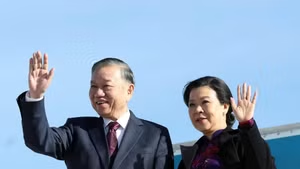
Local diplomacy is increasingly receiving attention, direct guidance, and close involvement from high-ranking Party and State leaders, who consider it a crucial strategic channel for concretising and effectively implementing commitments. Many local diplomatic activities involve the presence of high-ranking leaders, elevating the locality's diplomatic standing, creating the necessary “political credibility,” and enabling strategic messages to be quickly translated into concrete actions. These activities attract the active participation of international partners.
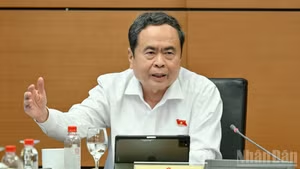
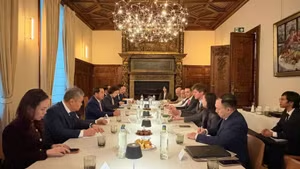
Notably, the successful organisation of four major conferences connecting localities with international partners attracted 400–800 delegates each, with the presence of Prime Minister Pham Minh Chinh and National Assembly Chairman Tran Thanh Man. Over 1,000 direct connections were made between Vietnamese localities and businesses and foreign businesses and partners within the framework of these activities. Local diplomacy has gradually affirmed its role as an extension of high-level diplomacy, where declarations and initiatives are “anchored” with concrete, substantive, and sustainable cooperation programmes.
Localities have shifted from a “single-promotion” mindset to a “joint development” approach in implementing economic diplomacy to serve development. Investment, trade, and tourism promotion activities are implemented in a coordinated manner, linked to regional development, the transformation of growth models, and the need to improve the quality and effectiveness of attracting external resources.
Foreign direct investment (FDI) in localities during the first 11 months of 2025 reached 33.69 billion USD, a 7.4% increase compared to the same period last year, with 3,695 licensed projects and registered capital of 15.96 billion USD, a 21.7% increase compared to the same period last year in terms of the number of projects. Of this, the processing and manufacturing industry accounted for 9.17 billion USD, representing 57.5% of the total newly registered capital.
Many localities have proactively leveraged new-generation free trade agreements, connecting with multinational corporations, business associations, and technology partners, gradually integrating economic diplomacy into their development structure. Local diplomacy not only brings in investment capital but also contributes to expanding markets, promoting technology transfer, enhancing governance capacity, and improving the position of localities in regional and global value chains.
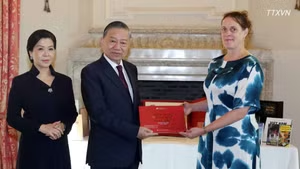
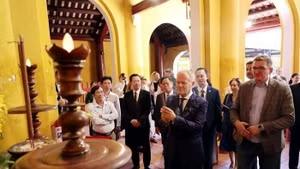
Cultural diplomacy in 2025 affirms the increasingly prominent role of culture as a soft resource for development in localities. With the active support and coordination of localities and businesses, eight projects honouring President Ho Chi Minh abroad, the largest number in the past 15 years, have been completed. The construction of “Ho Chi Minh Spaces” continues to be a priority for Vietnamese representative agencies abroad, identified as a key focus.
Through the support of the Ministry of Foreign Affairs, 23 localities have completed 48 dossiers related to heritage sites, and seven new UNESCO titles have been successfully lobbied for, bringing the total number of UNESCO titles inscribed on Viet Nam to 77. Many international cultural activities and events have been successfully organised in localities, helping to promote the image and unique culture of Vietnamese provinces and cities, closely linked to the development strategy of tourism, cultural industries, and local branding.
State management of foreign affairs at the local level continues to be strengthened, ensuring compliance with the law, maintaining discipline and order in foreign relations, while creating favourable conditions for localities to promote initiative and creativity within the permitted framework. Along with this, localities also focus on people-to-people diplomacy, coordinating border and territorial work, contributing to firmly protecting independence, sovereignty, and territorial integrity, and maintaining a peaceful and stable environment for national development.
Cooperation on climate change, environment, green transformation, digital transformation, and innovation is gradually integrated into the local foreign affairs programme, reflecting a keen awareness of major trends. Work related to overseas Vietnamese is implemented flexibly, aiming to connect overseas Vietnamese intellectuals and entrepreneurs with local development. Consular work, protection of citizens, and foreign non-governmental organisations continue to be implemented comprehensively and effectively, contributing to protecting national interests, caring for people, and securing additional resources for sustainable development.
Local diplomacy in the new era: some issues and the role of the Ministry of Foreign Affairs
In the increasingly open integration journey of localities, if each locality is a ship venturing out into the open sea, then the Ministry of Foreign Affairs is the strategic rudder helping those ships maintain their direction, stay on the right course, and accelerate at the right time. The Ministry of Foreign Affairs has continued to play a role in accompanying, guiding, connecting, and supporting, so that the integration momentum of localities can be sustainably developed.
Faced with the rapid and unpredictable changes in the international environment, the Ministry of Foreign Affairs does not stop at simply “opening up” foreign relations, but proactively regulates, helps localities identify opportunities, prevent risks, and effectively exploit international commitments at the strategic level. Through its network of Vietnamese representative offices abroad and close coordination with ministries and agencies, the Ministry of Foreign Affairs has been bringing the world closer to each locality.
Cooperation and networking activities, with the Ministry of Foreign Affairs playing a leading and supportive role, help localities connect and gradually participate more deeply in regional and global linkages. The Ministry of Foreign Affairs also pays attention to and supports localities in enhancing their internal capacity, from perfecting institutions and strengthening state management of foreign affairs to training cadres to meet the requirements of increasingly deep integration. This is the foundation for each locality to have the “courage” and “capacity” to stand firm against “storms,” seize opportunities, and handle challenges arising in the integration process.
Based on the results of 2025, local foreign affairs work in 2026 should focus on the following:
First, affirming the pioneering role in serving sustainable development at the local level. Localities need to exploit and maximise the current favourable situation and the increasingly enhanced role and position of the country to seek cooperation opportunities and attract external resources. In particular, cooperation in economics, science and technology, infrastructure development, energy, and digital transformation should be identified as the driving force for breakthroughs and the realisation of the goals of “rapid, strong, and sustainable” development in each locality.
Second, clarifying the crucial and ongoing role of foreign affairs, harmoniously combining and closely linking security and development. Specifically, this involves effectively managing border and territorial issues, ensuring security, and simultaneously promoting friendly cooperation and “win-win” partnerships with neighbouring localities.
Third, proactively participate in international cooperation mechanisms at the local level, contributing further to solving common problems of cities worldwide through proposing and sponsoring initiatives. In addition, learn from advanced development models and seek opportunities for cooperation with international localities, especially in new technologies, developing high-quality human resources, and expanding markets for distinctive products.
Fourth, implement a synchronised, harmonious, and effective combination of political diplomacy, economic diplomacy, cultural diplomacy, and other fields. Simultaneously, coordinate with the Ministry of Foreign Affairs and relevant ministries and agencies to promote other areas of cooperation based on the potential, strengths, development needs, and position of the locality in particular and the country in general in the new era, especially in technology diplomacy, semiconductor diplomacy, high-quality agricultural diplomacy, energy diplomacy, etc.
Fifth, strengthen and invest appropriately in the organisation of the local foreign affairs apparatus, and build a high-quality human resource pool to carry out foreign affairs work at the local level with strong political acumen, high professional skills, the ability to work in a high-pressure environment, and to meet the demands of the new situation.
In the process of implementing local foreign affairs work, the diplomatic sector — with the Ministry of Foreign Affairs at its centre — will always accompany, maintain the pace, guide, and accelerate the process. From there, each locality will become a dynamic entity integrating closely with the country's overall foreign policy strategy, and the nation's overall strength will be built upon persistent, innovative, and creative movements at the grassroots level. This is the foundation for Viet Nam to enter a new era of development with a confident stance, a wide-open space for development, and an increasingly solid capacity for integration on the international stage.