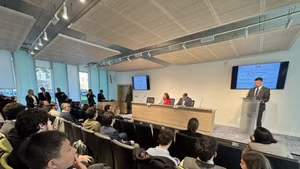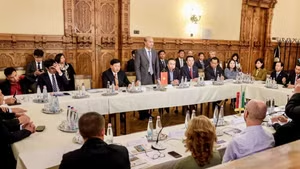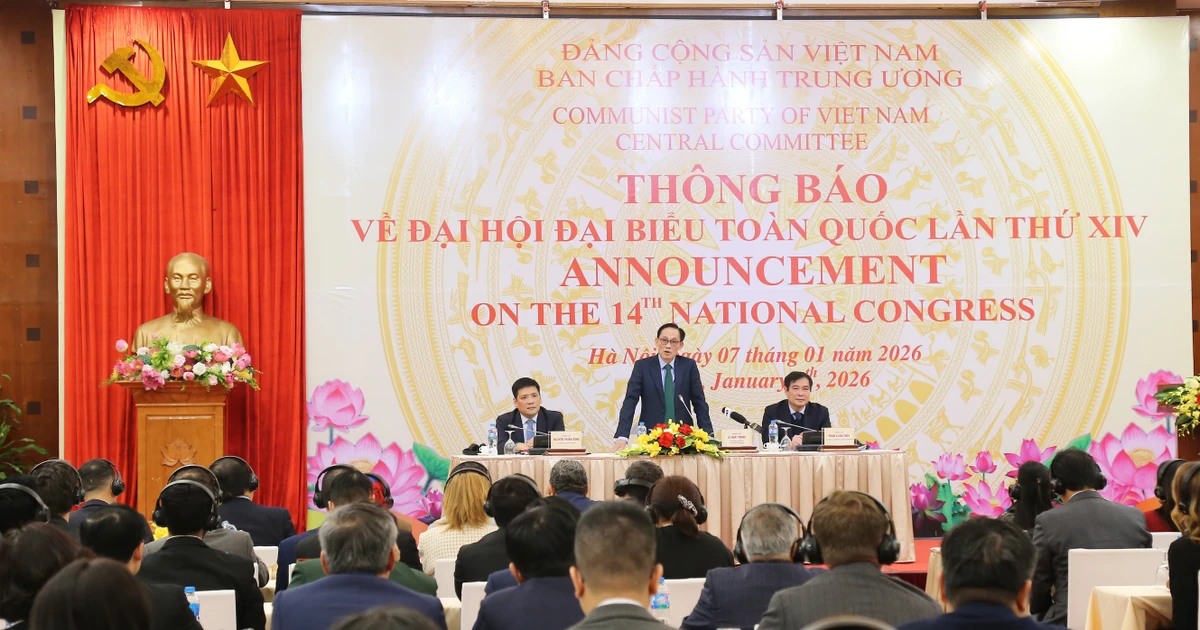
Secretary of the Party Central Committee and Minister of Foreign Affairs Le Hoai Trung emphasised that the event marks a pivotal milestone for the country’s development journey, amid a fast-changing and complex regional and global context filled with both opportunities and challenges.
He noted that it is an important occasion to review 40 years of the “Doi moi” (renewal) process and the five-year tenure of the 13th National Party Congress (2021–2026), in order to set comprehensive development goals and directions for the country in the new era.
Trung emphasised that the Congress themed “Under the glorious flag of the Party, join hands and effort, determine to successfully implement the country's development goals by 2030; be self-reliant and confident, advance strongly in the era of national development, for peace, independence, democracy, wealth, prosperity, civilisation, happiness, and steadily move towards socialism,” reflects encouragement, guidance, and motivation to further promote comprehensive, synchronised, and deep-reaching reforms; and underlines the determination to overcome challenges, achieve the country’s development goals by 2030 that marks the Party's 100th anniversary (1930–2030), and realise the vision for 2045 when the Socialist Republic of Viet Nam celebrates its centenary (1945–2045).
Regarding the preparation of the documents to be submitted to the Congress, Trung noted that the process was fundamentally renewed, with the political report for the first time integrating the contents of three documents - the political report, the socio-economic report, and another on Party building, reflecting a continued spirit of innovation in both approach and mindset.
The documents were carefully and thoroughly prepared, with broad consultation across the Party, the public, and Vietnamese communities abroad. For personnel affairs, Trung stressed that this important task was conducted meticulously, prudently, and accurately, viewed as a prerequisite for “turning vision and aspiration into results.”
He took the occasion to report the key achievements of the 13th Party Congress term and the “Doi moi” process over the last four decades.
Accordingly, over the last five years, Viet Nam’s economy recorded an average growth of 6.3% per year, with improved growth quality, efficient use of development resources, and stronger links between growth and social equity. National defence and security, foreign relations, and international integration were reinforced, while Party building and political system reforms achieved significant and breakthrough results.
Trung stated that in the next term, the draft political report and action programme for implementing the Resolution of the 14th National Party Congress identify three strategic breakthroughs and six key tasks to drive the country forward in the new era of development.
He highlighted that Viet Nam’s foreign policy mentioned in the Congress’s documents continues the reform-era approach while adding guidance to strengthen defence and security and actively promote diplomacy and international integration as a key and regular task. He noted that Viet Nam consistently pursues the foreign policy of independence, self-reliance, peace, friendship, cooperation, and development, as well as diversification and multilateralisation of relations; prioritising national interests based on the UN Charter’s fundamental principles and mutually beneficial cooperation; being a good friend, reliable partner and responsible member of the international community; and proactively engaging in addressing common issues of the region and the world.
The organisation of the Congress has been carefully prepared, ensuring security and safety in line with the Party’s regulations, and Viet Nam is ready for the important event, scheduled for January 19 – 25, 2026, the official said.
He cordially invited representatives of foreign diplomatic missions and international organisations in Viet Nam to the opening and closing sessions.
At the event, many ambassadors and heads of diplomatic missions praised Viet Nam’s recent development achievements and expressed high expectations for the country’s future development directions.
Lao Ambassador Khamphao Earthavanh said the 14th National Party Congress marks a new milestone in Viet Nam’s development journey after 40 years since the country started its “Doi moi” process, and that it is an important political event for Viet Nam, its international friends, neighbouring countries, and strategic partners.
Earthavanh praised Viet Nam’s achievements as a strong testament to the CPV’s leadership and the unity of the Vietnamese people. She expressed confidence that, with a spirit of solidarity, democracy, discipline, innovation, and development, the 14th National Party Congress will set comprehensive directions, laying a foundation for a more sustainable and successful development phase. He hoped that Viet Nam–Laos relations will continue to be strengthened for the benefit of both peoples and for peace, stability, and sustainable development in the region and the world.
Palestinian Ambassador to Viet Nam and head of the diplomatic corps in Viet Nam, Saadi Salama, showed the belief that the 14th National Party Congress would adopt major decisions that prioritise the interests of Vietnamese people and foster cooperation for lasting peace both regionally and globally.
Pauline Tamesis, United Nations (UN) Resident Coordinator in Viet Nam, highlighted Viet Nam’s achievements in social welfare and robust economic development, noting that the country’s story is inspiring not only in numbers but in its determined approach to ensuring growth, implementing practical policies, placing people at the centre of development, and strengthening institutions.
Ambassadors and representatives of foreign missions in Viet Nam said they believe that the 14th National Congress of the CPV will be successfully held.
Trung expressed his sincere thanks to partner countries and international organisations for their close cooperation with Viet Nam through its national development, calling for continued support from the international community during the country’s new era of development.