Strong decentralisation and delegation of power
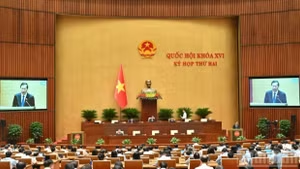
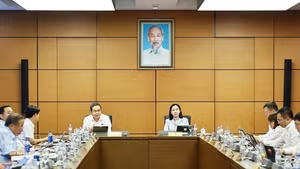
At the first session of the 16th National Assembly, during discussions in both group meetings and plenary sessions on the revised Law on the Capital, National Assembly deputies expressed strong consensus on the need for breakthrough reforms, emphasising robust decentralisation and delegation of authority alongside strict power control and enhanced accountability.
Speaking at Group 1 (the delegation of NA deputies in Ha Noi), General Secretary and President To Lam stressed that the overarching principle is to develop the Law on the Capital into a distinctive and advanced legal framework with sufficient guiding power to remove bottlenecks. According to him, the requirement is clear: greater empowerment and more thorough decentralisation must go hand in hand with clearer accountability and tighter control mechanisms, rather than any relaxation of oversight.
According to statistics, the draft law grants Ha Noi 192 powers, including 85 new authorities unprecedented in the current legal system. While this is regarded as a significant breakthrough, deputies particularly emphasised the need to ensure implementation capacity and effective oversight mechanisms.
Deputy Trinh Xuan An from Dong Nai Province's delegation analysed that given the extensive scope of responsibilities, the Ha Noi Municipal People’s Council can no longer be viewed as a conventional local authority but is being positioned as a high-level policy-making and institutional design body.
He added that for the capital city to develop rapidly and sustainably and lead the nation, governance cannot continue under conventional thinking or central dependency. Instead, it requires special mechanisms, including a higher proportion of full-time National Assembly deputies and significantly strengthened advisory, support and policy review capacities for the Ha Noi People’s Council to match the authority entrusted to it.
Deputy Ta Van Ha from Da Nang NA delegation proposed that Ha Noi should comprehensively assess the capacity of its policy advisory staff, who must possess the necessary experience, qualifications and strategic thinking.
In addition, there should be robust inspection and supervision mechanisms tied to the accountability of leaders, ensuring transparency and openness. Sharing this view, Deputy Nguyen Hai Nam from Hue delegation stressed the need for corresponding control mechanisms to mitigate potential risks, particularly in three sensitive areas: planning, land and investment.
Regarding decentralisation principles, including extensive delegation in organisational structure, staffing and the issuance of legal documents, Deputy Nguyen Thi Thuy from Thai Nguyen delegation argued that this should be approached as the Party and the State assigning high expectations to the capital city, rather than the NA granting preferential treatment to Ha Noi.
Therefore, special and exceptional mechanisms and policies are required to enable the capital city to fulfil its assigned objectives.
Institutional breakthroughs and vision for sustainable development
In contributing to the draft law, many deputies offered thoughtful proposals focusing on key areas of sustainable development. Deputy Pham Van Hoa from Dong Thap delegation pointed out that the main cause of environmental pollution in Ha Noi is excessive population density, with numerous high-rise buildings, production facilities, hospitals and schools concentrated in the capital city.
To address this issue fundamentally, it is necessary to consider relocating part of the population to surrounding areas and replacing deteriorating old apartment blocks with social housing, ensuring that not only Ha Noi residents but also people from across the country living in the capital city can enjoy cleaner air.
Meanwhile, Deputy Trinh Thi Tu Anh from Lam Dong delegation proposed that the law should provide clearer policies for developing the public school system in line with rapid urban population growth, thereby ensuring people’s access to education.
Deputy Tran Van Dang from Bac Ninh Province praised the controlled pilot mechanisms in science and technology and digital transformation, viewing them as a distinctive legal corridor enabling Ha Noi to compete in attracting venture capital with major regional hubs such as Bangkok (Thailand) and Singapore. He also recommended incorporating principles to prioritise talent attraction and retention through exceptional policies.
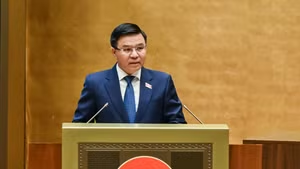
Addressing the deputies’ comments, Minister of Justice Hoang Thanh Tung affirmed that the guiding principle in drafting the law is a shift from a management-oriented approach to one focused on development facilitation and governance, under the motto: “Ha Noi decides, Ha Noi implements, and Ha Noi takes responsibility.”