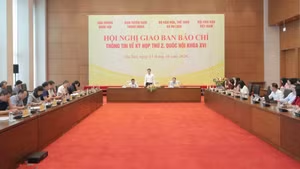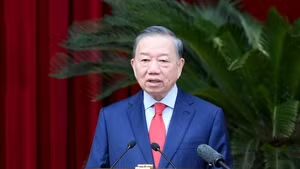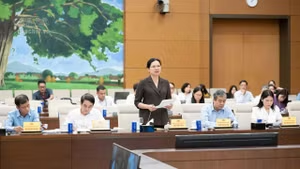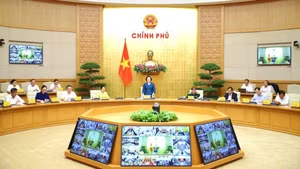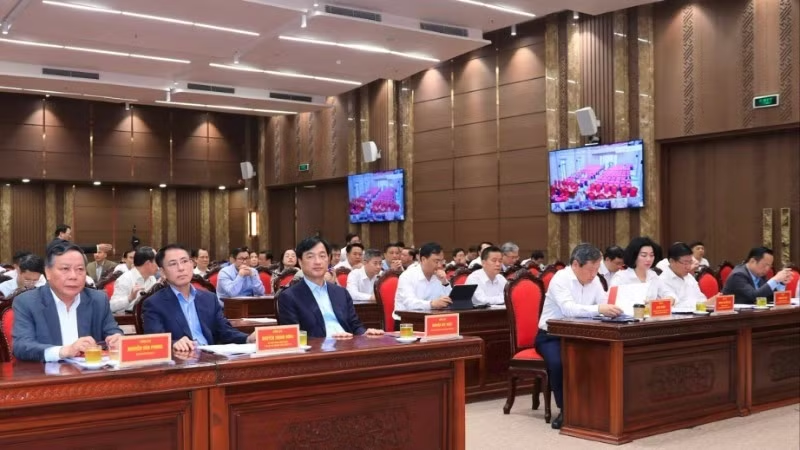
City leaders outlined the implementation of a new Politburo resolution on building and developing the capital in a new era at a conference held on March 26, chaired by Nguyen Duy Ngoc, Politburo member and Secretary of the Ha Noi Party Committee.
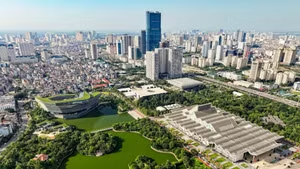
According to Duong Duc Tuan, Standing Vice-Chairman of the Ha Noi People’s Committee, the city has completed a comprehensive master plan to replace previously overlapping planning systems. The integrated framework aims to align socio-economic development with urban spatial organisation, addressing long-standing inconsistencies.
The plan covers the entire administrative area of the capital and extends connections to surrounding regions, with Ha Noi positioned as a growth hub driving regional development. The population is projected to reach 14–15 million by 2035 and stabilise below 20 million in the long term to ensure urban sustainability.
Urban development will follow a multi-centre model, with the Red River serving as a key ecological and cultural axis. A new spatial structure featuring nine growth poles, nine major centres, and nine development corridors will replace the previous framework.
Key corridors include routes linking Nhat Tan to Noi Bai, Ho Tay to Co Loa, and Ha Noi to Hai Phong, alongside the Thang Long–Ba Vi axis. The Red River boulevard is expected to become a defining feature of the capital’s future landscape.
The plan also proposes expanding the metro network to more than 1,100 km, alongside new inter-regional transport links, to ease pressure on the urban core and support transit-oriented development.
Efforts will also focus on urban renewal in central districts and along the Red River, while prioritising environmental improvements, including river restoration and a transition to clean public transport.
In addition, the city aims to place over 40% of its urban core underground, integrate low-altitude airspace (below 3,000m) as a new high-tech economic sector, and comprehensively tackle environmental challenges through river restoration and a shift to clean public transport and waste-to-energy, recycling-based systems.