No longer “early to bed”, but lacking destinations
For many years, Hue has remained a familiar destination for travellers seeking tranquillity and cultural depth. During the day, the city offers a wide range of activities, including heritage tours, experiences along the Huong River, culinary exploration, insights into local life, and eco-tourism programmes.
However, when night falls, the question of where to go and what to do after 10 pm remains difficult to answer for visitors to Hue. In reality, the city no longer “goes to bed early” as it once did.
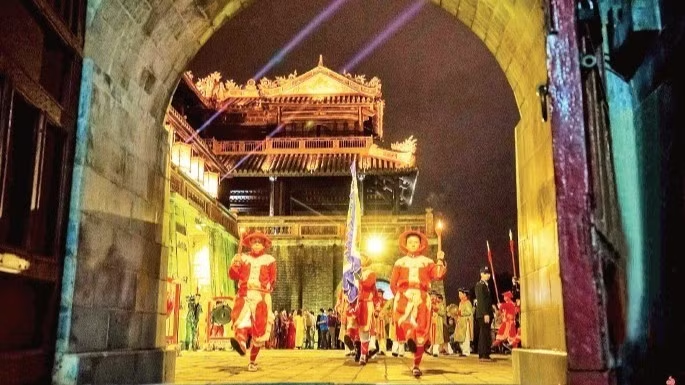
Some models such as pedestrian streets, night markets, artistic performances, and riverside services have been introduced. The Imperial Citadel’s night opening, which was previously implemented but closed shortly afterwards due to a lack of alignment with visitor preferences, has only recently recommenced. On many streets, shops and eateries now stay open later.
Nevertheless, these activities remain fragmented and lack connectivity. A visitor from Ha Noi shared that when travelling to Hue, he expected a gentle and immersive experience. After completing daytime activities, he still wanted places to stroll, sit, and further absorb the atmosphere of the city.
However, he found limited options, noting: “The city’s peacefulness is something we can feel along the way. But before that, we need a destination that motivates us to leave the hotel.”
A group of tourists from the Republic of Korea (RoK) expressed similar views. They appreciated Hue’s tranquillity and distinctive atmosphere, but observed that as the night deepens, activities almost come to a halt. What they seek is not loud entertainment, but cultural experiences and spaces that allow further exploration of Hue.
Ho Nam, a young visitor from Ho Chi Minh City, said that being accustomed to going out late at night, he found himself at a loss in Hue. “Hue has some late-night beer spots, but I did not come here for that. In Ho Chi Minh City, such experiences are far more abundant and vibrant,” he said. These recurring observations indicate that despite recent improvements, Hue still lacks a sufficiently diverse night-time service system to encourage visitors to extend stays and increase spending.
According to Le Nhat Quang, a tour guide, a clear limitation is that Hue has yet to develop any area that truly functions as a defined night-time destination. “Each place offers a piece, but not enough to create a compelling hub. Visitors may take part in one activity, but then have no follow-up options,” he said.
Tran Thi Hoai Tram, Director of Hue City Department of Tourism, also noted that night-time tourism activities in the city remain scattered, lack cohesion, and fail to form products strong enough to retain visitors.
Developing the night-time economy is therefore an urgent requirement in the current context, both to extend visitor stays and increase spending. At the same time, Hue’s urban night-time space has yet to be organised in a coherent and systematic manner.
Lighting and transport infrastructure, supporting services, and security in many areas has yet to be designed with night-time activities in mind, leading to fragmented visitor experiences. Another factor is a long-standing cautious mindset in development.
This has traditionally been a characteristic of Hue, helping to preserve its identity, but it has also slowed the experimentation with new models. In a context where the night-time economy requires flexibility and a willingness to test new approaches, such caution has, to some extent, become a barrier.
Start with a focal point
In the current context, developing a night-time economy in Hue requires a different approach from that of major tourist cities. The city does not have advantages in scale, nor is it suited to loud entertainment models. According to some economists, pursuing such models would make it difficult for Hue to establish a distinctive identity.
Therefore, a more appropriate direction is to develop in terms of depth, building on existing cultural values.
Nguyen Thi Dong Phuong, a business representative engaged in cultural-based development in Hue, suggested that the city should not spread its resources across numerous small-scale models, but instead focus on developing a single night-time destination strong enough to create a clear highlight.
Hue’s advantage lies in its cultural depth; thus, its night-time economy should be organised in a streamlined and selective manner.
Once a clear focal point is established, visitors will have a defined direction for their evening itinerary, allowing other activities to develop and form a broader ecosystem. Central areas associated with existing spatial axes, such as riversides, pedestrian streets, or places with high visitor concentration, offer clear advantages.
However, the core issue is not simply adding more attractions, but how experiences are organised. Hue’s night-time economy can begin with medium- and small-scale models that offer depth, such as artistic performances, cultural storytelling spaces, redesigned walking routes, or well-organised culinary zones. These activities need to be interconnected to create a continuous experiential flow.
According to the direction of Nguyen Khac Toan, Chairman of the Hue Municipal People’s Committee, the city is stepping up investment in services to extend visitors’ length of stay.
At the same time, infrastructure needs to be upgraded in a synchronised manner, from lighting and urban landscapes to transport and security, to ensure a safe and convenient environment. The role of businesses should also be strengthened through incentive mechanisms to encourage investment and diversify services.
Moreover, Hue currently holds a valuable policy opportunity: it is one of ten localities selected by the government to pilot the night-time economy model under Decision No. 1129/QD-TTg, allowing service operations at suitable tourist sites to extend until 6 am the following day.
In reality, visitors to Hue do not expect vibrant nightlife. What they need is a reason to leave their hotels after dark — whether to take a walk, enjoy local cuisine, watch a performance, or simply spend time in a safe and culturally rich space. In other words, there must be something that draws them out.
For Hue, therefore, developing the night-time economy is not about creating something entirely new, but about reorganising what already exists in a more effective and engaging way.

![[Video] Viet Nam among Top three Asian destinations for return visitors](https://en-cdn.nhandan.vn/images/nyM650OGFWrOVWc-xajqN-rTZ68Rlmc1fiGJOhBRYHErj-E25MBpvJqrpphXazfrpe9t-fYCGuQU4CN0yXo3Rg/du-lich-vietnam.jpg.avif)