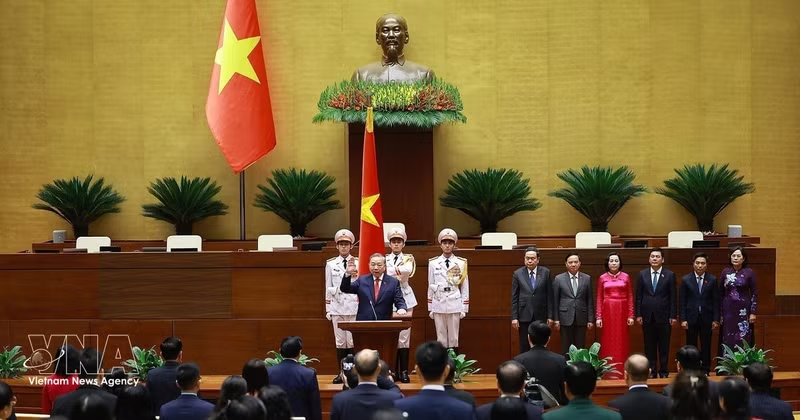
From these perspectives, Viet Nam’s recent consolidation of its high-ranking leadership is seen not only as a domestic matter but also as an important message of political stability and effective governance capacity amid increasingly complex regional developments.
India regards Viet Nam not only as a stable partner but also as an important pillar in a balanced, inclusive and rules-based regional architecture. At a time when competition among major powers is intensifying, a country with a solid political foundation like Viet Nam plays a constructive role in maintaining equilibrium, mitigating polarisation, and contributing to the preservation of a rules-based order.
Viet Nam’s political stability is also seen as an “anchor” helping the region cope with external shocks, particularly in the current global context marked by energy crises, supply chain disruptions and rising geopolitical risks. In this regard, a stable and adaptable Viet Nam with effective governance is expected to help reduce negative spillover effects and support regional economic and security stability.
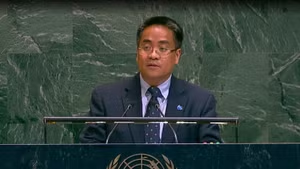
Another notable aspect highlighted by Indian observers is Viet Nam’s growing role and position in multilateral institutions such as the Association of Southeast Asian Nations (ASEAN) and the United Nations. A stable political foundation is considered an advantage enabling Viet Nam to engage more proactively in shaping regional norms, rules and initiatives, gradually enhancing its influence in both regional and global governance.
Looking further ahead, India expects that Viet Nam’s consistent and stable leadership will create favourable conditions for the promotion of new strategic linkages across Asia, particularly in key areas such as technology, energy and cybersecurity. In this context, the Viet Nam–India relationship is forecast to emerge as one of the important pillars of regional connectivity in the 21st century.