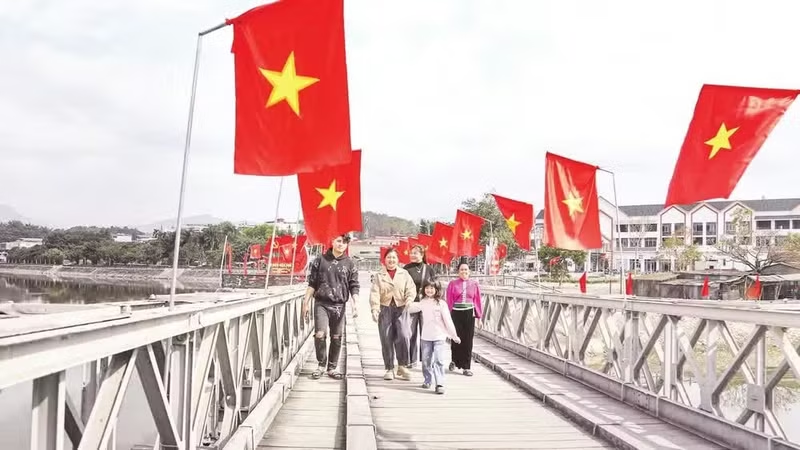
Seventy-two years after the victory of the Dien Bien Phu Campaign, enough time has passed to witness the unity and determination of generations of people who have contributed to building Dien Bien into a strong and prosperous border province and a friendly destination for visitors from near and far.
Among Dien Bien’s achievements today, the most outstanding is the success of hunger eradication and poverty reduction. Since the province was split from Lai Chau to form Dien Bien and Lai Chau provinces in 2004, the rate of poor households in Dien Bien has fallen from more than 50% to 17.66%, while average per capita income has reached nearly 54 million VND per year.
By the end of 2025, Dien Bien had completed its housing support programme for people with meritorious services and fully implemented the elimination of temporary and dilapidated housing, supporting 22,300 poor households in building or repairing houses.
The province’s economic structure has gradually shifted in a more effective direction, with the proportion of industrial, construction, and service sector output increasing rapidly year by year, while the agricultural sector’s proportion has gradually declined. The implementation of the two-tier local government model has also been carried out comprehensively and in line with reform goals aimed at enhancing effectiveness and efficiency under the “creative and accompanying government” model set by the central authorities.
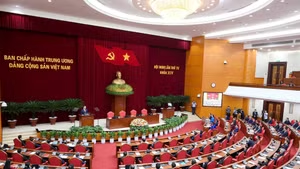
However, Dien Bien remains among the country’s poorest and most disadvantaged provinces. At the 15th Provincial Party Congress for the 2025–2030 term, the Executive Board of the Dien Bien Provincial Party Committee pointed out limitations and causes hindering development compared with the province’s potential. These include the small scale of the economy, weak internal capacity, underdeveloped infrastructure — especially transport, urban, commercial, and digital infrastructure — and limited local investment resources despite huge development demands. The application of science and technology, innovation, and digital transformation also remains slow.
Dien Bien is also heavily affected by natural disasters and climate change, while facing potential complexities relating to security and social order that affect the investment environment and development.
To proactively address obstacles and bottlenecks slowing development, the Party Committee, authorities, armed forces, and people of ethnic groups of Dien Bien Province are determined to uphold the heroic Dien Bien Phu tradition and the spirit of self-reliance to achieve the goal of “developing Dien Bien towards a green, smart, and sustainable economy and becoming a fairly developed province in the region.”
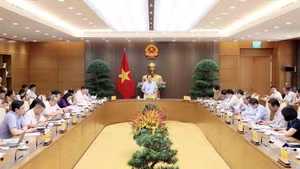
To realise this goal, the Dien Bien Provincial Party Committee has assigned specific tasks to sectors and authorities at all levels, particularly emphasising the role of leaders and promoting the spirit of “daring to think, daring to act, and daring to take responsibility” among officials and Party members. Across all resolutions and action programmes, Dien Bien Province calls for voluntary unity and collective efforts from officials, soldiers, and people of all ethnic groups to build a developed Dien Bien in the new era.
Sharing the goal of “building Dien Bien in peacetime” and wishing to contribute to the development of modern urban infrastructure, a 96-year-old Dien Bien veteran in Him Lam Residential Group 20, Dien Bien Phu Ward, voluntarily relocated his house in mid-April to hand over land for the construction of the provincial Sports Centre.
He is Nguyen Huu Chap, former commander of an 82mm mortar platoon under Battalion 166, Regiment 209, Division 312, who participated in the opening assault of the Dien Bien Phu Campaign against the Him Lam stronghold on March 13, 1954.
Together with his comrades, the young man fought bravely through enemy bombardments. Today, in the effort to build a new Dien Bien, the veteran voluntarily moved his house and cut down trees to clear land for construction. His noble act deeply moved local officials and residents, inspiring hundreds of households to agree to relocate and hand over land.
Nguyen Van Hoang, Head of Him Lam Residential Group 20, said that the Dien Bien Provincial Sports Centre project had been approved nearly 30 years ago but stalled due to site clearance difficulties. Only after Nguyen Huu Chap took the lead did local residents respond en masse.
Many people were touched to see the elderly couple, despite their old age and weak health, willingly sacrifice for today’s Dien Bien.
Following Nguyen Huu Chap’s example, by late April 2026, 122 households had voluntarily handed over land before compensation plans were finalised.
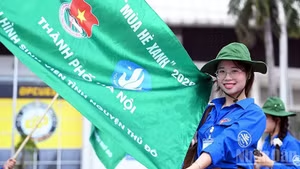
Responding to the call for a “Dien Bien Phu Campaign in peacetime” to restructure agricultural production and support crop conversion, more than 1,000 officers and soldiers from the Dien Bien Provincial Military Command travelled to 43 communes across the province in April 2026 to help residents dig holes for growing macadamia and coffee trees.
Colonel Trinh Duc Thiem, Commander of the Dien Bien Provincial Military Command, said that helping people with production and crop conversion is the responsibility of every officer and soldier.
With the spirit of volunteerism, thousands of officers and soldiers of the Dien Bien Provincial Military Command worked tirelessly under scorching heat, digging planting holes in highland and border villages from Tua Chua to Muong Nhe, Muong Cha, Na Sang, and Muong Pon.
Without counting the days or workload, each soldier carried a “mission in the heart,” travelling to villages to help residents prepare for the planting season. Thanks to the support of the provincial military forces, people in 43 communes completed preparations for planting more than 12,000 hectares of coffee and macadamia trees in April.
Le Xuan Canh, Director of the Department of Agriculture and Environment, affirmed that with current results, Dien Bien will certainly achieve its target of planting more than 12,000 hectares of coffee and macadamia trees. This result will provide a foundation and experience for expanding planting under the agricultural restructuring project, aiming for 40,000 hectares of macadamia and 20,000 hectares of coffee by 2030.
According to approved plans, immediately after the 72nd anniversary of the Dien Bien Phu Victory on May 7, 2026, Dien Bien will organise an investment promotion conference with the participation of more than 1,000 domestic and international businesses and investors to promote and attract investment.
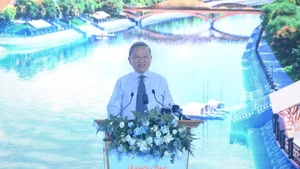
Le Van Luong, Chairman of the Dien Bien Provincial People’s Committee, said that the conference concretises Resolution No. 13-NQ/TU issued on December 31, 2025 by the Executive Board of the Provincial Party Committee on private economic development in the locality. The Provincial People’s Committee will introduce investors and businesses to Dien Bien’s potential and strengths
while committing to maintain a transparent, open, safe, and equal investment environment so enterprises and investors can confidently accompany the province in achieving its development goals.