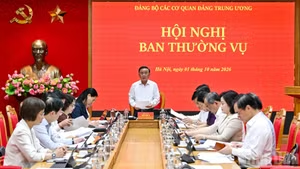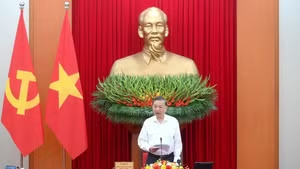
More than guiding documents, four major resolutions — Resolution No. 57 on the development of science and technology, innovation and national digital transformation; Resolution No. 59 on international integration in the new context; Resolution No. 66 on reforming the work of law-making and law enforcement; and Resolution No. 68 on private-sector development — have been described as a “quartet of pillar resolutions”, tasked with clearing the way and creating strategic momentum for the country’s development in the period ahead.
A solid growth base for a new development stage
Socio-economic results in 2025 and in 2021–2025 paint a positive, resilient growth picture. According to data from the Statistics Office under the Ministry of Finance, GDP in 2025 rose 8.02% year on year, among the highest rates in more than a decade. The economy reached a scale of around 514 billion USD, while GDP per capita surpassed USD 5,000, placing Viet Nam in the group of upper-middle-income countries.
Notably, average GDP growth in 2021–2025 stood at around 6.3%, higher than the previous term and among the fast-growing economies in the region and the world. Amid global economic turbulence, this result clearly reflects the soundness of the Party’s leadership line and the State’s flexible, effective governance.
The reorganisation of administrative units at provincial and communal levels has opened up new development space, enabling many localities to better leverage their role as growth engines. Five core localities — Ho Chi Minh City, Ha Noi, Hai Phong, Dong Nai and Bac Ninh — contributed more than 55% of the country’s total growth. Ha Noi alone recorded GRDP growth of 8.16% in 2025, with total budget revenue exceeding 704 trillion VND, up more than 37%, the highest level in many years.
“Quartet of pillar resolutions” and requirement for coordinated, substantive implementation
2026 is identified as the first year of implementing the Resolution of the 14th National Party Congress, opening a new development era with ambitious targets. Draft documents for the 14th National Party Congress set the goal of average GDP growth in 2026–2030 at 10% a year or higher, GDP per capita at around 8,500 USD by 2030, and the digital economy accounting for about 30% of GDP.
To achieve these goals, the coordinated and effective implementation of the Politburo’s pillar resolutions is defined as a central task for the entire political system.
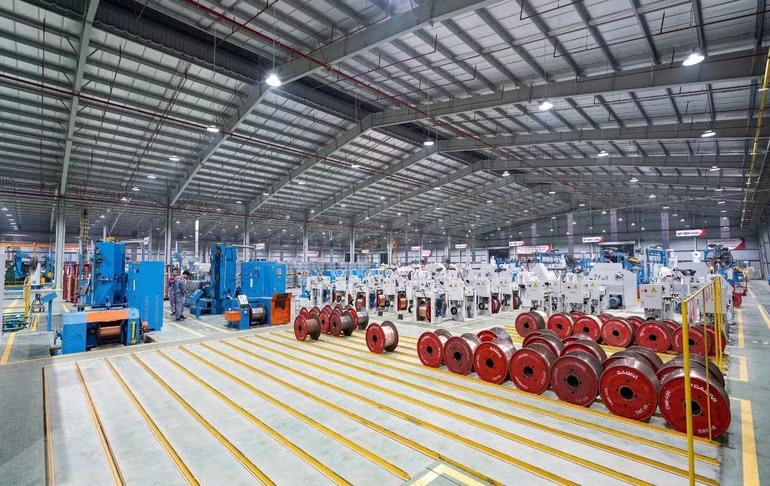
In particular, Resolution No. 68 clearly affirms the private sector as the most important driving force of the national economy. The reality of 2025 shows a clear positive impact, with an average of more than 18,000 newly established enterprises each month and more than 11,000 enterprises returning to operation. For 2025 as a whole, it is estimated that more than 300,000 new enterprises were established or resumed operation, with total registered capital of over 6 quadrillion VND.
Alongside this, the approach of using public investment to lead and catalyse private investment has continued to prove effective. In 2025, the country commenced and inaugurated 564 works and projects with total investment capital of more than 5.14 quadrillion VND, of which private capital accounted for nearly 75%. This is vivid evidence of the policy to mobilise and use effectively all social resources for development.
In parallel with Resolution No. 68, Resolution No. 57 identifies science and technology, innovation and digital transformation as a strategic breakthrough and the primary driver to modernise the country. In 2025, this field recorded growth of around 7.5–8%, the highest since 2013, indicating that major guidelines are increasingly taking root in practice.
Private technology enterprises emerge as central actors of new growth
In practice, the implementation of these resolutions shows that private enterprises — especially technology firms — are emerging as a core force in turning science and technology and innovation into real growth.
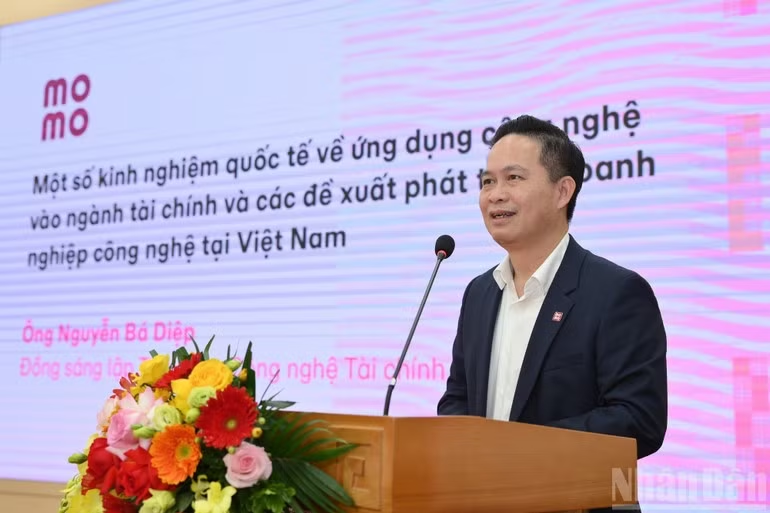
According to Nguyen Ba Diep, co-founder of MoMo, fintech not only helps expand access to finance for people and small businesses, but also improves the efficiency of the financial system, reduces operating costs, increases transparency and shapes new economic sectors. Viet Nam currently has four technology enterprises that have once reached unicorn status, and all four are fintech companies —highlighting the sector’s significant potential.
From the perspective of a large-scale technology enterprise, Dang Tung Son, Senior Vice President and Chief Strategy Officer of CMC Corporation, stressed that Resolution No. 57 and Resolution No. 68 are two organically linked pillars. If Resolution No. 57 is the necessary condition that creates momentum for innovation, then Resolution No. 68 is the sufficient condition that provides the push for the private sector to break through.
In 2025, CMC invested in and mastered several strategic technologies such as artificial intelligence, cloud computing, semiconductors and cybersecurity, while also implementing national tasks related to digital infrastructure and the Viet AI knowledge platform. The groundbreaking of CMC Creative Space in Ha Noi, with total investment of 300 million USD, is considered a symbol of an open innovation space model that connects enterprises, start-ups, universities and research groups.
According to Dr Nguyen Hien Phuong, General Director of Vietnamobile, Resolution No. 57 provides direction for encouraging enterprises to research and apply strategic technologies such as AI, Big Data, Cloud, Edge Computing, IoT, 5G/6G and others. This is the foundation for Vietnamobile to shift from “selling capacity” to “selling solutions”, developing value-added digital services and community-oriented services, as well as solutions for e-government, digital health, digital education and simplified digital finance for middle-income users. Enterprises are viewed as the centre of innovation, encouraged to take part in policy trials and new models, including sandboxes for digital services, and to cooperate with technology start-ups.
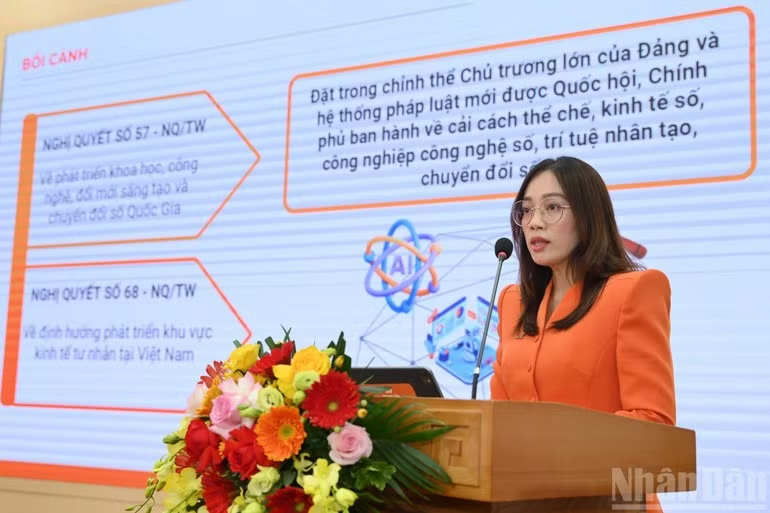
From practice, enterprises propose that the State continue to improve institutions, cut administrative procedures, expand sandbox mechanisms, lead the market through public procurement, and develop high-quality technology human resources. These are key “levers” to realise the goals of Resolutions No. 57 and No. 68.
Banking sector helps build the financial foundation for innovation
From a macro-policy perspective, Nguyen Tat Thai, Deputy Head of the Department of Forecasting, Statistics, and Monetary and Financial Stability at the State Bank of Vietnam (SBV), said the banking sector has been translating the orientations of Resolutions No. 57 and 68 into a coherent set of financial and credit policies.

Maintaining macroeconomic stability, controlling inflation and stabilising the monetary market are prerequisites for enterprises to confidently make long-term investment in science and technology. In addition, the SBV has deployed controlled pilot mechanisms in banking, promoted digital transformation, digital banking and cashless payments, and prioritised credit for the private sector.
By the end of 2025, outstanding credit to the private sector accounted for more than 92% of total credit outstanding in the entire economy. Preferential credit programmes for infrastructure and strategic technologies are helping mobilise resources for long-term development.
Ha Noi takes the lead in bringing the “quartet of pillar resolutions” into reality
As the nation’s political and administrative centre, Ha Noi is demonstrating clear determination to take the lead in implementing the Politburo’s strategic resolutions. The Ha Noi Party Committee identifies the four resolutions — Nos. 57, 59, 66 and 68 —as action guidelines, translated into programmes and plans linked to the accountability of heads of agencies.

In science and technology development and digital transformation, Ha Noi has for many consecutive years led the country in the local innovation index and the digital transformation index. The start-up and innovation ecosystem continues to expand, with the proportion of enterprises engaging in innovation exceeding 25%.
In international integration, Ha Noi has established cooperative relations with more than 100 capitals and cities worldwide, reinforcing its role as a central regional connector. In law and institutions, the city is stepping up the application of digital technologies, artificial intelligence and big data to improve the effectiveness of law-making and law enforcement, creating a favourable environment for innovation.
The private sector remains a growth pillar of the capital, with an economic scale of around 63 billion USD, accounting for more than 12% of national GDP. The concretisation of the special mechanisms under the 2024 Law on the capital through a series of resolutions adopted by the City People’s Council in 2025 has helped unlock resources and create new development space.
Overall, the “quartet of pillar resolutions” not only sets a strategic framework, but is also being steadily translated into visible changes in socio-economic development practice. Coordinated action by central and local authorities, the business community, and the financial and banking system is shaping a new growth engine — built on science and technology, innovation, and the strength of the private sector.
With a spirit of solidarity, discipline, creativity and development, Ha Noi and the whole country stand before a major opportunity to accelerate, build a firm foundation towards the success of the 14th National Party Congress, and realise the aspiration for Viet Nam to become a developed and high-income nation by 2045.