In this process, information, education, and mass mobilisation work plays a particularly important role: not only “leading the way” by shaping awareness and orientation, but also serving as a “bridge” to consolidate social consensus, thereby ensuring that the new model operates smoothly and stably from its very first steps.
Proactive communication and mobilisation
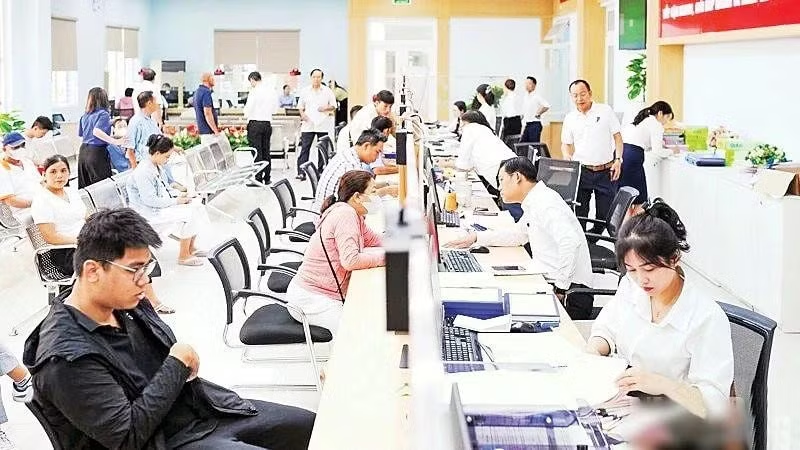
In implementing Resolution No. 18-NQ/TW of the Party Central Committee and subsequent Central Committee conclusions on further reforming and streamlining the organisational apparatus of the political system, as well as rolling out the two-tier local government model, the requirements for information, education, and mass mobilisation work go beyond simply communicating policies accurately and sufficiently. It must truly be one step ahead, proactively fostering unity in awareness and consensus in action across the entire political system and among the people.
During the process of reorganising and merging administrative units, streamlining organisational focal points, and redefining authority, initial difficulties are inevitable. This calls for the timely, proactive, and methodical engagement of those working in information, education, and mass mobilisation.
Da Nang City, established through the merger of the former Da Nang City and Quang Nam Province, occupies a particularly important position in terms of national defence and security, as well as socio-economic development, both in the central region and nationwide. Immediately after the Da Nang Municipal Party Committee issued the decision to establish the Municipal Commission for Information, Education and Mass Mobilisation, the Commission swiftly consolidated its organisational structure and stabilised its operations.
However, following the merger, Da Nang has faced numerous objective challenges: a vast geographical area, a large population, and a high number of grassroots units, along with a diverse and distinctive range of subjects to monitor and engage, spanning many fields such as religion, ethnic affairs, the press, education and science, culture, and ideology.
Meanwhile, the contingent of cadres working in the information, education, and mass mobilisation sector at the grassroots level remains limited in number, with uneven capacity. In addition, the system of legal documents and specialised regulations has not yet been issued in a fully synchronised manner, and there remain overlapping areas of authority among different levels.
In light of these realities, Huynh Thi Thuy Dung, Head of the Da Nang Municipal Commission for Information, Education and Mass Mobilisation, affirmed that in operating the two-tier local government model, under the direct leadership and guidance of the Municipal Party Committee, the Commission has clearly identified its role and responsibility as closely linking communication work with mobilisation efforts. Accordingly, communication is not merely about conveying guidelines and policies, but about focusing on clarifying the substance, objectives, and significance of the model; highlighting its long-term benefits for socio-economic development, enhancing the effectiveness of State management, and improving the quality of services provided to the people.
On that basis, the Commission proactively provides orientation and information for press and media agencies to promptly communicate, explain, and guide, helping citizens gain full and comprehensive access to, and understanding of, the two-tier local government model.
Communication is not merely about conveying guidelines and policies, but about clarifying the substance, objectives, and significance of the model; highlighting its long-term benefits for socio-economic development, enhancing the effectiveness of State management, and improving the quality of services provided to the people.
Huynh Thi Thuy Dung
Head of the Da Nang Municipal Commission for Information, Education and Mass Mobilisation
Alongside efforts to guide public communication, mass mobilisation work has been rolled out to ensure that all the Party’s guidelines and policies are implemented in a substantive and effective manner, on the basis of broad social consensus.
Huynh Thi Thuy Dung added that mass mobilisation has been carried out by the Municipal Commission for Communications, Education and Mass Mobilisation in close alignment with the political tasks of each agency, locality, and unit, while taking listening, dialogue, and an understanding of the people’s aspirations as the foundation for adjusting content and methods of engagement. As a result, many issues arising during the process of reorganising the organisational apparatus have been identified early and addressed promptly. “Hotspots” have not been allowed to emerge, nor have hostile forces been able to exploit the situation to distort information or incite unrest. This has contributed to strengthening public confidence in the Party’s reform-oriented policies.
Strengthening the monitoring of social opinion
The process of reorganising the two-tier local government model has a direct impact on organisational structures, cadres, and Party members, as well as on people’s daily lives. Taking advantage of this issue, hostile forces have continuously spread distortions, stirred up division, and sought to undermine the Great National Unity bloc, causing political and social instability, particularly in cyberspace.
In the context of rapid digital transformation, cyberspace has become a new “front”. Accordingly, information, education, and mass mobilisation work can no longer rely solely on traditional methods; it must proactively apply technology and take command of digital platforms in order to grasp, guide, and shape social opinion.
Clearly recognising the need for renewal and adaptation to digital technology, the Commissions for Publicity, Education and Mass Mobilisation of many provincial and municipal Party committees nationwide have stepped up the application of technology in communication work. They have focused on accelerating the digitalisation of communication content and gradually applying artificial intelligence in the production of media products. Initial results show clear effectiveness in monitoring public opinion, guiding discourse, and maintaining political credibility in the new context.
In particular, the establishment and effective operation of official information channels on social media platforms such as Fanpages, Zalo groups, and TikTok channels have played an important role in providing timely and accurate information, creating a “shield” against toxic information and erroneous, hostile viewpoints.
According to Do Thi Minh Hoa, Head of the Commission for Communications, Education and Mass Mobilisation under the Thai Nguyen Provincial Party Committee, following the merger, the requirement to grasp public opinion in order to guide ideological orientation during the reorganisation of the political system’s organisational apparatus for cadres, Party members, and the public has become especially urgent. On that basis, the Commission has synchronously deployed various formats, including briefings for reporters, press coordination meetings, coordination meetings with social opinion collaborators, and internal bulletins.
Special emphasis has been placed on building a network of collaborators and developing pages and groups on social media, such as the Thai Nguyen Communications, Education and Mass Mobilisation Fanpage, the Bac Kan – Comprehensive Information page, the Red Flag Bac Kan page, and TikTok channels including Thai Nguyen Tomorrow and Thai Nguyen Future. Through these pages and groups, positive information has been disseminated widely and in depth. The reception of feedback and monitoring of social opinion have also become faster and more effective, helping to detect and address early and from afar many potentially complex issues, preventing them from spreading or becoming prolonged.