Viet Nam was Malaysia’s 14th-largest trading partner in 2011, with total import–export turnover amounting to 7.2 billion USD, and was Malaysia’s 15th-largest export market (exports valued at 3.82 billion USD). By 2024, total two-way trade between Viet Nam and Malaysia had risen to 14.2 billion USD.
Both countries are striving towards a target of 25 billion USD in bilateral trade by 2030. In the first six months of 2025, Viet Nam–Malaysia trade is estimated to have reached 7.7 billion USD, up 6% year-on-year, with Viet Nam’s exports to Malaysia amounting to 2.5 billion USD. Viet Nam’s main exports to the Malaysian market include machinery, equipment and spare parts; computers; electronic products and components; iron and steel; petrol, and chemicals.
For Ho Chi Minh City, the locality places great importance on economic cooperation with Malaysia. In the first half of 2025, total import–export turnover between the city and Malaysia is estimated at 2.6 billion USD, an increase of nearly 35% compared to the same period in 2024. Of this, the city’s export turnover to Malaysia is estimated at 435 million USD, up 16.6% year-on-year.
Deputy Director of the Investment and Trade Promotion Centre of Ho Chi Minh City (ITPC) Ho Thi Quyen noted that although bilateral trade between the two countries continues to rise, it remains modest compared with their vast cooperation potential.
Malaysia is one of Viet Nam’s most promising import markets within ASEAN. Vietnamese goods still have significant room to expand exports to Malaysia, thanks to the country’s solid purchasing power and diverse demand.
Moreover, Malaysia has a highly open market with relatively low barriers for Vietnamese exports, as both countries participate in numerous agreements within the ASEAN and ASEAN+ frameworks, particularly the Comprehensive and Progressive Agreement for Trans-Pacific Partnership (CPTPP).
As a dynamic economy, Malaysia ranked 24th in global trade in 2024, with total trade exceeding 630 billion USD and trading relationships with more than 200 countries.
Malaysia’s economy is driven by business-friendly policies, a transparent business environment and a network of reliable suppliers with a professional business culture.
Zaimah Osman, Trade Consul at the Malaysia External Trade Development Corporation (MATRADE) in Ho Chi Minh City, reaffirmed the commitment to strengthening bilateral economic cooperation with Viet Nam. Malaysia considers Viet Nam an important partner and encourages Vietnamese enterprises to explore the wide range of business opportunities the country offers.
The Halal industry supplies products and services that comply with standards for Muslims. As the global Muslim population surpasses two billion people, the growing Halal sector presents opportunities for Vietnamese goods to expand their export markets.
According to Ho Thi Quyen, the Halal industry is expected to continue its strong growth in Asian, Middle Eastern and African markets. Emerging Halal trends will help reshape the global Halal business environment, creating new opportunities but also requiring businesses to adapt swiftly. Malaysia and Viet Nam hold significant potential for cooperation in the Halal food sector.
Malaysia’s Halal standards are recognised worldwide. Viet Nam now has a National Halal Certification Centre (HALCERT), serving as the focal point for Halal activities in the country, with experts in the field, including specialists from Malaysia.
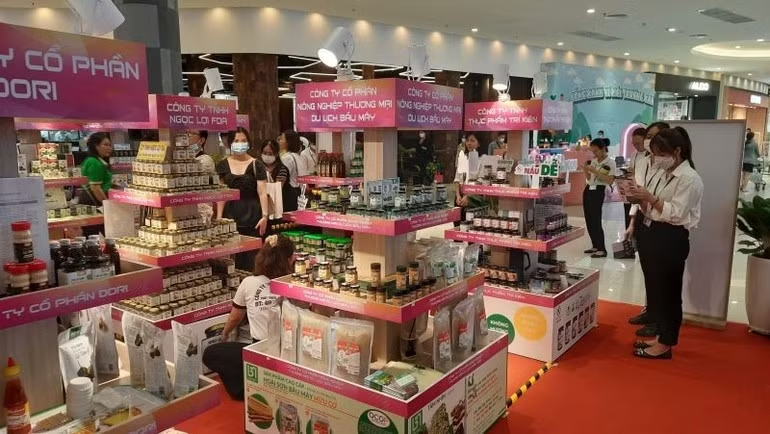
However, the number of entities authorised to issue Halal certificates in Viet Nam remains limited, and the associated costs are relatively high for small and medium-sized enterprises. Moreover, certain requirements are difficult to meet in Viet Nam, such as the stipulation that a Muslim supervisor must oversee production processes. This has made obtaining Halal certification—necessary for exporting goods to Muslim-majority markets—a major challenge for Vietnamese businesses.
Experts note that Viet Nam, in its process of deeper integration with the global Muslim community, has signed numerous free trade agreements (FTAs) with Muslim-majority countries such as Malaysia, Indonesia, the United Arab Emirates (UAE) and Turkey.
These agreements facilitate domestic enterprises in taking advantage of tariff incentives, improving market access and penetrating high-potential Halal markets. As a result, the path for Vietnamese businesses to enter the Halal market is becoming increasingly favourable.
In addition, the Halal Certification Agency of Viet Nam (HCA) has been officially recognised by the Department of Islamic Development Malaysia (JAKIM). This recognition is a key factor enabling Vietnamese products to meet standards and easily enter Malaysia’s distribution system.
Halal certification is not only a religious requirement but also a symbol of global standards in hygiene, ethics and sustainability, demanding integrity and traceability throughout the entire supply chain.
Shariza Binti Abdul Rasheed, Head of Halal Products at Maybank Malaysia, believes that market opportunities are opening up for Vietnamese businesses, with the global Halal market forecast to reach 5 trillion USD by 2030.
In Malaysia alone—one of the world’s most important gateways to the Halal market—the Halal sector is expected to reach a value of 113.2 billion USD. This potential spans multiple sectors, from food and beverages (85.2 billion USD) to cosmetics (10.5 billion USD) and pharmaceuticals (5.9 billion USD).