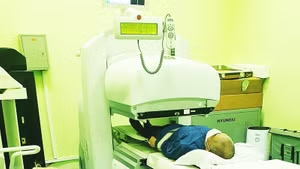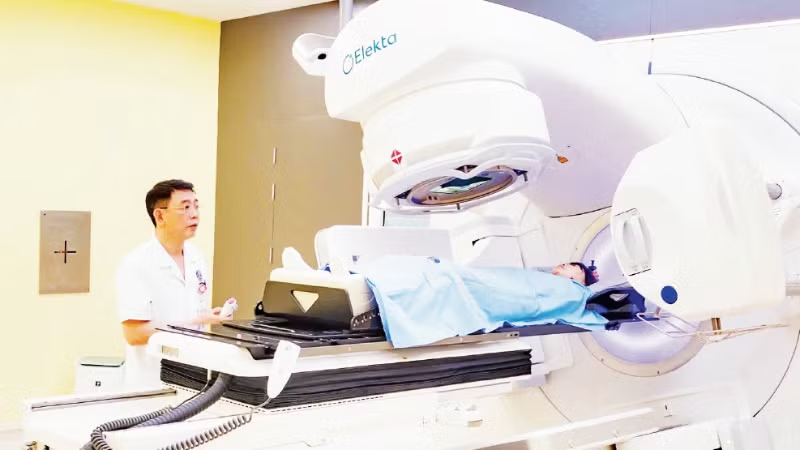
K Hospital's Quan Su facility has officially inaugurated and put into operation two linear accelerator radiotherapy systems along with nearly 100 modern devices for cancer diagnosis and treatment. The new medical equipment, covering various fields from imaging diagnosis to endoscopy, pathology, and laboratory testing, marks a significant step forward in the application of science and technology and modern equipment in cancer diagnosis and treatment. The total investment for the modern equipment is over 1 trillion VND, of which the State budget accounts for 790 billion VND and the Japanese Government provides 300 billion VND in non-refundable aid (equivalent to 1.83 billion Yen). The operation of these two linear accelerator radiotherapy systems, along with many other modern devices equipment, not only reduces the burden on other facilities of K Hospital but also demonstrates the support and concern of the Government and the Ministry of Health in caring for the health of the people.
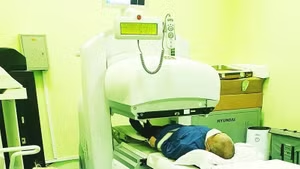
According to Professor, Dr. Le Van Quang, Director of K Hospital, cancer treatment is a multi-modal treatment, involving the coordination of three major specialties: surgery, chemotherapy, and radiotherapy, of which radiotherapy is a crucial method that brings many benefits to patients. As of January 2026, K Hospital already has nine linear accelerator radiotherapy machines, but with the increasing number of patients and growing treatment needs, investing in new equipment is necessary. The two Versa HD linear accelerators are the latest versions, enabling the full deployment of the most advanced techniques at present, including 3D, IMRT, VMAT, SRS/SRT radiosurgery, and SBRT, with dose rates up to 1,500–2,200 MU/minute. This shortens treatment time from 10 minutes to 2–3 minutes and allows for maximum dose concentration on the tumour, protecting healthy organs surrounding the treatment area.
Notably, the new linear accelerator system, combined with a 4D CT simulator, is synchronised with the latest AI-integrated Monaco software version 6.2.1, supporting auto-contouring and online consultations. The entire process is strictly controlled to meet international IAEA and ISRS standards, from simulation to planning and treatment, aiming to increase accuracy, shorten treatment time, and enhance patient safety. The radiotherapy process adheres to the recommendations of the American and European Societies for Radiotherapy & Oncology, ensuring safety and treatment effectiveness. With its state-of-the-art equipment, the Quan Su facility is not only a treatment centre but also a training centre for trainees and professional staff in the field of radiotherapy nationwide.
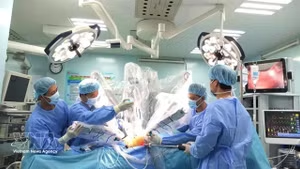
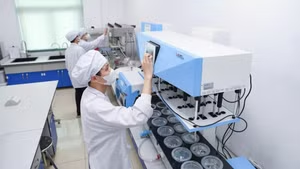
In addition to radiotherapy, the new equipment also covers areas such as biochemistry-haematology, centralised drug preparation, pathology, anaesthesia and resuscitation surgery, and functional endoscopy. Notable systems include eight modern endoscopy systems; more than 30 diagnostic testing devices; a 3D laparoscopic surgery system with 4K resolution integrated with ICG fluorescence technology; MRI scanners; digital X-ray systems; and a 64-slice CT scanner with simulation capabilities for radiotherapy planning.
As the cancer incidence in Viet Nam continues to rise, improving the quality of medical examination and treatment at specialised oncology facilities is essential to achieving cancer control goals. With a patient-centred approach, K Hospital has been making positive progress, aiming to improve treatment effectiveness and service quality so that patients can access advanced technologies on par with major cancer treatment centres in the region and around the world, enabling them to receive treatment domestically without having to go abroad.
The commissioning of these advanced equipment systems marks an important milestone, affirming a new step forward for Viet Nam’s oncology sector in applying modern science and technology in diagnosis and treatment, contributing to improving the quality of patient care, greater access to advanced techniques, and reducing cost burdens and overload on the healthcare system.
Deputy Minister of Health Vu Manh Ha
Deputy Minister of Health Vu Manh Ha said that the commissioning of these advanced equipment systems marks an important milestone, affirming a new step forward for Viet Nam’s oncology sector in applying modern science and technology in diagnosis and treatment, contributing to improving the quality of patient care, greater access to advanced techniques, and reducing cost burdens and overload on the healthcare system. As cancer is becoming a major burden on the healthcare system, the Ministry of Health has called on K Hospital to effectively and safely utilise the newly invested modern equipment to best serve cancer diagnosis and treatment.
At the same time, the hospital is encouraged to continue promoting scientific research and the application of high technologies, gradually improving treatment quality to match advanced oncology centres in the region. It should also strengthen its role as a leading hospital by enhancing training and transferring technologies to lower-level hospitals, thereby improving cancer treatment capacity nationwide.
In addition, close coordination with relevant agencies, particularly the social insurance agency, is necessary to ensure patients’ healthcare benefits, enabling cancer patients to access quality medical services at reasonable costs. Strengthening coordination among units to promote health education and awareness campaigns on cancer prevention and control, including enhancing communication about cancer risk factors, preventive measures, screening, and early detection; guiding people to adopt healthy lifestyles and proactively undergo regular health checkups to detect the disease in its early stages.