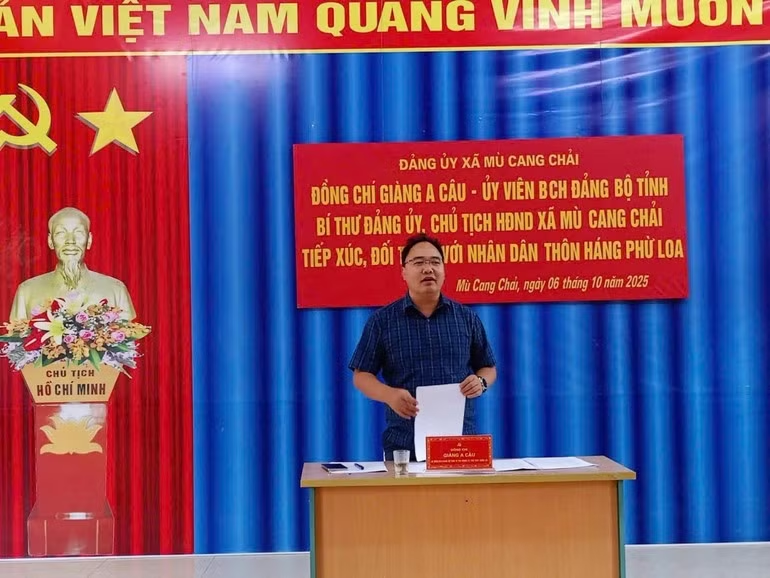
According to Giang A Cau, Secretary of the Mu Cang Chai Commune Party Committee, the action programme must build upon the achievements of the 2020-2025 tenure, while fully reflecting the policies, objectives, targets and tasks set out in the resolutions of both the Lao Cai Provincial Party Congress and the First Party Congress of Mu Cang Chai Commune for the 2025-2030 tenure.
The overall goal is to build a clean and strong Party and political system; to utilise resources effectively; to inspire the aspiration for development; and to gradually lift Mu Cang Chai out of poverty, turning it into one of the province’s key tourist destinations.
The commune encourages innovative models and new approaches to create breakthroughs in performing its key tasks, focusing on the following three strategic breakthroughs.
Firstly, the commune will make a breakthrough in construction planning, maximising resources from both the state and private sector to invest in essential infrastructure, with a focus on transport systems and tourism facilities. These will serve to connect, support and promote Mu Cang Chai’s strengths.
The commune will strengthen regional linkages, attract investment, and promote the development of all economic sectors, particularly the private sector. It will also work to attract investment projects that contribute to socio-economic development, shifting from a passive to a proactive approach in investment attraction, focusing on priority areas such as tourism infrastructure. Special attention will be paid to administrative reform and improving the investment and business environment to enhance the quality of investment attraction.
Secondly, Mu Cang Chai will create a breakthrough in the tourism development thinking; attract investment in trade and service sectors in the commune centre; develop destinations and tourism products such as eco-tourism, community-based tourism, resort tourism, and distinctive cultural tourism; and promote digital transformation for sustainable tourism development.
The commune aims to fully tap into its potential and advantages to develop tourism proactively and sustainably, making it a spearhead of economic growth and contributing to labour restructuring. All resources will be mobilised for targeted investment in the tourism sector while ensuring tourism development goes hand in hand with the preservation and promotion of ethnic cultural identity, agricultural development, and environmental protection, thus contributing to rapid and sustainable poverty reduction.
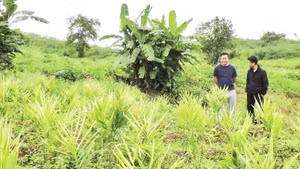
Thirdly, the commune will foster a strong aspiration for development and the will to escape poverty; to promote sustainable, multi-purpose agricultural and forestry models, such as planting medicinal herbs under forest canopies, linking forest protection with environmental conservation; and to develop livestock farming in the direction of biosecurity.
The commune will build a modern and synchronised infrastructure system to serve socio-economic development. This includes the effective connection of transport, digital, tourism and agricultural infrastructure, creating favourable conditions for production, consumption, investment attraction and the growth of community-based tourism. The share of social investment will be increased in priority areas such as tourism, high-tech agriculture, services and digital infrastructure.
It will make the most of land, resources and natural landscapes for green, sustainable development adaptable to climate change. The commune will promote economic restructuring, improve people’s incomes, and contribute to building new-style rural areas and sustainable poverty reduction.
The commune will shift its mindset from purely agricultural production to an agricultural economy, promoting the cultivation of medicinal herbs and clean vegetables; linking with neighbouring communes to establish highland markets in central clusters to facilitate the exchange of goods and agricultural products.
It will harness its comparative advantages and natural conditions to develop key, specialty and organic OCOP products associated with tourism and services.
The commune aims to develop five OCOP products during the 2025-2030 period, maintain forest coverage at 64.2%, and expand medicinal herb cultivation to 50 hectares.
Giang A Cau, Secretary of the Mu Cang Chai Commune Party Committee, emphasised that the locality will focus on restructuring agriculture towards higher quality, efficiency and added value, promoting rural economic development linked with the sustainable building of new-style rural areas.
It will encourage organic, high-tech, smart and circular agriculture; continue developing animal husbandry through concentrated livestock production zones, striving to increase the total number of major livestock to over 22,000 by 2030, with meat output reaching 850 tonnes. Aquaculture will also be expanded through intensive and semi-intensive farming over a total area of about 2.7 hectares.
The commune will mobilise and integrate resources to implement the National Target Programme on New-Style Rural Development, striving for Mu Cang Chai Commune to meet new rural standards by 2030.