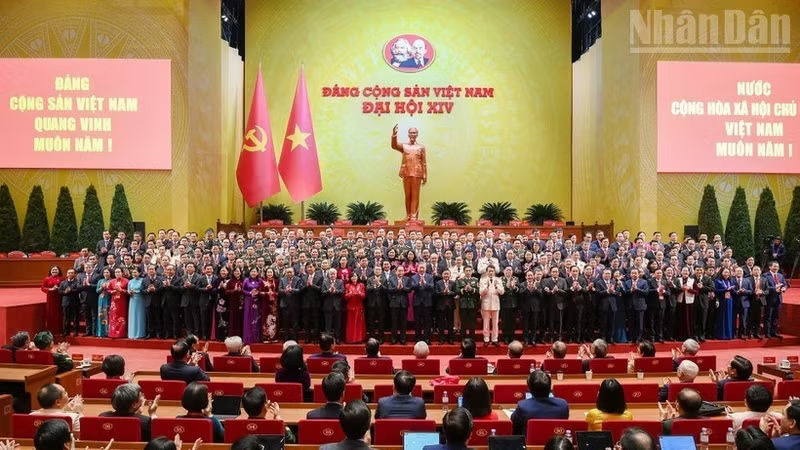
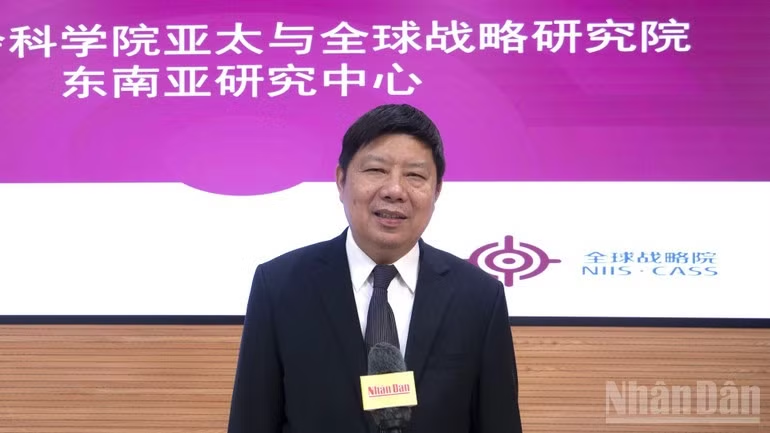
This assessment was made by Professor Xu Liping, an expert on international affairs and Director of the Centre for Southeast Asian Studies under the Institute of Global and Asia-Pacific Strategic Studies of the Chinese Academy of the Chinese Academy of Social Science (CASS), in an interview with a Nhan Dan correspondent based in China regarding the key outcomes of the 14th National Party Congress and Viet Nam’s development prospects in the coming period.
According to Professor Xu Liping, the documents adopted at this Congress represent a harmonious integration of the practical experience of building socialism in Viet Nam with the governing theory of the Communist Party, reflecting creativity and guiding capacity. The approved action plan fully articulates the themes, roadmap, resources, and objectives set out in the Resolution of the 14th National Party Congress, demonstrating an organic unity between principles and flexibility, as well as a close linkage between short-term and long-term goals, and outlining an overall plan for concrete implementation over the next five years.
The Congress is of milestone significance for Viet Nam’s development in the new era. First, it points out a clearer direction for renewal and opening-up over the next five years and beyond. Second, it provides Viet Nam with new theoretical and ideological tools for national development in the new era. Third, it elects a strong leadership team to steer the country’s development in the new era.
Professor Xu Liping, Chinese Academy of Social Sciences
Professor Xu Liping added that the Congress concluded one and a half days earlier than scheduled, fully demonstrating its efficiency and practicality, while also reflecting the high level of endorsement by delegates of the Congress’s spirit. The Congress is of milestone significance for Viet Nam’s development in the new era.
First, it points out a clearer direction for renewal and opening-up over the next five years and beyond.
Second, it provides Viet Nam with new theoretical and ideological tools for national development in the new era.
Third, it elects a strong leadership team to steer the country’s development in the new era.
Sharing his views on the position and role of the Communist Party of Viet Nam, Professor Xu Liping said that the Party plays a leading role in the process of building and developing the country.
First, the Party takes the lead in maintaining social stability and a favourable international environment for Viet Nam, laying a solid foundation for national construction and development.
Second, the Party leads the formulation of five-year and longer-term development plans, outlining Viet Nam’s medium- and long-term development directions.
Third, the pioneering and exemplary role of Party leaders and members creates strong momentum for national construction and development, serving as an important source of strength for progress.
Looking ahead as Viet Nam enters a new era, Professor Xu Liping noted that the Communist Party of Viet Nam will play an even stronger leadership role in shaping the country’s development path and approach amid an increasingly complex international situation. In particular, it will serve as a cornerstone and a firm pillar in strengthening strategic autonomy, enhancing strategic trust, and steadfastly adhering to the socialist development path.
The Communist Party of Viet Nam will play an even stronger leadership role in shaping the country’s development path and approach amid an increasingly complex international situation. In particular, it will serve as a cornerstone and a firm pillar in strengthening strategic autonomy, enhancing strategic trust, and steadfastly adhering to the socialist development path.
Professor Xu Liping, Chinese Academy of Social Sciences
Regarding the foreign policy orientation set out at the 14th National Party Congress, Professor Xu Liping said that the Congress identified the requirement to integrate diplomacy with national defence, security, and economic development, firmly upholding principles while maintaining tactical flexibility.
This diplomatic approach aligns with Viet Nam’s medium- and long-term development goals and with the practical realities of national construction and development. Over 40 years of renewal and integration, Viet Nam has continuously improved relations with neighbouring countries, established partnerships with most countries, and actively integrated into the international system, thereby steadily enhancing its international position and influence.
Assessing Viet Nam–China relations as being in one of their most positive phases in history, Professor Xu Liping suggested that the two sides should fully leverage the political advantages of their ruling Communist Parties, strengthen Party-to-Party exchanges, elevate bilateral relations to a new level, and promote the deepening and consolidation of the China–Viet Nam Community with a shared future of strategic significance.