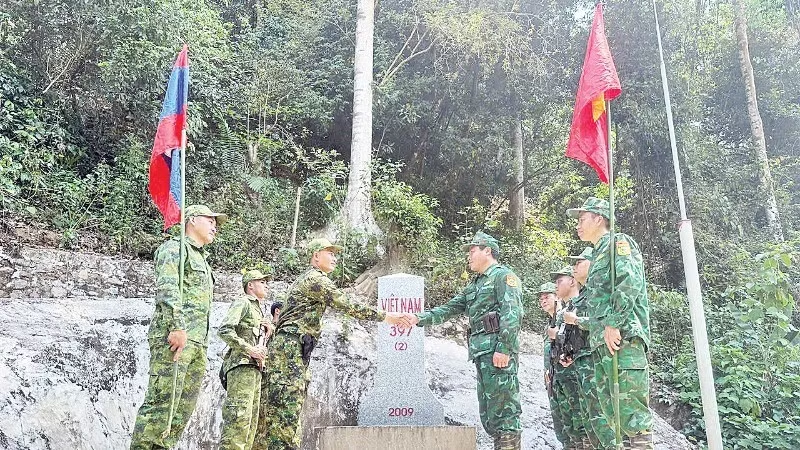
Nghe An Province shares its border with three Lao provinces: Houaphanh, Xiangkhouang, and Bolikhamsai. Over the years, the province’s border external relations activities have yielded notable achievements, contributing to reinforcing bilateral friendship and building a border of peace, stability, and sustainable development.
Expanding the scale and level of coordination
Along the more than 468-kilometre border with Laos, border guard stations under the provincial command have proactively coordinated with their Lao counterparts to organise regular monthly, quarterly, and ad hoc joint patrols. Notably, while such activities were previously conducted mainly at the station–company level, in the 2024–2025 period they have been elevated to the provincial level, thereby enhancing coordination effectiveness in border management and protection.
In July 2025, for the first time, the Nghe An Provincial Border Guard and the Military Command of Houaphanh Province conducted a provincial-level joint patrol, marking a new step forward in Viet Nam–Laos border protection cooperation.
Despite heavy rain, slippery terrain, and landslides, officers and soldiers from both sides conducted patrols and inspections in the areas of markers 363, 364, and 365—an especially challenging section of the border managed by Thong Thụ Border Guard Station and Company 216. The patrol focused on inspecting boundary lines, marker systems, signboards, and addressing issues such as illegal cultivation, encroachment, and violations of border regulations.
Earlier, in May 2024, the Nghe An Border Guard Command, in coordination with the Military Command of Xiangkhouang Province, organised a joint patrol along the section between markers 406 and 409 on the Viet Nam–Laos border, marking the introduction of provincial-level joint patrols.
At the year-end talks in 2025 between the Nghe An Border Guard and the military commands of Houaphanh, Xiangkhouang, and Bolikhamsai, all sides highly valued the effectiveness of cooperation, particularly in combating drug-related crimes, preventing illegal entry and exit, and organising dozens of joint patrols along the entire border.
These patrols not only help inspect and safeguard the national boundary marker system, exchange information, and combat crime, but also incorporate public outreach to encourage border residents to comply with the law. As a result, many cases are detected early and handled promptly at the grassroots level, preventing the emergence of hotspots.
The organisation of provincial-level joint patrols represents a breakthrough, marking a new phase in bilateral coordination mechanisms. It demonstrates the proactiveness and flexibility of border protection forces in translating bilateral defence cooperation into practice, thereby enhancing their capacity to respond to cross-border threats.
Colonel Ho Quyet Thang, Deputy Commander and Chief of Staff of the Nghe An Border Guard
According to Colonel Ho Quyet Thang, Deputy Commander and Chief of Staff of the Nghe An Border Guard, the organisation of provincial-level joint patrols represents a breakthrough, marking a new phase in bilateral coordination mechanisms. It demonstrates the proactiveness and flexibility of border protection forces in translating bilateral defence cooperation into practice, thereby enhancing their capacity to respond to cross-border threats.
Promoting border external relations activities
Over the past five years, the Nghe An Border Guard has intensified training in border management and protection, transnational crime prevention, and situational response skills for nearly 160 officers and soldiers from border protection forces in Houaphanh, Xiangkhouang, and Bolikhamsai.
In parallel, twinning activities between units on both sides have been identified as a key pillar of border external relations. To date, 10 border guard stations in Nghe An Province have established twinning relationships with nine Lao border companies and one border gate police station, maintaining regular briefings, coordinating patrols, and promptly addressing emerging issues to ensure border stability.
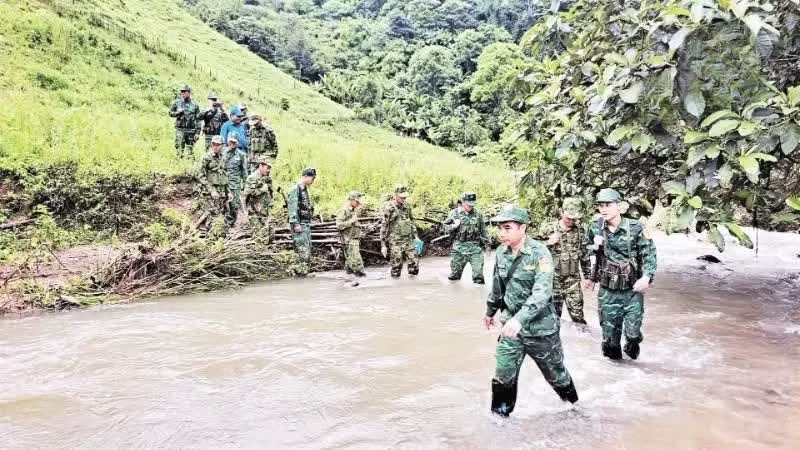
According to Lieutenant Colonel Nguyen Dinh Vien, Commander of Muong Ai Border Guard Station, his unit and Company 221 have jointly organised numerous patrols to inspect boundary lines and markers, promptly detecting and preventing illegal crossings and unauthorised entry and exit, thereby maintaining security and order in the area. Notably, when marker 410 was swept away by floods, both sides proactively exchanged information, reached agreement, and advised relevant authorities to reconstruct it in accordance with regulations and cooperation protocols.
In addition to direct support from units and socialised resources, the provincial Border Guard has advised the provincial People’s Committee to allocate funding to assist Lao border villages in building meaningful community infrastructure.
Typical examples include support for Nam Tay Village (Vieng Phan cluster, Sam Tay District, Houaphanh Province) in constructing a “Community Cultural House” and three “Friendship Houses” for poor households, with a total budget of nearly 1.3 billion VND; the construction of a military-civilian medical station in Xop Tong Village (Nam On cluster, Xaychamphon District, Bolikhamsai Province) worth over 14.9 billion VND; and the installation of a clean water system in Pung Vai Village (Pha Danh cluster, Muang Kuan District, Houaphanh Province).
The unit also sponsors 13 Lao students from disadvantaged backgrounds under the programme on “supporting students to stay in school”, providing 500,000 VND per student per month.
The unit’s border external relations work has become increasingly substantive and effective. Units have translated higher-level directives into practical actions suited to local conditions, receiving strong support from their Lao counterparts. Through these models and activities, solidarity, friendship, and coordination between forces on both sides—as well as among border communities—have been further strengthened.
According to the leaders of the Nghe An Border Guard, there are currently 21 twinned village pairs between Nghe An and villages in Houaphanh, Xiangkhouang, and Bolikhamsai. These partnerships maintain regular cultural and sporting exchanges, share production experiences, and support each other in economic development, contributing to poverty reduction and strengthening solidarity along the border.