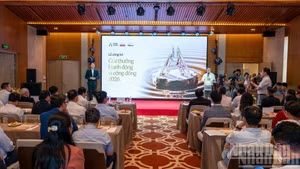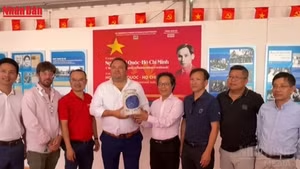
Within the framework of the Ha Noi Creative Design Festival 2026, and with the aim of contributing to the building of an urban creative ecosystem and promoting the development of cultural industries and the creative economy, the seminar themed “Surveying potential spaces to become creative spaces and cultural industry centres in the city” was recently held. The seminar noted that, despite possessing abundant creative resources, Ha Noi is still facing a shortage of infrastructure for the development of cultural industries. The project “Surveying potential spaces to become creative spaces and cultural industry centres in the city” is expected to serve as leverage to build a solid creative infrastructure, helping the capital preserve its heritage for the future.
This activity is also part of the project “Surveying potential spaces to become creative spaces and cultural industry centres in the city”, directed by the Ha Noi Municipal People’s Committee and the Viet Nam Association of Architects and coordinated and implemented by the Ha Noi Department of Culture and Sports, Architecture Magazine, Ha Noi University of Civil Engineering, the School of Interdisciplinary Sciences and Arts, together with the Network for a Liveable Ha Noi and ECUE Social Enterprise.
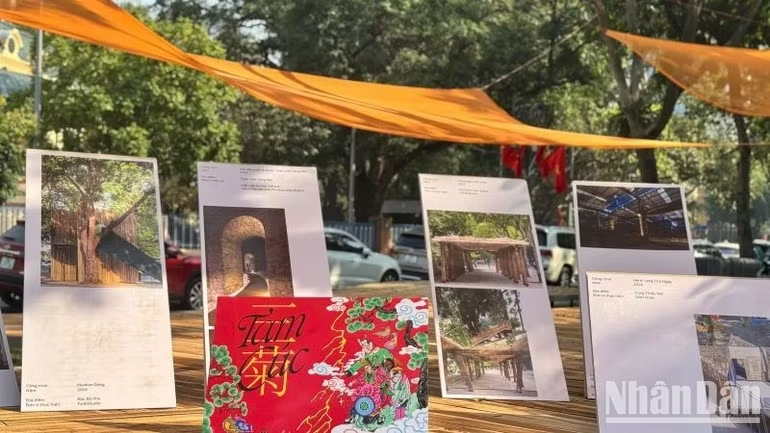
This event also marked the launch of a multi-stakeholder consultation process for the project to survey, introduce orientations, a criteria framework, and an implementation plan for the following six months, as well as sharing international experience in transforming industrial spaces and public assets into creative spaces. In addition, it connects management agencies, experts, businesses, investors, and the creative community, while collecting practical feedback to ensure that the survey is strategic, feasible and closely aligned with the demands of Ha Noi’s creative ecosystem.
Since joining UNESCO’s Creative Cities Network in the field of design in 2019, Ha Noi has affirmed its position as the nation’s cultural and creative centre. However, the city’s creative ecosystem is facing a paradox. While creative resources are abundant, the infrastructure supporting creative activities remains limited. Most existing creative spaces are operating in a fragmented manner, lacking connectivity and standardised infrastructure to serve stages from production and experimentation to incubation of creative models. This disconnect between creative ideas and implementation infrastructure has become a major bottleneck, hindering the breakthrough development of the capital’s cultural industries.
In response to the urgent demand for a professional working environment, the creative community is turning its attention to valuable urban resources that have not been fully exploited. These include old factories, workshops, and warehouses slated for relocation, surplus offices after administrative apparatus rearrangement, and neglected public spaces.

According to Bui Thi Thanh Huong, Deputy Editor-in-Chief of The Architecture Magazine under the Viet Nam Association of Architects, there is currently a clear contradiction between abundant creative resources and the limitations of existing infrastructure. She therefore expects that, through the project, the city will be able to turn potential spaces into creative cultural spaces.
Sharing the same view, Master Le Quang Binh, Director of ECUE Social Enterprise and Coordinator of the Network for a Liveable Ha Noi, affirmed that although Ha Noi leads the country in terms of the number of creative spaces, the lack of multifunctional infrastructure remains a major challenge that must be overcome in order to affirm its status as a UNESCO Creative City.
Speaking with Nhan Dan Newspaper, Master Le Quang Binh said that Ha Noi is determined to develop cultural industries, with a target of contributing 8% of GDP by 2030. To achieve this target, material facilities for artists and creators are essential. Transforming old factories and surplus offices after mergers into cultural spaces is therefore necessary. Initial statistics after mergers show that Ha Noi has nearly 300 offices and 100 factories that could be renovated.
“It is necessary to survey the current status of these facilities to identify their functions and legal issues, thereby building a policy framework to support cultural industries. Some policies have already been stipulated in Resolution 24/2025/NQ-HĐND on the list of areas, relics, heritage sites and works that require focused resources for protection and value promotion; the list of distinctive blocks and streets with cultural and historical value; and the list of valuable architectural works to be restored, protected, and promoted across Ha Noi. These policies prioritise the reuse of material facilities for cultural industries, with support in terms of tax incentives and land-use costs for start-ups,” said Le Van Binh.

From a professional perspective, Assoc. Prof. Dr. Pham Quynh Phuong, Head of the Faculty of Cultural Industries and Heritage at the School of Interdisciplinary Sciences and Arts, Viet Nam National University, Ha Noi, believes that the regeneration of spaces requires a long-term vision and patience. According to her, the core value of a creative space does not lie in its construction scale, but in the quality of cultural life, where people and ideas interact strongly to generate new creative value.
Dr and Architect Truong Ngoc Lan from Ha Noi University of Civil Engineering proposed the need for a system of criteria to evaluate transformed spaces, while also sharing international experience in regenerating old industrial and office spaces. Focusing on the role of cultural industry centre infrastructure in Ha Noi’s creative ecosystem and multi-stakeholder coordination mechanisms, Dr and Architect Truong Ngoc Lan noted that this is an important initial step for the project, while also laying the foundation for the announcement of a list of potential spaces for transformation in 2026.
With the support of experts and the determination of management agencies, the project “Surveying potential spaces to become creative spaces and cultural industry centres in the city” is expected to mark the beginning of a long-term strategy, transforming Ha Noi into a truly leading cultural industry centre in the region.
Since 2020, a number of experts in architecture, heritage and planning have conducted surveys of factories across Ha Noi. The results show that the city possesses a very large number of old industrial spaces, which have not been exploited in a systematic manner.
Moreover, Ha Noi has not issued a unified set of criteria to identify facilities eligible for transformation, and lacks a synchronous data map of potential spaces. Meanwhile, real estate commercialisation pressure is threatening to erase urban industrial memories and push small creative communities out.
In the near future, experts will gradually carry out field surveys, review legality and set up GPS mapping, in combination with interviews with related parties and consultations with experts and the community. On that basis, the research team will select 10–15 potential sites for in-depth study, moving towards proposals to pilot the transformation of at least three facilities with the participation of investors.
Once completed (expected in November 2026), the project is expected to become a support tool to make decisions for the city, helping to connect industrial heritage with sustainable urban development, while contributing to the preservation of Ha Noi’s identity and historical memory during its development process. To help the project to be implemented in practice, it needs the support of management agencies, experts and the creative community in contributing ideas to policies, governance models and financial mechanisms.