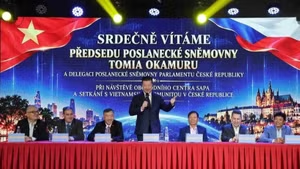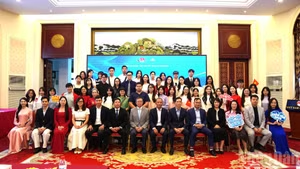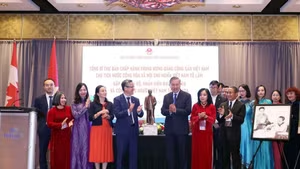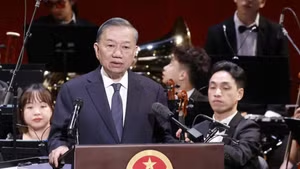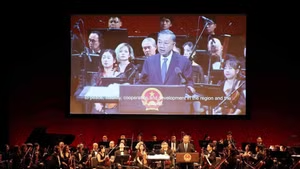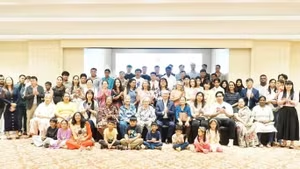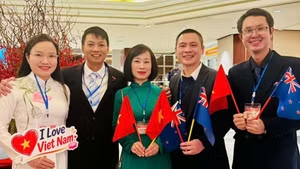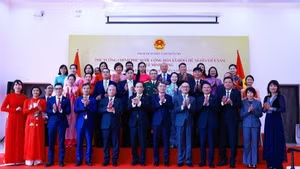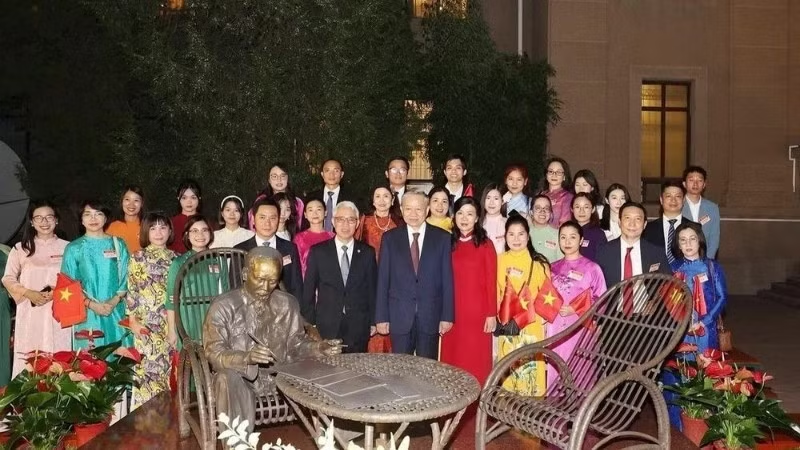
In recent days, the Vietnamese community in Beijing and neighbouring localities has been filled with a sense of excitement and anticipation, as, after nearly two years, they once again have the opportunity to welcome the top leader of the Party and State on an official visit to China.
For them, the visit is not only an occasion for leaders of the two sides to set out major directions for bilateral ties, but also an opportunity for overseas Vietnamese to share their thoughts on work and life, express their expectations and confidence in the sound policies of the Party and State, and look forward to the continued positive momentum and a new level of development in Viet Nam–China relations.
Nguyen Van Ky, doctoral candidate at Yanshan University — Deeply moved to welcome the Party chief twice
Nguyen Van Ky, a lecturer at the University of Economics–Technology for Industries, currently pursuing a PhD at Yanshan University, expressed his profound emotion, pride, and honour at having twice joined representatives of Vietnamese students and expatriates in directly welcoming To Lam during his visits to China in his capacity as the country’s top leader.
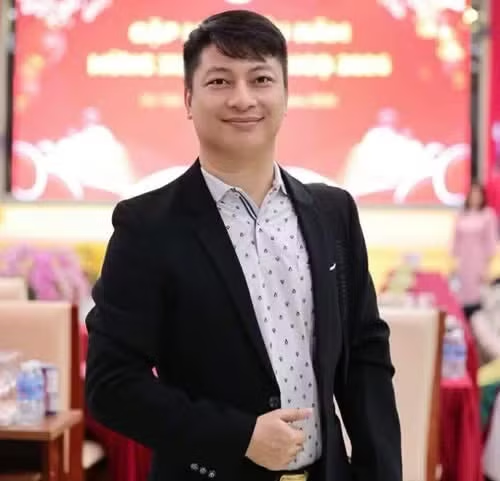
This has allowed him to gain a vivid sense of the times and the stature of Viet Nam–China relations at what he described to be their most dynamic stage of development. “Witnessing the respectful reception from the host country and the warm, thoughtful gestures of the Party General Secretary and State President towards the community of intellectuals and students, I feel as though I have been given renewed enthusiasm and a strong motivation to contribute,” he said.
As Vice Chairman of the Vietnamese Students’ Association in Beijing, and from the perspective of an educator and researcher, Ky believes this is a “golden opportunity” for the two countries to realise their strategic orientations. He proposed further strengthening student and faculty exchange programmes; building more substantive youth connectivity channels that go beyond cultural exchanges to include start-up idea competitions and large-scale academic forums; promoting mutual recognition of qualifications; and expanding joint and dual-degree training programmes.
In the field of science, technology and innovation, he noted that China has made significant advances in applying core technologies and expressed hope that the two countries would soon establish joint key laboratories focusing on artificial intelligence (AI), semiconductor technology, and green energy.
Confident that the visit has opened a promising new chapter of cooperation, Ky affirmed that Vietnamese intellectuals in China would continue striving to serve as strong bridges of knowledge and as “small cultural ambassadors”, contributing to elevating Viet Nam–China friendship to new heights for the prosperity of both nations.
Nguyen Thanh Hang, owner of a Vietnamese restaurant chain in Beijing: The visit instils renewed trust and motivation and motivation for Vietnamese community
Having lived and worked in Beijing for 15 years and now operating a chain of Vietnamese restaurants in China, Nguyen Thanh Hang expressed her honour at being selected as one of the community representatives to welcome Party General Secretary and State President To Lam and the high-level Vietnamese delegation.
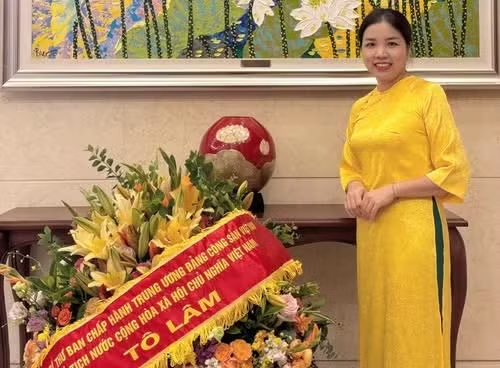
Sharing her impressions of the visit, Hang noted that it comes at a time when bilateral relations are at their best in history, demonstrating strong political determination to maintain dialogue, enhance strategic trust, and open substantive cooperation across multiple fields, including economy, trade, culture, education, and people-to-people exchanges. For the Vietnamese community in China in particular, the visit serves as a “fresh breeze” instilling renewed confidence and motivation to stabilise their lives, comply with local laws, and remain connected to their homeland.
The visit is also expected to promote economic and trade cooperation, creating favourable conditions for businesses — including Vietnamese restaurant chains — to access ingredients, expand markets, enhance cultural exchanges, promote Vietnamese cuisine and national image, and establish a more supportive legal framework for overseas Vietnamese.
As a Vietnamese entrepreneur building a career in China’s culinary sector, Hang recommended that the Party and State continue to strengthen policies for overseas Vietnamese, including in China. She suggested opening more Vietnamese-language classes for expatriate children in major cities such as Beijing, Shanghai, and Guangzhou; providing textbooks, storybooks, and video lectures on Vietnamese language, culture, and history; and organising annual “Journey to the Homeland” summer camps to help younger generations visit historical sites and scenic landmarks, thereby nurturing their love for the country.
Regarding her business, Hang said she currently operates two restaurants — one at the Great Wall area and another in Beijing’s High-Tech Zone — and hopes for greater support in promoting Vietnamese cuisine brands abroad. She proposed including outstanding restaurants in official lists of venues showcasing Vietnamese culinary culture during events such as “Viet Nam Days Abroad” and “Vietnamese Cuisine Week”, as well as facilitating mechanisms for overseas Vietnamese businesses to import signature ingredients such as Phu Quoc fish sauce, ST25 rice, and Buon Ma Thuot coffee.
“With my restaurant chain at the Great Wall and in Beijing’s High-Tech Zone, I am committed to turning each venue into a ‘mini Viet Nam’, serving as a bridge to promote the country, its people, and its culture to Chinese friends and the wider world,” she said.
Hoang Dinh Thiet, Secretary of the Party Cell of Vietnamese Students in Beijing: Worthy successors to Viet Nam–China friendship
In an interview with Nhan Dan Newspaper, Hoang Dinh Thiet, a Vietnamese student at Beijing Language and Culture University and Secretary of the Party Cell of Vietnamese Students in Beijing, emphasised that the traditional friendship between Viet Nam and China is a longstanding international relationship founded by President Ho Chi Minh and Chairman Mao Zedong and nurtured by generations of leaders and people of both countries.
Built on shared revolutionary ideals and a spirit of international solidarity, the two nations have stood side by side through struggles for national independence and in national construction and development. The sentiment of being “both comrades and brothers” is not merely a slogan but a symbol of the deep bond between the two parties and states.
Thiet affirmed that in the current context, Viet Nam–China relations continue to be consolidated and developed across various fields. Notably, the state visit to Viet Nam by General Secretary and President of China Xi Jinping in 2025, along with this state visit to China by Party General Secretary and State President To Lam, demonstrates both sides’ determination to preserve and promote their traditional friendship amid a rapidly changing international environment.
He stressed that for the younger generation — especially Vietnamese youths studying and living abroad — proper awareness of Viet Nam–China relations is crucial in shaping revolutionary ideals and political resilience. Young people should understand the historical value of the bilateral friendship, thereby enhancing their sense of responsibility in preserving the image of Viet Nam and its people, promoting people-to-people exchanges, and contributing to shared development. Ideological education, he noted, must go beyond awareness and be reflected in concrete actions, such as diligent study, self-improvement, and active participation in community activities.
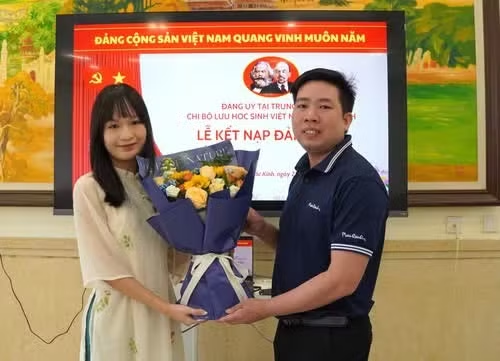
As secretary of a Party cell with a large membership, and with Party development among students as a key task, Thiet said that identifying, nurturing, and admitting outstanding individuals into the Party not only strengthens Party organisation but also creates a pool of high-quality personnel for the country’s future. In an international environment, this work requires flexibility, creativity, and adaptation to practical conditions while still ensuring adherence to the Party’s principles and standards. Thanks to its strong emphasis on Party development, the Vietnamese Students’ Party Cell in Beijing has, in recent years, identified and admitted many outstanding individuals into the Party ranks.