The 2021–2025 period marked persistent and determined efforts by the entire political system in the mission to bring fallen soldiers back to their homeland and to identify their remains.
Determined from direction to action
Over the past five years, the search and recovery of soldiers’ remains has consistently received close attention and guidance from the Government, relevant ministries, and the 515 Steering Committees at all levels. Across the country, 23 permanent teams are tasked with recovery missions both domestically and in Laos and Cambodia. Local authorities have proactively reviewed and supplemented soldiers’ records; they have also strengthened communication and mobilised the public, particularly veterans and historical witnesses, to provide information on where soldiers fell and were buried.
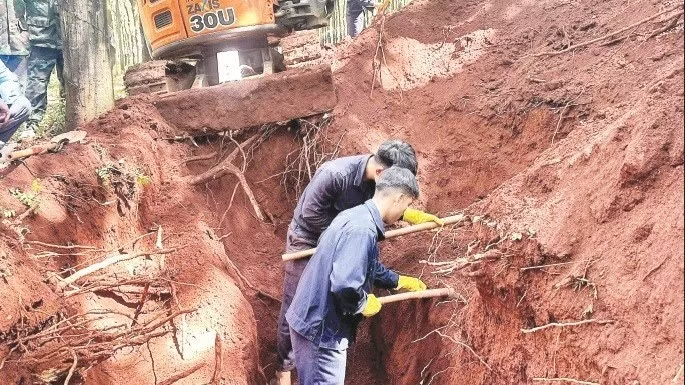
As a result of these efforts, authorities have recovered nearly 7,000 sets of soldiers’ remains both within Viet Nam and in neighbouring Laos and Cambodia. Behind these figures lie thousands of journeys across forests and streams, digging in lands that were once fierce battlefields; they also reflect the silent sacrifices of officers and soldiers who work tirelessly on the ground, facing harsh weather, difficult terrain, and unexploded ordnance left from the war. In Military Region 4, over five years, the armed forces recovered 1,380 sets of remains (840 in Laos and 540 domestically), most of which have yet to be identified. Funeral and reburial ceremonies have been conducted with solemnity and care.
Currently, nearly 176,000 sets of soldiers’ remains nationwide have yet to be recovered, and approximately 300,000 graves lack sufficient information.
The identification of remains lacking information has been intensified using various methods. Tens of thousands of remains samples and DNA samples from relatives of fallen soldiers have been collected, stored, and analysed.
According to Vu Ngoc Thuy, Deputy Director of the Department for Martyrs and Wounded Soldiers under the Ministry of Home Affairs, over the past five years, using empirical methods, localities and agencies have identified 2,560 sets of soldiers’ remains; more than 13,000 remains samples were received, of which over 9,300 met the conditions for analysis. Through DNA analysis of 1,094 samples, authorities identified 103 sets of soldiers’ remains, notified their families, and updated information on tombstones. The verification results are stored at a central facility for long-term support in identifying soldiers’ remains.
According to the Operations Department (General Staff, Ministry of National Defence), as of June 30, 2025, the country had completed area assessments and prepared maps for the first-phase search and recovery in all provinces and cities, thereby identifying over 112,000 unrecovered soldiers and laying an important foundation for subsequent search phases.
At the same time, mine and explosive clearance to support recovery operations has been strengthened to ensure the safety of personnel and civilians, while also contributing to socio-economic development in former battlefields. Between 2021 and 2025, forces cleared more than 7,900 hectares in Military Regions 1 and 2. The Ministry of Defence has also approved mine clearance projects for 2025–2027 covering tens of thousands of hectares.
Major challenges in bringing soldiers home
Despite significant results, the search, recovery, and identification of soldiers’ remains continue to face numerous challenges. Nearly 176,000 sets of remains remain unrecovered, and around 300,000 graves still lack information.
According to Colonel Bui Yen Tinh, Deputy Director of the Operations Department, from 2026 onwards, area assessments will face considerable difficulties as most remaining records belong to the group with insufficient information. Many remains were buried long ago, have heavily decomposed, or have been relocated multiple times, compromising the quality of biological samples for DNA verification. Approximately 17,000 remains samples have been collected but cannot yet be analysed due to procedural, resource, and technical constraints. In Nghe An Province alone, nearly 7,000 soldiers have no living relatives eligible for DNA sample collection to cross-check information.
Many remains buried long ago have heavily decomposed or been relocated multiple times, affecting the quality of biological samples for DNA analysis. Currently, around 17,000 remains samples have been collected but remain unanalyzed due to procedural, resource, and technical limitations. In Nghe An Province alone, nearly 7,000 soldiers have no living relatives eligible for DNA sample collection to cross-check information.
Colonel Bui Yen Tinh,
Deputy Director of the Operations Department
Identification based on empirical methods also faces difficulties due to a lack of information about where soldiers fell and were initially buried, incomplete records and burial diagrams, and limited decoding of wartime unit symbols and designations. From this practical experience, specialised agencies have identified the need to continue innovating approaches; accelerate comprehensive digitisation of soldiers’ records; integrate and clean cross-sector data; enhance the application of science and technology and expand international cooperation; and improve mechanisms, policies, and resources for this special mission.
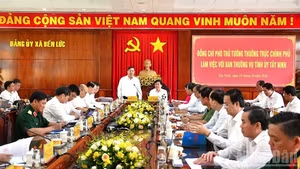
At the summary conference reviewing the search, recovery, and identification of soldiers’ remains lacking information for 2021–2025, Deputy Prime Minister Pham Thi Thanh Tra emphasised: “The search, recovery, and identification of soldiers’ remains is not only a sacred political duty but also a command from the heart, reflecting the moral principle of ‘Never forget your roots’ and fulfilling the wishes of the people and relatives of fallen soldiers.”
The Deputy Prime Minister called on ministries and sectors to strengthen coordination, swiftly agree on solutions to remove difficulties and obstacles, and accelerate the search, recovery, and identification of soldiers’ remains lacking information by 2030 and beyond; with a focus on completing a unified policy system, clearly defining key regions and areas, promoting the responsibility of state management agencies and relevant organisations, and boosting emulation movements to collectively fulfil the mission effectively.