Arguments denying the role of Marxism-Leninism and Ho Chi Minh Thought appear from many angles. For example, some argue that the demands of the modern era, posing new challenges such as digital transformation, climate change, and international competition, have gone beyond the scope of these ideologies, thus claiming that Marxism-Leninism and Ho Chi Minh Thought “cannot solve the problems of the new era”.
The distortion that shortcomings in management, corruption, and wrongdoings still exist, and are even increasing in the current period, is evidence that this doctrine reveals many inadequacies. In essence, these are still the same arguments often propagated by hostile and reactionary forces, aiming to deny the values of Marxism-Leninism and Ho Chi Minh Thought in the era of national progress.
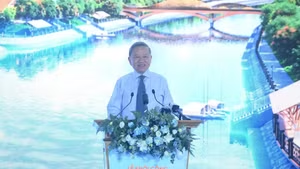
General Secretary To Lam affirmed: The era of national progress is an era of development, wealth, and prosperity, creating strong, decisive, and breakthrough movements to overcome challenges, realise aspirations, reach goals, achieve great accomplishments, and successfully build a socialist Viet Nam that is prosperous, strong, democratic, just, and civilised. This era demands new developments in theory, thinking, strategy, implementation methods, and tasks, especially political determination to achieve the goals.
However, this does not mean completely rejecting existing theories; rather, it is necessary to inherit, supplement, develop, and perfect the established and achieved theoretical thinking, including steadfastly applying and creatively developing Marxism-Leninism and Ho Chi Minh Thought, steadfastly pursuing the goal of national independence and socialism, steadfastly adhering to the reform line and the principles of Party building to build and protect the socialist Vietnamese Fatherland. This is the crucial theoretical foundation, the “immutable” principle, irreplaceable and unwavering, of this era of progress.
The assertion that Marxism-Leninism and Ho Chi Minh Thought are outdated in the new era – the era of national progress – and no longer suitable for the digital economy, AI, and globalisation, and therefore unable to solve contemporary problems and challenges, is a grave error.
On the one hand, the more developed the era becomes, the more challenges and problems arise, the greater the need for a correct and scientific ideology, a theoretical foundation, and a guiding principle.
On the other hand, neither Marxism-Leninism nor Ho Chi Minh Thought are closed doctrines, nor are they rigid formulas. In their own works, Karl Marx and Friedrich Engels repeatedly emphasised that theory only has value when it is constantly tested and developed in accordance with practice.
Viet Nam has consistently supplemented, applied, and creatively developed these principles, most clearly demonstrated in its theories on the reform process, socialism and the path to socialism, the socialist-oriented market economy, and the approach to the knowledge economy... This proves that this ideological foundation continues to be valuable and capable of guiding and directing development in the new context – the era of national progress.
The ideas and theories of Marxism-Leninism and Ho Chi Minh Thought continue to illuminate, guide, and direct practice in the era of national progress.
The development of the knowledge economy and the Fourth Industrial Revolution is not a denial but a vibrant addition to the laws of development pointed out by Marxism.
Marxism considers the forces of production as the decisive factor in the movement of society. In today’s era, the explosion of digital technology and human knowledge represents a remarkable development of the forces of production. These changes continue to demonstrate the validity of Marxist laws regarding the relationship between the forces of production and the relations of production.
When the forces of production reach a new level, the relations of production must be adjusted accordingly to liberate the forces of production. It is precisely by adhering to this law that Viet Nam has made decisions on opening up, integrating, and developing a socialist-oriented market economy, ensuring harmony between development and social justice – a matter that is increasingly urgent in the new era.
To achieve breakthrough development in this era of progress, Viet Nam must confront and resolve major challenges, including the risk of dependence and conflicts of economic interest. Simultaneously, the country must continue to address global issues such as climate change, environmental pollution, resource depletion, and unsustainable development.
These challenges cannot be solved with outdated thinking, nor can they be solved solely based on economic profit. Marxism-Leninism, with its critique of capitalism and its goal of liberating humanity from alienation, has pointed out the dangers of a development model based on resource depletion and labour exploitation.
Karl Marx once wrote that the development of society must respect the harmonious relationship between humanity and nature. This is the spirit that modern concepts such as sustainable development and the green economy aim for. As the world strives towards sustainable development in line with the United Nations Goals, the values of Marxism-Leninism are becoming increasingly relevant, not outdated.
It is impossible to ignore the spread of democratic values, human rights, and equality in this new era. The distorted arguments that Marxism-Leninism is contrary to democracy often deliberately misinterpret the nature of socialist democracy. Marxism views democracy as a condition for the people to hold power, while Ho Chi Minh Thought affirms that “the people are the masters, the people exercise mastery.”
In an era where transparency, accountability, and social dialogue are increasingly important, his thought proves its practical value. More broadly, it can be seen that the arguments claiming that Marxism-Leninism and Ho Chi Minh Thought are outdated are essentially political sophistry aimed at denying the socialist path that Viet Nam has chosen.
In an era where Viet Nam is deeply integrating into the global community and striving for powerful development, steadfastly adhering to, applying, and creatively developing Marxism-Leninism and Ho Chi Minh Thought is not only an objective requirement but also a prerequisite for the Vietnamese nation to continue to rise and confidently stand shoulder to shoulder with the world’s leading powers, as envisioned by President Ho Chi Minh.