Priceless assets
As one of the northern mountainous provinces, Son La has consistently viewed new-style rural area development as more than upgrading infrastructure or fulfilling set criteria. It is pursuing a higher goal: turning local culture into a driver of development.
Through the “Son La joins hands to build new-style rural areas” campaign, the province has chosen a development path based on the distinctive strengths of its 12 ethnic groups, viewing cultural preservation not as maintaining static values, but as unlocking endogenous resources for sustainable growth.
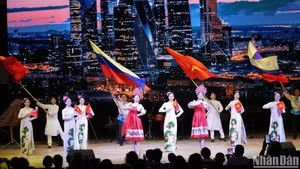
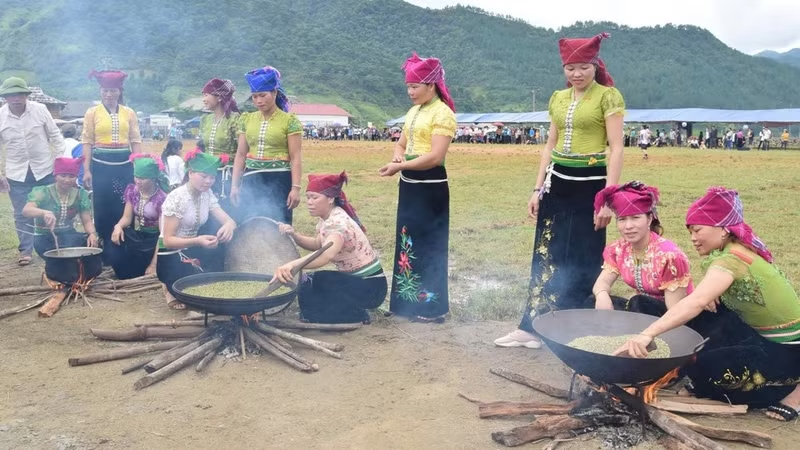
From restoring traditional festivals and reviving weaving and handicraft traditions, to organising classes to pass on folk songs and dances and preserving stilt houses, villages and cultural spaces, Son La has gradually turned local cultural values into “assets” that support community-based tourism and provide livelihoods for local people.
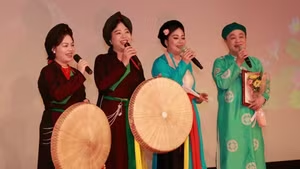
In Kha Village in Yen Chau Commune, two cultural performance teams regularly perform Khap Thai folk songs and traditional Xoe dances for tourists. These activities not only help pass cultural heritage from one generation to the next, but also enable local residents to become “cultural ambassadors” for their village.
Chairman of the Yen Chau Commune People's Committee Doan Van Ngoc said the locality had incorporated cultural preservation into its development resolutions, established traditional craft clubs, and linked new-style rural area development with tourism and OCOP products. This approach has helped preserve local identity while encouraging residents to proactively protect and develop their culture as an important source of employment, income and sustainable livelihoods.
In Ngoc Chien Commune, local culture and natural resources are regarded as the two pillars of community-based tourism development. Building on the cultural identities of the Thai, H'Mong and La Ha ethnic communities and the area's natural hot springs, the locality has mobilised more than 6 billion VND (230,000 USD) in socialised funding to preserve stilt houses, festivals, folk songs and traditional crafts, while investing in tourism infrastructure.
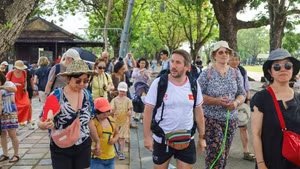
At the Viet Bac Homestay run by the family of Lo Van Hac, the homestay welcomes around 4,000 visitors each year and generates nearly 2 billion VND (76,700 USD) in revenue from accommodation, hot spring bathing and cultural experiences.
Philip, a tourist from France, said what he remembered most about Son La was its beautiful, unspoilt natural landscape, traditional houses that had been preserved, and the distinctive cuisine and way of life of its ethnic communities.
Promoting the role of local people
Building on the success of Kha Village in Yen Chau Commune and Ngoc Chien Commune, Son La is gradually expanding the model of new-style rural area development linked with the preservation and promotion of cultural values. With 64 communes recognised as meeting new-style rural area standards, 11 meeting advanced new-style rural area standards, 82 villages meeting the standards and 28 model villages, the challenge is not only to improve the quality of the criteria but also to preserve the identity of each community.
Alongside investment in transport infrastructure, electricity, clean water and connectivity between tourist attractions, the province is promoting the digitalisation of heritage, developing OCOP products, preserving traditional craft villages and strengthening the role of local people as the custodians of their culture.
The experience of Son La shows that while new-style rural area development in the past was measured mainly by the number of criteria met, in the 2026–2030 period it needs to be broadened to include the ability to preserve cultural identity. The goal of new-style rural development is not to create identical rural communities, but to develop them on the foundation of the distinctive values of each locality.
According to Ho Xuan Hung, former Deputy Minister of Agriculture and Environment, following the merger of administrative units and under the impact of urbanisation, a number of criteria in the National Set of Criteria for New-style Rural Areas have revealed aspects that are no longer appropriate, requiring them to be reviewed and improved to meet the demands of a new development period.
According to Nguyen Xuan Dai, Chief of the Central Coordination Office for the National Target Programme, if every locality builds the same type of village gate, uses the same design for its community cultural centre, and adopts the same approach to village roads and landscapes, rural areas may become more modern and orderly, but the distinctive identity of each region will gradually be eroded. Some cultural values, once lost, are extremely difficult to restore through investment projects alone.
The image of a rural community is not defined only by banyan trees, village wharves, communal courtyards or historic structures, but also by village and community structures, traditional crafts, customs, festivals, cuisine, indigenous knowledge, neighbourly bonds and the way communities interact with nature. These values give each rural area its distinctive character, nurture local pride and strengthen people's attachment to where they live.
The experience of new-style rural area development in Son La demonstrates that development and preservation can go hand in hand if culture is placed at the heart of the process.
Nguyen Minh Tuan, Secretary of the Party Committee of Ngoc Chien Commune, said the locality had determined that new-style rural development could only be sustainable when culture served as its foundation. Therefore, alongside its target of welcoming around 28,000 visitors and generating approximately 15 billion VND (575,000 USD) in tourism revenue by 2030, the commune will continue to preserve its cultural spaces, improve the quality of new-style rural area criteria and promote its cultural identity as a competitive advantage.
According to Pham Hong Thu, Deputy Director of the Son La Department of Culture, Sports and Tourism, developing tourism based on culture must go hand in hand with protecting cultural spaces, avoiding commercialisation or stage-based presentations that could erode traditional values. What is noteworthy about Son La is not simply the number of communes recognised as meeting new-style rural area standards, but its choice of a development path that does not sacrifice cultural identity for growth, instead treating culture as an endogenous resource and a foundation for sustainable development.