Informing, educating, and shaping public awareness
In the context of a rapidly developing market economy and national digital transformation, the press is not merely a channel for disseminating information but also a tool for education, oversight, and the fight against social misconduct. Increasingly, the press is affirming its role as the “extended arm” of the State in managing society through law.
By spreading knowledge, shaping perceptions, and raising citizens’ legal awareness, the press strengthens the legal foundation and helps build a transparent environment for sustainable development—particularly in emerging fields such as e-commerce, the creative economy, and digital media.
Commenting on the press’s role in tackling e-commerce violations, Dr Dinh Van Trung of the Ho Chi Minh National Academy of Politics noted that the press has been instrumental in detecting and reporting breaches in Key Opinion Consumer/Key Opinion Leader (KOC/KOL) activities—marketing campaigns using influencers to promote products or services.
Press and media reports have enabled the public to discern the boundary between inspiration and commercial promotion, cautioning content creators about standards and legality in the online environment. T
In practice, numerous high-profile cases have demonstrated the press’s sensitivity and guiding role in issuing warnings, providing social critique, and generating public pressure.
Recent incidents revealed how the press was the first to investigate and expose “miraculous” advertising gimmicks that blurred the line between “functional foods” and “medicinal cures”. Media coverage helped the public grasp the true nature of commercial fraud, while prompting authorities to take action.
A recent case involving a well-known KOC prosecuted for “violating accounting regulations, causing serious consequences” received swift, multifaceted coverage. This underscored the press’s contribution to re-examining professional ethics and social responsibility among KOLs/KOCs, while reminding consumers that “media influence is not beyond the reach of the law”.
Press and media reports have enabled the public to discern the boundary between inspiration and commercial promotion, cautioning content creators about standards and legality in the online environment. These incidents exemplify the press’s “social reflex” in investigating, warning, and guiding public opinion—not merely as information, but as action to protect justice and community trust.
Building a “mental vaccine” for the digital age
")
Despite its crucial role, experts warn that some media outlets still engage in “disguised PR”, “paid articles”, or “brand polishing” for violating KOLs/KOCs, undermining objectivity and credibility.
A lack of legal and digital expertise leaves many journalists and editors ill-equipped to detect e-commerce fraud at an early stage. The cross-border spread of information via TikTok, YouTube, and Facebook further complicates verification and removal of false content.
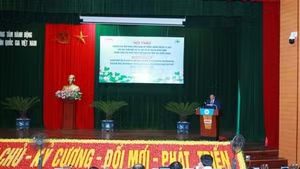
To enhance the press’s effectiveness, Dr Dinh Van Trung recommends strengthening professional skills and media ethics, with intensified training in law, the digital economy, and digital media for journalists and editors.
He emphasised the need to establish a Code of Professional Ethics and Integrity in E-Commerce Media Activities, grounded in the values of “Integrity – Responsibility – Transparency”.
To enhance the press’s effectiveness, it is necessary to strengthen professional skills and media ethics, with intensified training in law, the digital economy, and digital media for journalists and editors.
Dr Dinh Van Trung
Additionally, centres, institutes, and associations should be leveraged as strategic partners of the press; collaborative verification of products, enterprises, and KOLs should be established; annual “Transparent Enterprises – KOLs” lists should be developed; and technical support provided for monitoring, traceability, and anti-counterfeit labelling.
Dr Trung also proposed linking regulatory agencies and press bodies to create an Early Warning Coordination Centre for E-Commerce, enabling media, associations, and ministries to share data and alerts on violations. A mechanism involving the press, the State, and society should be formed to establish an effective control triangle.
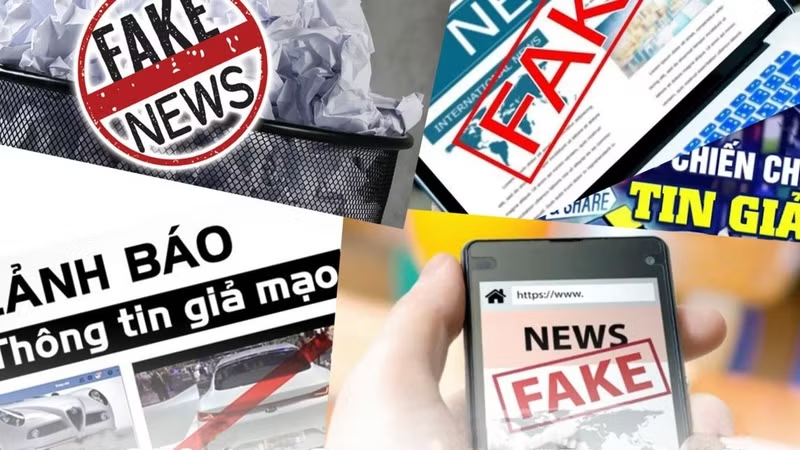
Experts argue that in the digital economy, the press does not merely report but also creates knowledge and trust. Each article, feature, or responsible media segment acts as a “mental vaccine” against deceit and manipulation in e-commerce.
Therefore, outreach on digital economy law should be diversified across television and online newspapers, while talkshows, podcasts, and legal livestreams should be organised to allow experts, journalists, and KOLs/KOCs to engage directly with the public. Multimedia investigative reports on e-commerce, advertising, and media ethics should also be encouraged.