During the past tenure, the Executive Board of the Ninh Binh Provincial Party Committee has demonstrated solidarity; upheld a sense of responsibility, proactiveness, and creativity; closely followed practical realities; and focused its leadership and direction in a drastic, focalised, and effective manner. It has mobilised the strength of the entire political system, the business community and the people, seriously implementing the Resolution of the 13th National Party Congress and the Resolution of the Congress of the Provincial Party Committee for 2020–2025 tenure, and achieving many results across various fields.
Building a pure, strong, comprehensive Party and political system
Party building in terms of politics, ideology and morality has always been the top priority of the Ninh Binh Provincial Party Committee and has been conducted in a synchronous, comprehensive and regular manner throughout the tenure. The dissemination, study, and communication of resolutions, directives, and conclusions of the central authorities and the province have been carried out with many innovations and creativity, thereby contributing to raising awareness among cadres, Party members, and the people, creating consensus in both thought and action within the entire Party Committee.
The protection of the Party’s ideological foundation and the fight against wrongful and hostile viewpoints have been strengthened. The study and following of President Ho Chi Minh’s thought, morality and style have been implemented effectively. Political theory education, revolutionary tradition education, morality and lifestyle education have been given due attention. As a result, degradation in political ideology, morality, and lifestyle has been prevented and repelled; the Party and the political system have been increasingly purified and strengthened.
Party building in terms of organisation and personnel has been implemented vigorously and comprehensively, particularly the arrangement and streamlining of the political system apparatus in accordance with Resolution No. 18-NQ/TW of the Party Central Committee and the conclusions of the Political Bureau and the Secretariat with high political determination.
The organisational system, Party and state agencies, the Viet Nam Fatherland Front, socio-political organisations and mass associations have been reorganised synchronously, compactly, and effectively. At the same time, the province has implemented the merger of the provinces and commune-level administrative units without organising district-level administrative units; streamlined the apparatus; and promptly settled regimes and policies for officials, public servants, and employees who retired or resigned before the prescribed age, ensuring compliance with the requirements, schedule, and regulations. Building grassroots Party organisations, the admission and screening of Party members have been strengthened, with many highlights in developing Party membership among dignitaries, religious followers, and private enterprises.
During the 2020–2025 tenure, the entire Ninh Binh Provincial Party Committee admitted 22,643 new Party members. Training and fostering of cadres at all levels have been given attention, gradually meeting the requirements and tasks in the new period.
Inspection and supervision work have been enhanced, with renewed contents and methods, creating clear results in tightening discipline, improving leadership capacity and promoting integrity in public service. Internal affairs, anti-corruption, waste combat, prevention of negativity, judicial reform, citizen reception, and settlement of complaints and denunciations have achieved significant results. Mass mobilisation work has been renewed in accordance with the legitimate needs and interests of the people. National defence and security have been firmly maintained, while political security and social order and safety have been ensured.
Economic picture with bright spots
With renewed leadership, management and administration methods, the provincial authorities have operated effectively, and the economic, cultural and social picture of Ninh Binh during the tenure has continued to develop with many bright spots. The province has basically completed the targets and indicators of socio-economic development for the 2020–2025 period, raising the provincial economic scale after the merger to 352.164 billion VND. The estimated budget revenue in 2025 is 75.219 billion VND, with the average growth rate of gross regional domestic product (GRDP) during the 2020–2025 period estimated at 9.26% per year; per capita GRDP by the end of 2025 is estimated at 89.45 million VND.
New growth driving forces have been created and initially promoted, especially in the development of high-tech industry, cultural industry, tourism, digital economy, green economy, and heritage economy. Economic restructuring has seen comprehensive transformation, focusing on shifting industrial and intra-sectoral structures towards industrialisation, modernisation, digital, and green transformation.
The province has basically achieved a balance between budget revenue and expenditure; effectively used public investment capital under the motto “public investment guiding private investment”. The road transport infrastructure system has been modernised, opening new development corridors and increasing the scale of social investment mobilisation, with total social investment capital estimated at 654.440 billion VND.
At the same time, industrialisation and modernisation have been vigorously promoted, with several key industrial products such as automobile engineering, electronics, textiles and garments, processing, and supporting industries. Tourism, cultural industry, and entertainment industry have gradually affirmed their role as spearhead economic sectors.
The province has always paid attention to social development and investment in people based on effective implementation of social security policies, educational reform, training, and healthcare improvement.
As a result, the social structure has shifted in harmony with the economic structure; the multidimensional poverty rate has declined rapidly. Social welfare policies, social security, and the assurance of citizens’ access to essential social services have been particularly emphasised.
Building Ninh Binh into a centrally-run city
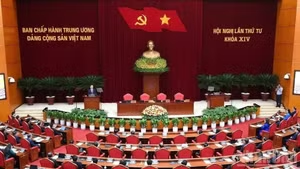
The 1st Congress of the Ninh Binh Provincial Party Committee holds important political significance, marking a milestone for the province’s new development phase.
The congress identifies the general direction and targets for the 2025–2030 tenure: to promote potential, advantages, resources and driving forces, to accelerate breakthroughs under a new growth model; to strive to make Ninh Binh a centrally-run city by 2030 with a modern industrial sector, high-quality tourism services, and green urban areas associated with heritage, ranking among the leading localities nationwide in terms of growth rate and per capita income.
The congress also sets the goal of setting the province’s position and role as a national and international tourism centre; a centre for high-quality human resource training; a centre for healthcare and medical services; and an inter-regional and national centre for high-tech industry with key pillars of automobile engineering, information technology, electronics industry, processing, manufacturing, energy industry, and green materials; to harmonise the preservation of cultural heritage and environmental protection with economic growth, green and digital transformation; to build strong local defence potential and a firm defensive area, ensuring security, order, and social safety; and to build a pure, strong, and comprehensive Party and political system, a developed economy, a prosperous society, happy people, and a preserved and promoted local cultural identity.
To achieve the set targets, the Ninh Binh Provincial Party Committee will focus on effectively implementing seven key tasks, three breakthroughs and four major groups of solutions.
These include continuing to strengthen the pure and strong Party building, rectification, and political system; innovate leadership, management, administration, and local governance methods; promote digital transformation, administrative reform and improve local competitiveness in association with operating a two-level local government; build a streamlined, professional, and effective administrative apparatus; build a contingent of cadres and Party members, especially leaders and managers at all levels and in all sectors, with morality and talent commensurate with their tasks; combat corruption, wastefulness, and negativity; and build and implement mechanisms and policies to serve development, promptly removing bottlenecks and obstacles, ensuring synchrony and harmony across sectors, and meeting the requirements of rapid and sustainable development in the coming period.
The province will also effectively carry out planning and planning management as a basis for promoting investment attraction and socio-economic development; develop key industrial sectors and products, as well as diversified, distinctive and high-quality tourism and service products; exploit local potential and advantages, especially the strategic location south of the capital Ha Noi and the Red River Delta; mobilise and focus resources on developing an inter-provincial synchronised, intelligent and strategic infrastructure system; build advanced, model, and smart new-style rural areas, contributing to improving the living standards and quality of life in rural communities.
Along with economic development, Ninh Binh Province will continue to focus on cultural and social development; preserve and promote the values of historical relics; protect the ecological environment in association with the promotion of cultural, heritage, and natural resources to serve the strategy of sustainable growth; accelerate administrative reform, enhance the responsibility of cadres and public servants in performing their duties, tighten administrative discipline, promote the application of information technology, and build e-government; focus on strengthening national defence and security; ensure political security, social order, and safety; and synchronously and effectively implement foreign affairs activities and international cooperation.