Appreciate more peaceful life today
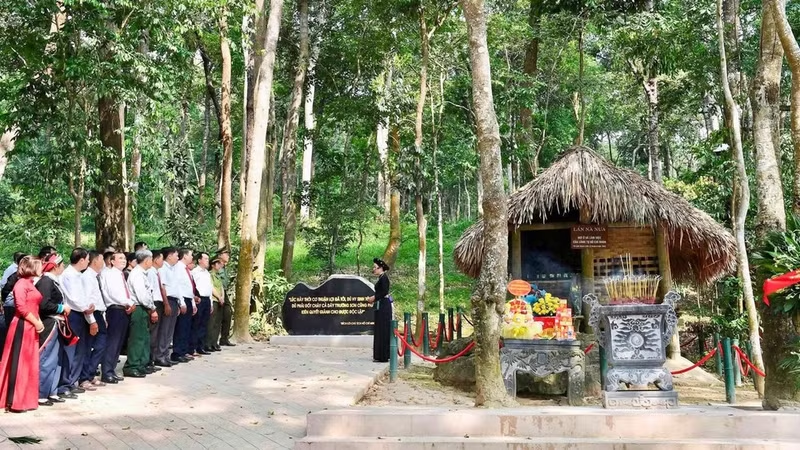
In the last days of August, Tan Trao Special National Relic Area (Tuyen Quang Province) welcomed many groups of visitors from localities to visit and learn about history. This is the area closely associated with the activities of President Ho Chi Minh, the Party Central Committee, the Government, the National Assembly, and the Front, along with ministries, central departments, and branches, during the preparation period of the August 1945 General Uprising and the resistance war against the French colonialists.
In the flow of people returning to their origins, many families bring their children along so that historical lessons are connected with real-life experiences. Visiting the Na Nua shack, where President Ho Chi Minh once lived and worked to prepare and lead the General Uprising, visitors will be introduced to his life, activities, and important decisions in historic days.
From here, the delegations continued to visit Tan Trao Communal House, where the Tan Trao National Congress took place in August 1945; and visit Tan Trao banyan tree, where the Liberation Army unit commanded by comrade Vo Nguyen Giap held a ceremony to depart for Ha Noi on the afternoon of August 16, 1945.
Dang Ngoc Ha from residential group No. 18, Phu Ly Ward, Ninh Binh Province, said that previously, his children only knew these places through textbooks and social networks.
Now, after seeing Na Nua shack and Tan Trao Communal House in person and hearing stories about those historic days, they have gained a clearer understanding of what they had learned, felt the sacrifices of previous generations, and highly appreciated today’s peaceful life.
Do Huyen Anh, a student of class 3C1, Le Van Tam Primary School, Tuyen Quang Province, shared that she was deeply impressed when he was introduced to the days when Uncle Ho lived and worked at the Na Nua shack. Last June, she went to Tan Trao to make a video introducing the book "Uncle Ho in Tan Trao" for the province's 2026 Reading Cultural Ambassador contest and won a high prize.
"Standing in Tan Trao, I felt very moved and proud. This was where Uncle Ho lived and worked in a small and simple shack to lead our country's revolution and win independence for the country," Huyen Anh shared.
Right in the inner city of Ha Noi, many red addresses that mark the revolutionary movement associated with the active life of President Ho Chi Minh and revolutionary leaders have now become attractive destinations for sightseeing, tourism and traditional education. Among them is the 5D House Relic on Ham Long Street (Cua Nam Ward), where Viet Nam’s first communist party cell was established in March 1929.
The site has received special attention from Ha Noi authorities in terms of preserving and promoting its historical value. In early 2026, the Ha Noi Management Board for Monuments and Landscapes carried out conservation and restoration work, in combination with efforts to search for and supplement documents. Visitors to the site today can see the space where revolutionary leaders once held meetings, preserved almost exactly as it was, and explore documents about the first members of the communist party cell.
The glorious past vividly brought to life
These days, one of the most popular historical sites is House No. 48 on Hang Ngang Street in Hoan Kiem Ward. This was the house where Uncle Ho lived and worked after the success of the August Revolution and where he wrote the Declaration of Independence. The room where he stayed and the desk where he and other leaders held meetings on national affairs in preparation for September 2, 1945, are carefully preserved.
Since 2025, to better serve the public, the site has incorporated digital technologies, including hologram and 3D Mapping technologies, to recreate images of President Ho Chi Minh and present the historic moment when he read the Declaration of Independence at Ba Dinh Square. All artefacts associated with President Ho Chi Minh at the site have also been given QR codes, allowing visitors to look up information and learn more about the objects and the historical stories behind them.
“On major national anniversaries and holidays, House No. 48 on Hang Ngang Street always welcomes large numbers of tourists who come to visit and study President Ho Chi Minh’s ideology and the history of the Party. Therefore, our staff always make every effort to serve the public. Alongside carefully preserving the artefacts, we also always seek additional documents and objects so that people can learn more about Uncle Ho’s revolutionary activities,” said Nguyen Doan Van, Director of the Ha Noi Management Board for Monuments and Landscapes.
“My family and I came to visit the Old Quarter and the site associated with Uncle Ho in the heart of the Old Quarter. I found that the artefacts are very well preserved and presented in a vivid way, helping us learn more about Uncle Ho’s life and career as well as the significance of the Declaration of Independence, and feel even prouder of our nation’s revolutionary traditions,” said Nguyen Hong Vinh from Phu Tho Province while visiting House No. 48 on Hang Ngang Street.
During this year’s National Day holiday on September 2, alongside traditional tourism programmes, many travel companies in Ho Chi Minh City have proactively renewed their tourism products with themed tours, offering more cultural and historical experiences while combining high-quality services with diverse ways of exploring destinations.
Among them, tour packages — such as “Saigon Commandos”; “I love Ho Chi Minh City” connecting central Ho Chi Minh City with surrounding areas such as Can Gio, Cu Chi, and Binh Duong; and “Legends of Heroes (Rung Sac Special Forces – The Steel Land)” — have been chosen by many visitors.
Several city exploration tours also offer visitors a range of interesting experiences. One such tour explores the Cu Chi Tunnels Historical Site at night through the "Moonlight in the War Zone" programme, taking visitors back to the past, where stories of courage, love for the Fatherland, and the desire for freedom are told through the living breath of history itself.
Le Van Hung, from Xuan Hoa Ward, said that he was deeply impressed by the programme as he witnessed the beauty of Cu Chi after nightfall, together with vivid reenactments of heroic stories.
Many other revolutionary historical sites across Ho Chi Minh City are also being utilised in association with traditional education and trips to places of historical significance. The sites are connected to the local landscapes and culture, creating additional experiences for visitors, particularly pupils and young people, thereby fostering a sense of pride and love for their homeland and country among the younger generation.

![[Video] Viet Nam among Top three Asian destinations for return visitors](https://en-cdn.nhandan.vn/images/nyM650OGFWrOVWc-xajqN-rTZ68Rlmc1fiGJOhBRYHErj-E25MBpvJqrpphXazfrpe9t-fYCGuQU4CN0yXo3Rg/du-lich-vietnam.jpg.avif)