Linking up to drive sustainable tourism growth
Entering the 2026–2030 period, Viet Nam’s tourism sector is undergoing a strong transformation in line with the spirit of the Government’s Resolution No. 82/NQ-CP and the Tourism system development plan for 2021–2030, with a vision to 2045. At the heart of this transformation is a shift from extensive growth to in-depth development, placing the green economy and cultural experiences at the centre of strategic direction.
Ha Van Sieu, Deputy Director General of the Viet Nam National Authority of Tourism, observed: “Today’s travellers no longer travel solely for sightseeing or leisure, but also to experience, to explore culture, to live alongside local communities, and to seek out green, authentic and distinctive values.”
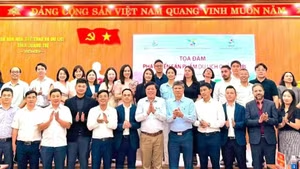
A notable example is the recently launched tourism cooperation programme between the expanded Northwest provinces and Ho Chi Minh City for the 2026–2030 period, which reflects the proactive and determined efforts of localities to realise regional connectivity goals. This is expected to create fresh momentum for the sustainable development of Viet Nam’s tourism industry.
Under the programme, the expanded Northwest provinces — including Son La, Dien Bien, Tuyen Quang, Phu Tho, Lai Chau, Lao Cai, Lang Son and Thai Nguyen — together with Ho Chi Minh City have agreed to cooperate in tourism state management, tourism product development and regional tourism linkages. The programme also includes digital transformation and the application of science and technology in tourism development, tourism promotion and investment attraction, as well as tourism human resource development.
The collaboration aims to increase two-way tourist flows between the expanded Northwest provinces and Ho Chi Minh City. In addition to promoting sustainable growth in the tourism sector, the parties will coordinate to formulate synchronised tourism development plans across localities, helping each area maximise its comparative advantages and utilise resources more effectively.

Through this partnership, destinations are expected to diversify tourism offerings, creating integrated inter-regional tourism products, programmes and routes while conducting joint promotion campaigns in domestic and international markets. At the same time, efforts will be made to develop a friendly and safe tourism chain built around each locality’s signature tourism products. The cooperation is also expected to attract social investment resources and support businesses in finding partners for investment, development and operation of tourism products.
Forming a shared tourism development space
The recently signed tourism cooperation agreement is not merely a continuation of earlier cooperation, but rather a transition into a new phase with higher requirements, more systematic implementation and more substantive goals.
According to Ha Van Sieu, Deputy Director General of the Viet Nam National Authority of Tourism, localities need to approach connectivity with a new mindset by creating a shared tourism development space featuring common products, a common brand, shared markets, shared data and unified coordination mechanisms.
On that basis, the Viet Nam National Authority of Tourism is encouraging localities to move decisively from event-based cooperation to tourism value chain linkages, with a focus on developing several competitive and commercially viable inter-regional tourism products associated with the common brand of the expanded Northwest region.
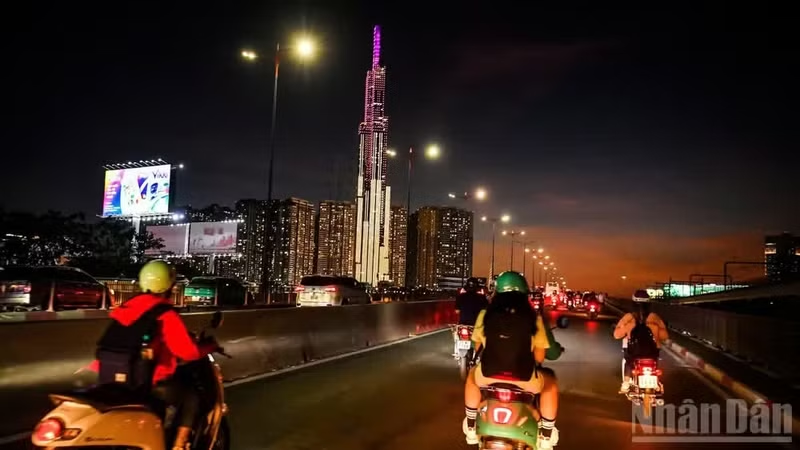
Particular emphasis should be placed on maximising the role of Ho Chi Minh City as a market gateway, serving as the country’s leading hub for visitor distribution, travel businesses, communications, investment and international connectivity.
“The combination of the market capabilities of Ho Chi Minh City and the distinctive resources of the eight expanded Northwest provinces will create a comprehensive tourism product ecosystem that not only enhances economic value but also honours and spreads pride in the diverse beauty of Viet Nam during this new stage of development,” Ha Van Sieu expressed optimistically.
The cooperation process should prioritise digital transformation, using it as a tool to improve tourism management and promotional effectiveness. At the same time, there should be stronger efforts to improve the quality of tourism human resources and destination services, while enhancing public-private partnerships with businesses placed at the centre.
During the 2021–2025 period, tourism cooperation between Ho Chi Minh City and the eight expanded Northwest provinces achieved many positive results.
In 2025 alone, the total number of visitors to localities participating in the cooperation programme reached approximately 90 million, including around 37 million visitors to the expanded Northwest region.

![[Video] Viet Nam among Top three Asian destinations for return visitors](https://en-cdn.nhandan.vn/images/nyM650OGFWrOVWc-xajqN-rTZ68Rlmc1fiGJOhBRYHErj-E25MBpvJqrpphXazfrpe9t-fYCGuQU4CN0yXo3Rg/du-lich-vietnam.jpg.avif)