
Despite creating many changes in management, administration and the provision of public services, digital transformation continues to be hindered by bottlenecks involving unsynchronised infrastructure, disconnected data, and procedures that have not yet been restructured. Identifying and removing these bottlenecks is a core requirement of the 100-day campaign, towards a seamless and convenient digital administration that uses service effectiveness as its measure.
Identifying the bottlenecks
After more than one year and eight months of implementing Resolution No. 57-NQ/TW, national digital transformation has made progress in institutions, infrastructure, and digital platforms. At the same time, the implementation process has also revealed bottlenecks that need to be addressed, ranging from data, infrastructure, and resources to shared platforms and implementation.
At the National Conference reviewing one year and six months of the implementation of Resolution No. 57-NQ/TW, Party General Secretary and State President To Lam requested the implementation of a 100-day action plan to address digital transformation bottlenecks, create strong changes, and make digital transformation substantive.
To concretise this requirement, Plan No. 05-KH/BCDTW identifies 50 key tasks for the 100-day peak campaign. The requirement is not only to complete the tasks on schedule but also to produce deliverables that can be put into operation, have users, and produce verifiable results.
On July 29, Prime Minister Le Minh Hung signed Decision No. 88/QD-BCDCP promulgating the Government Steering Committee's action plan. The peak campaign is being implemented over 100 working days, focusing on urgent and delayed tasks and creating changes in governance, administration, and services for people and businesses.
It can be affirmed that this is a series of resolute, continuous and systematic directives, with specific steps and plans. The most important content of Plan No. 05 is the requirement that each task must produce a deliverable that can be put into operation, has data and users, and produces verifiable results.
A given data platform, or digital transformation in general, can only be accepted and recognised when it has a large number of users; an online public service is meaningful only when people submit their applications through it and receive results quickly and accurately. The 100-day campaign to remove digital transformation bottlenecks and unblock the flow of data is an important step towards renewing governance methods, reducing paperwork, shortening procedures, and improving the quality of services for people and businesses.
According to the Central Steering Committee for the Development of Science, Technology, Innovation and Digital Transformation, of the 92 key tasks under Plan No. 05, many have so far achieved noteworthy results, creating clearer momentum in implementation. Eight of the 12 national databases have completed data connection and synchronisation with the National Database Centre.
Regarding specialised databases, 67 databases have been connected and synchronised, 23 of which fully meet data quality criteria and can be synchronised in the coming period. A review of feedback from ministries, sectors, and localities found that 498 of the 786 administrative procedures had been cut or replaced, while 244 of the 786 administrative procedures had been abolished.
However, the implementation process continues to reveal numerous inter-sectoral bottlenecks that have not been fully resolved. Digital infrastructure remains uneven, with areas still experiencing signal gaps, power shortages, and a lack of end-user devices. Digital data remains siloed and does not yet ensure that it is “correct, complete, clean, live, unified, and shared.”
Online public services are not yet truly convenient, and procedures have not been thoroughly restructured, meaning people are still required to declare and resubmit documents and data that are already available. In the digital economy, open data, data services, and data connectivity have not been effectively harnessed for management, production, and business.
Gaps in access remain in the digital society, particularly for vulnerable people and those in disadvantaged areas, while essential services such as healthcare and education are not yet fully interconnected.
Among the issues identified as bottlenecks, particularly noteworthy is the fact that data remains fragmented, and unsynchronised; connectivity and data sharing between systems remain limited; and standards, data dictionaries, and responsibilities for updating data remain unclear. This is also why some public services are not yet truly convenient, with people still having to declare or provide information that State agencies already possess.
These bottlenecks are present at every stage of implementation at the grassroots level. In Hoai Duc Commune (Ha Noi), although digital infrastructure has been invested in, it is not yet truly synchronised; connectivity and data sharing between some databases and specialised software remain incomplete and do not yet meet the requirements for using data to handle administrative procedures under the principle of “declare once, use many times.” Meanwhile, human resources for digital transformation at the commune level remain insufficient for the requirements of the tasks.
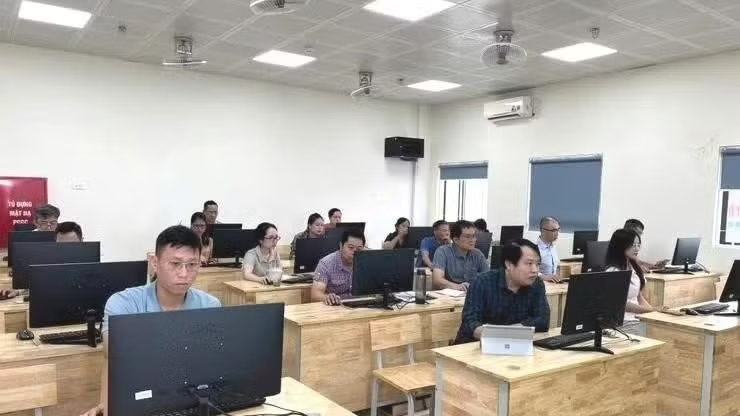
At a recent supervision session by the Science, Technology and Environment Committee of the Ha Noi People's Council, a number of departments, sectors, and localities also raised difficulties and obstacles in digital transformation, such as some specialised systems and software not being interconnected, requiring officials to log into multiple platforms and re-enter information.
Information systems for handling administrative procedures between the central and local levels remain fragmented and not yet fully synchronised. Guidelines on expenditure items, spending norms, service procurement, data creation and cleansing, maintenance of digital products, artificial intelligence applications, and the operation of Community Digital Transformation Teams remain insufficiently specific.
Based on the situation at the grassroots level, localities proposed that Ha Noi departments and sectors continue to pay attention to and support communes in upgrading and completing shared software, ensuring stable data connectivity and sharing; organise in-depth training in data governance, information security, and artificial intelligence; support localities in implementing and expanding effective digital transformation models; and supplement information technology and digital transformation personnel at the commune level.
It can be affirmed that resources for science, technology, innovation, and digital transformation have never before received the level of attention or been allocated on such a large scale as they are today. Therefore, the requirement now is to make a strong shift from awareness to action and tangible results.
Vice Chairwoman of the Ha Noi People's Council Pham Thi Thanh Mai
According to Vice Chairwoman of the Ha Noi People's Council Pham Thi Thanh Mai, institutional bottlenecks are gradually being removed. Alongside laws passed by the National Assembly, the city has established a system of People's Council resolutions, mechanisms for implementing the Capital Law, and numerous new and breakthrough measures in the spirit of Resolution No. 57-NQ/TW, creating substantive changes in this field.
“It can be affirmed that resources for science, technology, innovation and digital transformation have received never before the level of attention or been allocated on such a large scale as they are today. Therefore, the requirement now is to make a strong shift from awareness to action and tangible results,” Pham Thi Thanh Mai stressed.
Bottlenecks at the grassroots level and in disadvantaged areas
Grassroots realities show that digital transformation is not only a challenge for major cities such as Ha Noi. In many localities, although tasks have been reviewed and clearly assigned to specific people, practical implementation still reveals bottlenecks in infrastructure, data and digital human resources, directly affecting the progress and effectiveness of implementation.
For example, in Da Nang, Director of the City Department of Science and Technology Nguyen Thanh Hong said that the city had achieved initial results in developing and exploiting data and digital platforms.
The city currently has 94 databases identified for sharing and common use among state agencies, while more than 1,000 datasets have been transferred to the shared data warehouse. It has also provided, exploited, and used centralised and unified open data on the city's data portal, with more than 2,500 datasets, nearly 9,000 data tables and thousands of API services (software that allows different applications to communicate and exchange data with each other), effectively serving the monitoring and administration of city leaders.
However, the completion, standardisation, and interconnection of digital systems and databases to support the cutting and simplification of administrative procedures based on data under Resolution No. 66.7/2025/NQ-CP and to support the development of the data economy have only produced initial results and need to be pursued in a substantive, widespread, and effective manner.
Bottlenecks in infrastructure, data, and digital human resources are not only found at the local level but are also clearly present in many provinces, particularly in mountainous, remote, and isolated areas.
In Tuyen Quang, Permanent Deputy Secretary of the Provincial Party Committee Le Thi Kim Dung pointed out that digital infrastructure remains incomplete, with 57 villages, hamlets, and residential clusters across the province still lacking mobile coverage. Many specialised databases are not yet synchronised, while interconnection with national platforms remains limited, reducing the effectiveness of data exploitation and use.
Notably, digital transformation human resources remain a major bottleneck. The province currently has 326 people with information technology qualifications, but only 199 have been assigned specialised duties, while personnel at the commune level are mainly working on a concurrent basis and do not meet the increasingly high requirements for data management, operation, and security.
These limitations show that, for digital transformation to go deeper, alongside improving institutions and shared platforms, localities need to simultaneously remove “bottlenecks” in infrastructure, data, and the personnel directly responsible for operation, particularly in areas that continue to face difficulties. This is also a requirement in the process of reorganising and improving the effectiveness of grassroots government operations in the digital environment.

Reality in Lao Cai shows that as foundational conditions have gradually improved, digital transformation has created clear changes in individual sectors and fields. The health sector has completed the implementation of electronic medical records at 100% of medical examination and treatment establishments, while more than 1 million medical visits have used chip-based citizen ID cards or the VNeID application.
In education, digital school records have been implemented at 100% of general education establishments, all upper-secondary graduation diplomas issued in 2025 have been digitised, and artificial intelligence has been introduced into teaching at 34 schools. However, these initial results do not mean that the bottlenecks have been completely removed.
According to Tran Ngoc Luan, Director of the Lao Cai Provincial Department of Science and Technology, a number of difficulties remain, including unsynchronised digital infrastructure in remote and isolated areas; 22 villages and hamlets still being without fixed broadband internet and two villages without mobile coverage; incomplete land databases; a shortage of specialised digital transformation personnel; and delays in some assigned tasks.
Against this backdrop, Vice Chairman of the Lao Cai Provincial People's Committee Giang Quoc Hung asked the Department of Science and Technology to focus on accelerating the implementation of shared digital platforms; advise on the effective implementation of eight major tasks in science and technology, innovation, and digital transformation; complete the draft resolution on policies to promote innovation and digital transformation; urgently review and propose plans for investing in information technology equipment for communes and wards; strengthen cybersecurity and data security; and advise on plans to invest in AI camera systems to serve management and administration.
The Lao Cai Department of Science and Technology focuses on accelerating the implementation of shared digital platforms; advising on the effective implementation of eight major tasks in science and technology, innovation, and digital transformation; and completing the draft resolution on policies to promote innovation and digital transformation.
Vice Chairman of the Lao Cai Provincial People's Committee Giang Quoc Hung
It can be seen that digital transformation bottlenecks are not only a matter of lacking technology but also of the ability to connect infrastructure, share data, and allocate sufficient resources with the capacity to operate the systems. Therefore, removing bottlenecks in the coming period needs to be approached in a synchronised manner, prioritising the weakest “links”, particularly at the grassroots level and in remote and isolated areas.
When public services are “not fully end-to-end”
Resolution No. 57-NQ/TW identifies people and businesses as the centre, subjects, resources, and driving forces of digital transformation, while setting a target of more than 80% of public services being used online by 2030.
This shows that the measure of digital transformation in public administration is not only the number of procedures brought online, but, more importantly, whether people and businesses can carry out procedures in a convenient, end-to-end, and personalised manner on a platform where data is seamlessly connected and shared.
However, there remains a considerable gap between the target and the actual experience. The level of readiness among ministries, sectors, and localities, and even among different groups of procedures, remains uneven.

A representative of the National Digital Transformation Authority under the Ministry of Science and Technology said that practical reviews showed that a number of bottlenecks still needed to be addressed.
Some procedures, although already made public and configured on the system, are not yet truly operated end-to-end; connectivity between the National Public Service Portal, administrative procedure settlement systems, databases, and specialised systems is at times not seamless. Cases of delays in synchronising application status, payments, and digital signatures, or requiring people and businesses to provide again information that state agencies already possess, still occur.
In Vinh Phuoc Commune, Ca Mau Province, the obstacles have been identified quite specifically: digital infrastructure, equipment, and human resources do not yet meet requirements.
The locality has proposed synchronised investment in infrastructure at the Public Administration Service Centre, while also strengthening training for officials, particularly in cleaning civil status and land data and using digital signatures. These are also areas that Ca Mau is focusing on under its 100-day action plan, with 59 tasks in 10 fields, to be implemented from July 10 to November 30, 2026.
It is worth noting that a high proportion of online applications does not necessarily mean that people can easily carry out services themselves. Some applications still require officials to provide support, guidance, or re-enter information.
At Van Mieu-Quoc Tu Giam Ward (Ha Noi), Secretary of the Party Cell of Residential Cluster No. 8 Vu Van Long said that not everyone has the same level of skill in using digital applications. Some people can perform the operations themselves, while others need step-by-step guidance.
Therefore, support should be provided through a “hands-on” approach, enabling each person to carry out the necessary operations themselves in the digital environment. The approach should also be flexible according to each locality and target group. In addition to providing guidance at community cultural centres, support can be offered via Zalo, through home visits, or by organising mobile groups when people need assistance.
Digital transformation is opening the way to a modern administration where people can carry out a wide range of procedures from home with just a few operations on a smartphone. Yet behind the impressive figures on the proportion of online applications and internet coverage are still “blank spots” that receive less attention. These include older people, ethnic minorities, and people with disabilities struggling in front of smartphone screens or having to ask others to carry out procedures that are directly related to their own rights and interests.
At 62, Dang Van Truong of Duy Tien Ward, Ha Nam Province, is no stranger to smartphones. But when carrying out digital services such as logging into an electronic identification account, facial authentication, and checking social security information and health records, operations that seem simple can become barriers. “Although my children and grandchildren have guided me many times, I still struggle from the login stage. Remembering my account, password, and OTP code is difficult enough; when the application reports an error, asks me to update something, or changes its interface, I often give up because I am afraid of doing something wrong,” Truong said.
These obstacles show that the bottlenecks in digital transformation lie in technological infrastructure, people's ability to access and use digital services, and the level of interconnection and synchronisation among systems. Therefore, if people still encounter difficulties in using services or are required to perform multiple operations on platforms that are not seamlessly connected, the effectiveness of digital transformation will be difficult to achieve as expected.