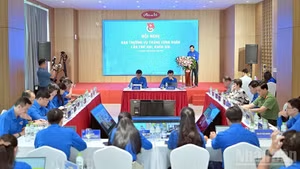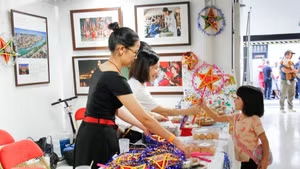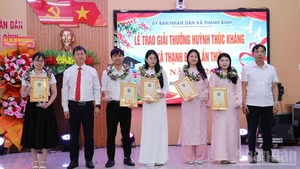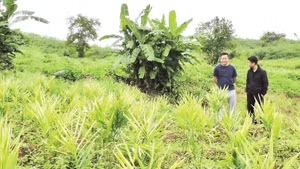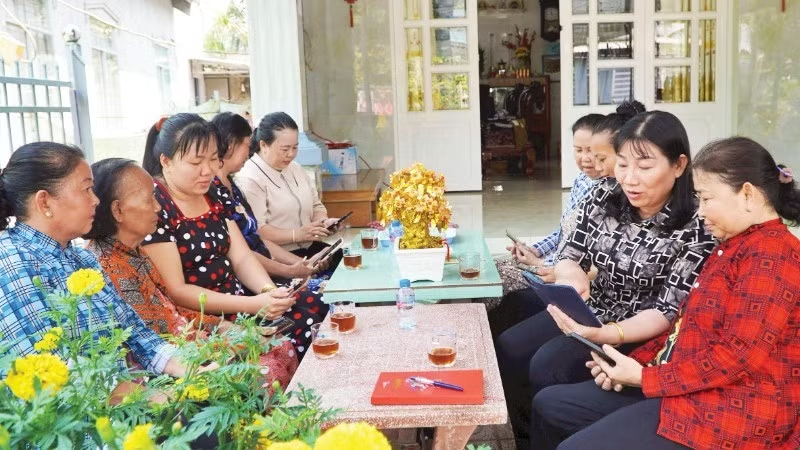
Through this campaign, the quality of family life has been improved, protection for women and children has been strengthened, and positive contributions has been made to new-style rural area construction and sustainable poverty reduction.
The 15-year journey of “5 Nos, 3 Cleans”
In Dong Thap Province, the “Building families with 5 Nos and 3 Cleans” campaign, associated with new-style rural area construction, is not just a movement but has been concretised through many practical models, projects, and tasks, gradually becoming an integral part of each family's lifestyle. These models not only bring tangible results but also inspire women’s responsibility and role in fulfilling new-style rural criteria.
Tan Thanh Commune has seven hamlets with more than 26,000 households. Most residents earn their living through farming, small trading, and hired labour, so many families still face economic difficulties. Through the “digital family” model introduced by the commune Women’s Union, many households have boldly applied science and technology to production and online sales, gradually increasing income and improving living standards.
Nguyen Thi Mai Trang, Chairwoman of the Tan Thanh Commune Women’s Union, said that the “Digital Family” model is linked with the new-style rural area construction movement, helping people access useful information and develop economy through online business and product innovation, while also raising awareness about online fraud and scams.
Since 2025, through models such as “Women’s Savings Groups”, “Supporting Women’s Start-ups”, and “Digital Family”, the Women’s Unions at all levels in the province has helped thousands of households escape poverty. The criterion of “no violations of law and social evils” has also been effectively maintained through close coordination with police forces in women-led crime prevention models at the local level.
Entering the next phase, the model “Building families with 5 Have and 3 Cleans” has been introduced in advanced new-style rural communes and model rural communes, adding criteria such as having safe housing, sustainable livelihoods, health, knowledge, and a cultured lifestyle. The movement continues to move towards sustainable development. So far, the proportion of households meeting all eight criteria in Dong Thap Province has remained stable at over 90%.
One of the outstanding examples in implementing the “Building Families with 5 Nos and 3 Cleans” campaign is Dang Thi Dao, Head of the Women’s Association of Hamlet 3, Xuan Hong Commune, Ninh Binh Province. She has consistently set an example, worked closely with grassroots communities and linked the women’s movements with the political tasks of the locality.
According to Dao, implementing the campaign at the grassroots level still faces difficulties as some women believe the criteria are only temporary, while uneven economic conditions make sustainability challenging.
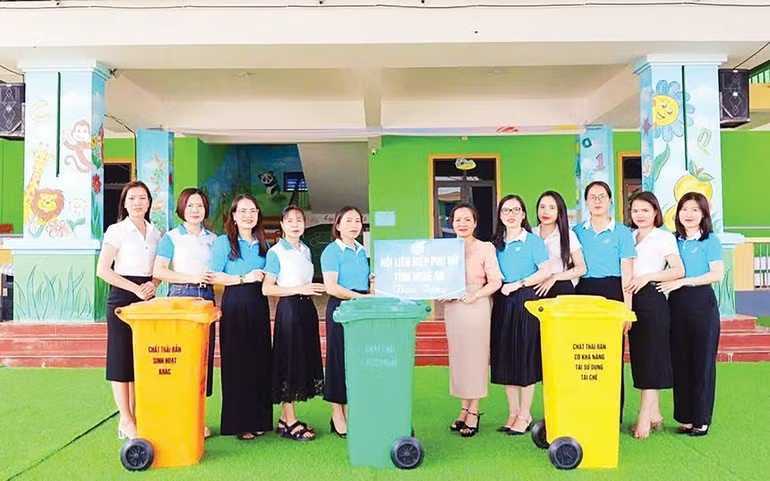
In response, she chose a persistent and creative approach: using the example set by Women’s Union officials to persuade others and spreading successful pilot models. For many years, she and the association have continuously promoted waste classification at source, created sustainable livelihoods, and disseminated models such as “Green Women’s Association”, “Happy Family”, and “5 Have, 3 Clean Association”. The association also regularly organises “Green Sunday” activities to clean village roads and lanes, contributing to environmental criteria in model new-style rural area construction.
Bringing “3 Safeties” deeper into the campaign
Looking back over 15 years, the impact of the “Building Families with 5 Nos and 3 Cleans” campaign is reflected in simple but meaningful models. These include tidy and warm “3 Clean Houses”, flower-lined rural roads across the countryside, initiatives such as “Green Women” and “Turning waste into money” that promote environmentally friendly lifestyles, and “Safe houses for women and children”, which provide support for vulnerable individuals.
During the 2010–2020 period, the campaign truly took root in daily life through practical initiatives, including flower roads cared for by women, “Shelters of compassion” built in flood-prone areas, more than 90,000 women-headed poor households escaping poverty, tens of thousands of self-managed roads, and the creation of “5 Nos, 3 Cleans” models. These efforts contributed to creating rural landscapes and reaffirming the role of women in building new-style rural areas.
In the 2021–2025 period, the campaign saw significant innovation to meet new challenges in the new situation. More than 18,000 projects and activities supporting new-style rural area construction were completed, over 10,000 environmental protection models adapting to climate change were launched, and millions of women received social welfare support and access to health insurance. The campaign gradually expanded beyond individual households to become a community-wide driving force, linking women’s responsibility with sustainable development goals.
However, current family life also presents new challenges such as domestic violence, abuse of women and children, risks in cyberspace, declining mental health, and unsafe living environments. These challenges require movements and campaigns to continue evolving in a more comprehensive, substantive, and sustainable direction.
Nguyen Thi Thu Hien, Vice President of the Viet Nam Women’s Union, said that upgrading the campaign to “Building Families with 5 Nos, 3 Cleans and 3 Safeties” with the three components “Safety – Peace of Mind – Social Security” is an inevitable requirement to ensure safe and stable living conditions and access to essential social services for every family. On December 29, 2025, the Prime Minister issued the national criteria for new-style rural areas for the 2026–2030 period, in which the criterion on “the proportion of households meeting the standards of 5 Nos, 3 Cleans and 3 Safeties” is assigned to the Viet Nam Women’s Union for implementation guidance.
According to Nguyen Thi Thu Hien, practical experience from support models shows that protecting and supporting women and children in communities needs to be renewed in a more proactive, timely, interconnected, and sustainable manner. Completing the criteria framework is only a necessary condition; the key lies in effective implementation so that the “3 safeties” criteria truly become part of family and community life through practical and feasible models and solutions at the grassroots level.
Meanwhile, Thai Ngoc Bao Tram, Vice President of the Viet Nam Fatherland Front Committee of Dong Thap Province and Chairwoman of the Provincial Women’s Union, said that to help the “Building families with 5 Nos, 3 Cleans and 3 Safeties” campaign to truly become a driving force for the new-style rural area construction programme in the 2026–2030 period, the focus must shift to deeper implementation so that these values are absorbed into every household and community. She emphasised that the “3 Safeties” criterion is particularly urgent, requiring inter-sectoral coordination and changes in awareness and action from every family member.
In recent years, Women’s Union organisations at all levels in Dong Thap Province have paid special attention to safety in cyberspace, guiding women how to recognise online scams, protect personal information and use social networks effectively. This helps families achieve both peace of mind and safety in the digital era.
“Successfully implementing the ‘3 Safeties’ will not only help meet new-style rural area criteria but also build a trustworthy living environment where every citizen feels being protected and cared for,” Thai Ngoc Bao Tram affirmed.