Preliminary figures show that thousands of homes were destroyed and tens of thousands of households were forced to evacuate. Numerous schools and health stations were damaged, while transport links in many localities were cut off. For many families, when the waters receded, all that remained were bare ground or crumbling walls. With no homes left, many people began a daunting journey of recovery, both materially and emotionally.
In response to urgent needs, Prime Minister Pham Minh Chinh launched the Quang Trung Campaign with the goal of rebuilding homes for affected residents in the shortest possible time. This is not merely an effort to mitigate losses but also a clear affirmation that the State stands alongside its people at their most vulnerable moments. A safe home is essential for psychological stability and for laying the groundwork for long-term recovery.
The campaign, named after an 18th-century hero, who led a rapid campaign against the invading Qing forces, stresses early, concrete and effective action, ensuring that no one is left behind.
Households whose homes were completely destroyed, as well as families with elderly members, children or people who are ill, are given top priority so they can quickly secure stable accommodation. Speed must go hand in hand with stringent quality requirements.
Painful lessons from past disasters show that in some places, rebuilt homes were unable to withstand subsequent storms and floods. As such, standards for foundations, load-bearing structures and material durability must be applied consistently, ensuring that reconstructed homes meet long-term safety requirements and provide people with lasting security.
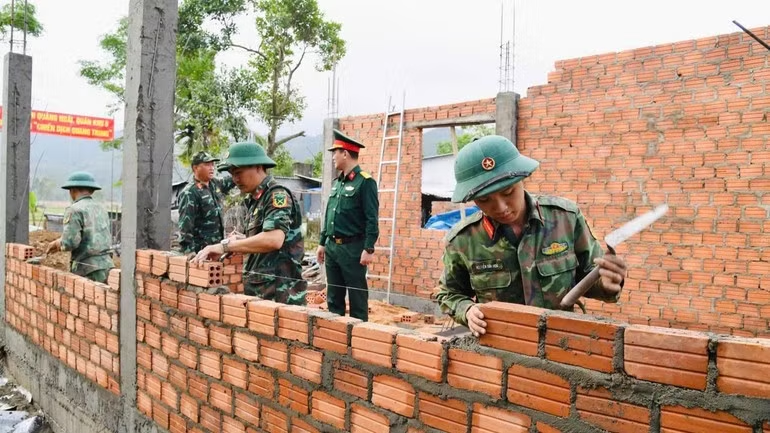
The campaign has seen close and effective coordination among multiple forces. The military and public security forces take on heavy and technical tasks, local authorities mobilise resources from businesses and social organisations and residents contribute within their means. This closely coordinated yet flexible model helps optimise resources while reinforcing solidarity in the aftermath of disaster. With the State organising, the armed forces serving as the backbone, and the community as the active participant, an effective support structure is formed.
The reality of this latest flooding also underscores the need for a profound shift in disaster prevention thinking. Climate change has altered established patterns, with landslides and flash floods occurring even in areas once considered safe.
This calls for updated risk maps, enhanced geological data and stronger monitoring systems to ensure that planning does not become reactive.
The role of hydropower reservoirs in flood regulation must be carefully reviewed, as rainfall exceeding forecasts can place heavy pressure on downstream areas. Inter-reservoir operating procedures need to be revised to better suit current climatic and hydrological conditions.
The Quang Trung Campaign represents a more comprehensive approach to disaster response. When home reconstruction is carried out in parallel with relief efforts and the restoration of daily life, people can stabilise their living conditions more quickly. The sustained presence of functional forces helps reinforce public confidence in the State’s capacity to protect and care for its citizens.
Community strength remains a precious resource. Many businesses provide machinery and materials; social organisations and volunteer groups deliver food and clothing or take part directly in building homes; youth union members and militia forces clear access roads to isolated residential areas and clean schools and health stations so they can resume operations as soon as possible. In the most difficult moments, human compassion becomes the strongest bond.
Nevertheless, rebuilding houses is only the first step. Many households have lost their means of livelihood, from farmland and livestock to fishing gear and boats. The recovery phase must therefore include livelihood support, vocational transition or the creation of new jobs. A new house only has full meaning when it shelters a stable life and restored self-reliance.
Alongside housing reconstruction, residential planning in high-risk areas must adopt a long-term vision. Climate change is rapidly shifting safety boundaries, demanding greater investment in early warning systems, geological data and adaptive infrastructure.
The homes gradually taking shape on land recently ravaged by disaster stand as a testament to the efforts of the people and society as a whole. Yet what is being built on an even greater scale is an unshakeable confidence in the Party, the State, the strength of the community and the national spirit. That confidence will help every Vietnamese become ever more resilient in the face of all challenges.