According to a report by the Ministry of Agriculture and Environment, seafood exports are estimated to have increased by 13.1% in 2025 compared to 2024, reaching 11.34 billion USD. These figures demonstrate strong growth in the fisheries sector but also place significant pressure on the environment in aquaculture areas.
According to the Fisheries and Aquaculture Inspection Department, environmental monitoring and warning in aquaculture not only involves recording technical indicators but also plays a crucial role as an “early defence system” for the entire farming area. Continuous monitoring of parameters such as dissolved oxygen, pH, temperature, salinity, and toxic gases like NH3 and NO2 helps in early detection of abnormal changes in the water environment, facilitating timely intervention.
When indicators exceed thresholds, farmers can quickly implement measures such as changing water, increasing aeration, and adding microbial preparations, thereby limiting the risk of disease outbreaks and other harmful factors. Maintaining a stable farming environment also means that livestock have increased resistance, thereby reducing losses and damage during production.
Not only is it important for risk prevention, but the environmental monitoring system is also a crucial technical support tool, helping to optimise the farming process. From the monitoring data, farmers have a basis to adjust feed quantities, feeding frequency, choose appropriate water change times, and proactively stabilise alkalinity and pH using lime or minerals.
When environmental factors are maintained within optimal limits, livestock will grow faster, develop uniformly, contributing to increased productivity and economic efficiency. Simultaneously, monitoring and inspecting the quality of incoming water sources helps limit the risk of toxins, pathogens, or external pollution entering the aquaculture ponds.
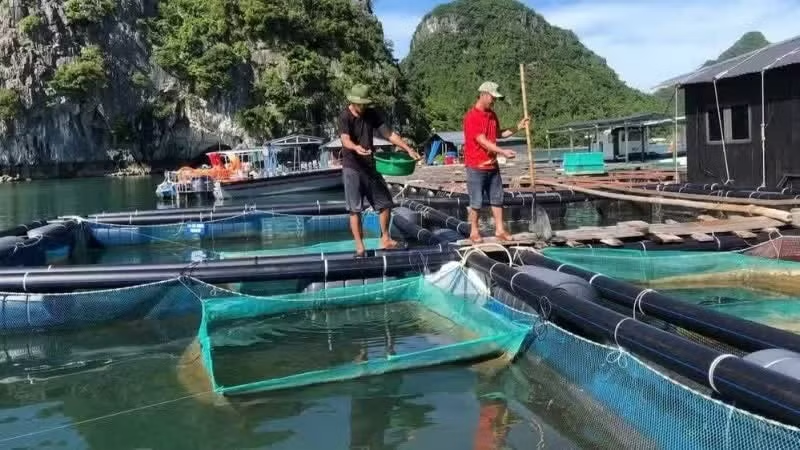
In fact, the monitoring network has been significantly expanded to 1,192 monitoring points for various aquaculture species, from brackish water shrimp, catfish, molluscs, and tilapia, and freshwater cage farming to lobster, marine farming, cold-water fish, and several other species.
Monitoring results from 2021-2024 showed that the percentage of parameters exceeding limits was relatively high at certain times, focusing on organic and bacterial pollution parameters. However, in 2025, the percentage of some parameters exceeding limits decreased (oxygen, pH, salinity). Mass mortality of farmed aquatic animals (clams, lobsters, cage-farmed fish) tended to decrease.
In Can Tho (including the former Ben Tre), the Binh Dai clam farming cooperative did not experience mass clam deaths, and the price of commercial clams remained high (70,000-80,000 VND/kg for size 50-60). This was due to adherence to procedures, improved awareness among farmers, and timely monitoring and recommendations that helped farmers better control the environment, resulting in more stable water quality. This demonstrates that monitoring water quality parameters contributes to identifying potential pathogens in the water, providing a basis for proactive disease surveillance in aquaculture and minimising losses.
However, complicated environmental developments still posed many risks. Currently, the aquaculture environment is deteriorating and showing an increasing trend, which is difficult to control due to climate change, water pollution from domestic, agricultural, and industrial wastewater, as well as aquaculture activities.
In addition, some legal regulations are not keeping pace with practical requirements; they are especially lacking specific standards and guidelines on preventing and controlling pollution sources and handling pollution incidents in aquaculture activities. Furthermore, monitoring equipment in many places is outdated, data is scattered and not updated in real time, and regular funding is limited and heavily dependent on projects.
According to Phung Duc Tien, Deputy Minister of Agriculture and Environment, sustainable, responsible, and environmentally friendly aquaculture development is the inevitable path. Strengthening waste control, technological innovation, promoting digital transformation, and mobilising the participation of the entire society will create a foundation for the formation of high-quality, high-value Vietnamese seafood products at reasonable costs, while simultaneously achieving economic efficiency and avoiding harm to the environment and natural ecosystems.
To overcome these limitations, according to Ngo The Anh, Head of the Aquaculture Department, Fisheries and Fisheries Inspection Agency, it is first necessary to continue improving the legal framework in a synchronised and practical manner. This includes reviewing and amending the Law on Environmental Protection, Decree No. 08/2022/ND-CP, and guiding documents for the implementation of the Fisheries Law, while simultaneously developing a plan for environmental monitoring in aquaculture for the 2026-2030 period, along with specific implementation guidelines.
Standards should be issued regarding sediment, prevention and control procedures for high-risk aquaculture activities, and response procedures in case of environmental incidents.
In addition, there needs to be a strong shift from passive response to proactive prevention. Regular monitoring of water sources in aquaculture areas must be maintained; pilot models for preventing, controlling, and warning of environmental incidents should be developed; and the database system needs to be upgraded towards a unified and interconnected system between environmental monitoring data and disease prevention and control data.
In the long term, the crucial breakthrough must still come from science, technology, and digital transformation to build an intelligent monitoring and risk warning system in aquaculture, gradually forming a modern, proactive environmental management system capable of responding more quickly to increasingly complicated changes.