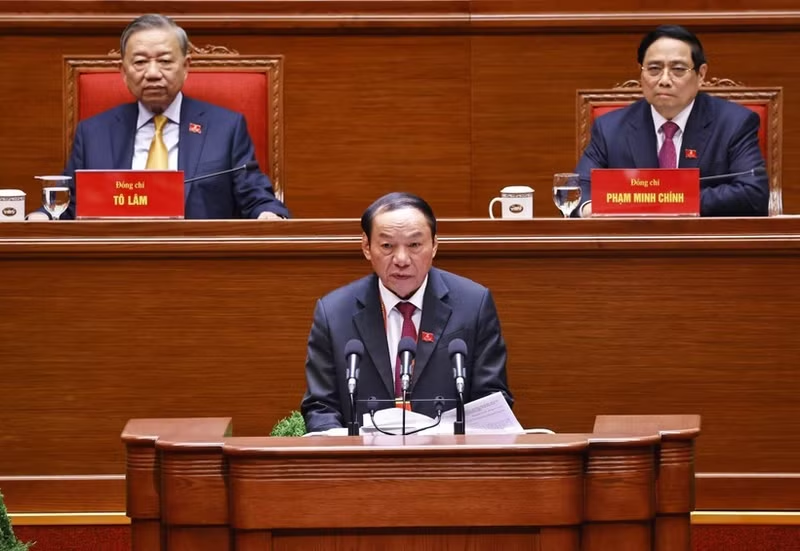
Whenever the country has faced danger, hardship or trials, it has been the spirit of great national unity, the tradition of patriotism, the will for independence and self-reliance, and the compassion and mutual support among the people that have combined to create an unparalleled strength, enabling the nation to move forward and write glorious chapters in its history.
Looking back through history, from the very early days of its establishment, amid the many urgent and critical tasks required to prepare for the general uprising to overthrow fascist, colonial and feudal regimes and to establish a democratic republic, the Party and beloved President Ho Chi Minh clearly identified the special position of culture. The 1943 Outline of Vietnamese Culture – the Party’s first cultural platform – defined culture as one of three fronts (political, economic and cultural), demonstrating the Party’s vision, strategic thinking and deep commitment to cultural development.
Beyond its close relationship with other areas of social life, the “new culture” set out in the Outline also reflected progressive theoretical values by placing people at the centre. The central role of people is reflected in the Party’s leadership over cultural and artistic work, and more importantly in the recognition that the people themselves are the subjects of culture – the creative force that creates, transmits, preserves and promotes cultural values.
Three years after the Outline was issued, at the First National Cultural Conference on November 24, 1946, President Ho Chi Minh further emphasised the guiding role of culture in national development, affirming that “Culture must guide the people towards Independence, Self-reliance and Self-determination” and that “Culture lights the way for the nation”.
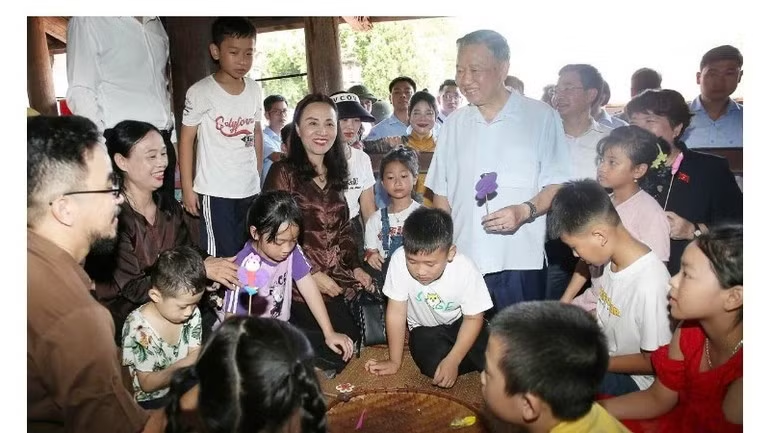
Since then, throughout successive Party Congresses and through resolutions, conclusions and directives issued by the Party Central Committee, the Politburo and the Secretariat, culture has consistently been affirmed as the spiritual foundation of society, serving both as a goal and a driving force for development.
Culture has nurtured the nation’s soul and identity, from the heroic melodies of resistance culture to the confident movements of sport in international integration; from aspirations to rise higher to the footsteps of tourism bringing the country to the world; and with the press becoming a conduit of knowledge, connecting trust between the Party and the People.
At the 13th National Party Congress, the Party reaffirmed that development tasks must be closely linked and synchronously implemented, with socio-economic development as the centre, Party building as the key, cultural development as the spiritual foundation, and national defence and security as regular and essential priorities. The Congress identified a core task: “To inspire aspirations for a prosperous and happy country; to promote cultural values and the strength of the Vietnamese people in national construction and defence, and international integration.”
Reviewing the recent period, particularly the implementation of the Resolution of the 13th National Party Congress, under the comprehensive leadership of the Party Central Committee, directly and regularly led by the Politburo and the Secretariat, headed by the General Secretary; with the close attention of the National Assembly; the decisive and creative direction of the Government and the Prime Minister; the collective efforts of cultural, information, sports and tourism professionals nationwide; and the consensus and support of all social strata as the creators of culture, culture has gradually permeated all areas and activities of life.
Notably, it has inspired pride in the nation’s heroic history and fine traditional cultural values among the younger generation, contributing positively to the country’s overall achievements. Through culture and from culture, the image of Viet Nam as “safe – friendly – gentle – hospitable – integrated – developing”, with a rich cultural identity, has become widely recognised by international friends, reflected in prestigious global awards such as World’s Leading Heritage Destination and Asia’s Leading Cultural Destination.
Looking back at 2025 – a year marked by many major political events and also the year celebrating the 80th anniversary of the cultural sector – General Secretary To Lam attended and delivered a keynote address at the commemorative ceremony. He affirmed: “Eighty years – an emotional journey marked by hardship, sacrifice and resilience, yet one of great glory – reflecting the aspirations of a nation that has always regarded culture as its spiritual foundation, its endogenous strength and the torch lighting the way to every victory.”
The successful conclusion of the 14th National Party Congress marks the country’s entry into a new era. The year 2026 is the first year in which the entire Party, people and armed forces implement the Resolution of the 14th Congress. It is also the first year of implementing Resolution No. 80-NQ/TW dated January 7, 2026 of the Politburo on the Development of Vietnamese Culture, along with the National Target Programme on Vietnamese Cultural Development for the 2025–2035 period and a comprehensive system of policies, strategies and projects approved by competent authorities.
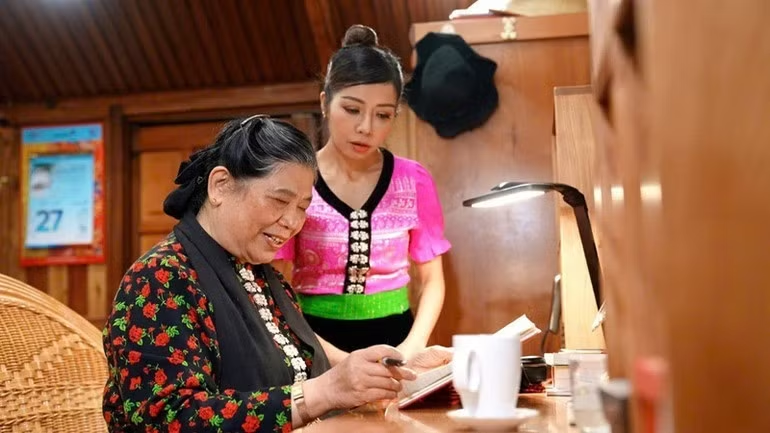
Culture must go ahead to light the way, permeate every policy decision, shape human dignity, social ethics and national character, and truly become a firm foundation and endogenous strength contributing to rapid and sustainable development, as well as the two 100-year goals set by the Party, the State and the People.
In a world forecast to continue experiencing rapid and complex changes, with intensifying major power competition – including competition over values and cultural influence – countries are striving to position themselves in a new global order, where “cultural standing” is increasingly important. This context demands strong determination, great effort and decisive action from those working in culture nationwide.
Fully aware of the responsibilities entrusted by the Party, the State and the Government, in the coming period the entire cultural, sports and tourism sector will continue to deepen research and enhance understanding of culture in line with the spirit of the 14th National Party Congress and Resolution No. 80-NQ/TW, particularly within state management agencies.
Culture must be developed on an equal footing with politics, economics and society. Cultural and human development must serve as the foundation, a vital endogenous resource, a major driving force, a pillar and a regulating mechanism for the country’s rapid and sustainable development. This requires “correct awareness for meaningful action”, and the effective implementation of the sector’s thematic message: “Culture is the foundation – Information is the conduit – Sport is strength – Tourism is the bridge of connection”.
At the same time, Party resolutions and conclusions on culture must be promptly institutionalised, with a coherent, feasible and practical legal framework aligned with the Politburo’s key resolutions, particularly in the context of digital culture, the digital economy and digital citizenship, as well as decentralisation and delegation of authority to localities.
Bottlenecks and legal gaps, especially in performing arts, literature and certain cultural industries, must be reviewed and addressed to create mechanisms that fully mobilise resources for sustainable development in culture, information, sports and tourism.
Priority must be given to effectively implementing the three strategic breakthroughs outlined in the Political Report of the 14th National Party Congress, focusing on institutions, infrastructure and human resources in culture, sports, information and tourism within the context of digital government, the digital environment, the digital economy and digital society.
Organisational structures should be streamlined for greater effectiveness and efficiency, with thorough decentralisation and delegation of authority. A contingent of capable, ethical and competent officials and professionals must be built to meet new demands, with particular emphasis on training young talent and nurturing successors in creative fields, digital creativity and traditional arts.
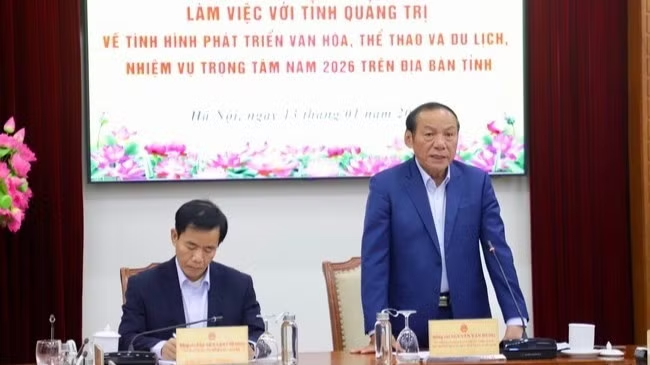
Scientific and technological development, innovation and digital transformation must be accelerated across the sector, including the effective construction and utilisation of national cultural data infrastructure and digital platforms, fully integrated with national databases.
Efforts must focus on realising the principle that “Culture is the foundation”, with continued emphasis on building healthy cultural environments as the root of an advanced culture imbued with national identity, unified in diversity.
Cultural values must permeate families, communities, institutions and businesses, fostering solidarity, confidence, self-reliance and national pride. National, cultural and family value systems, along with standards of human conduct, must be completed and implemented, while moral decline and social ills are prevented. Cultural access gaps between regions must be narrowed, with particular attention to remote areas, ethnic minorities, islands and border regions.
Greater emphasis must be placed on preserving and promoting cultural heritage so that “heritage becomes an asset – a special cultural commodity” delivering tangible socio-economic value. Nationwide digitisation of heritage, effective preservation and revitalisation of traditional festivals, and strong linkages between heritage and tourism should be advanced, alongside the preparation of UNESCO nomination dossiers.
Comprehensive strategies and breakthrough solutions are needed to accelerate the development of Viet Nam’s cultural industries, enhancing connectivity, increasing product value and transforming cultural values into national soft power. Legal frameworks on copyright and related rights, along with supportive policies on taxation, land and credit access, must be improved, while the application of science and digital technology in cultural industries is expanded.
Journalism, media and publishing must truly serve as the internal “conduit” regulating social stability and balance. External communication should be renewed to effectively promote the image of Viet Nam and its people internationally, improve the quality of publications, diversify book fairs and exhibitions, and foster a culture of reading and a learning society.
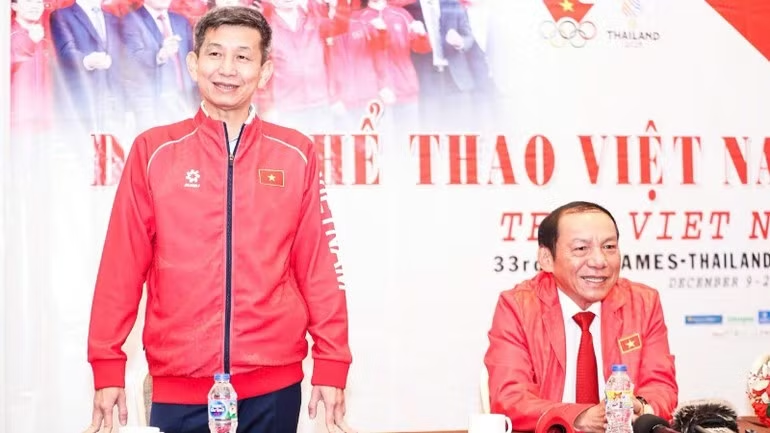
Physical education and sport must be elevated to a new level, in line with the principle that “A strong people make a strong nation”. At the same time, tourism should be developed as a “bridge of connection” – connecting cultures, people and heritage regions, and linking Viet Nam with friends around the world.
One term has concluded with profound achievements. A new term begins with a renewed journey, new springs approaching, carrying faith and aspiration. With a mindset of “long-term vision, broad perspective, deep thinking and bold action”, the culture, information, sports and tourism sector will continue to innovate and create, maintaining rhythm while generating new, more comprehensive, intellectual and humane rhythms.
Guided by the motto “Decisive action – Aspiration to contribute”, today’s achievements will remain a firm foundation for tomorrow and for generations to come, with the ultimate goal of building and developing Vietnamese culture and people as an endogenous strength, foundation and driving force for the country’s rapid and sustainable development in the new era – an era of prosperity, strength, democracy, equity, civilisation, happiness and national flourishing.