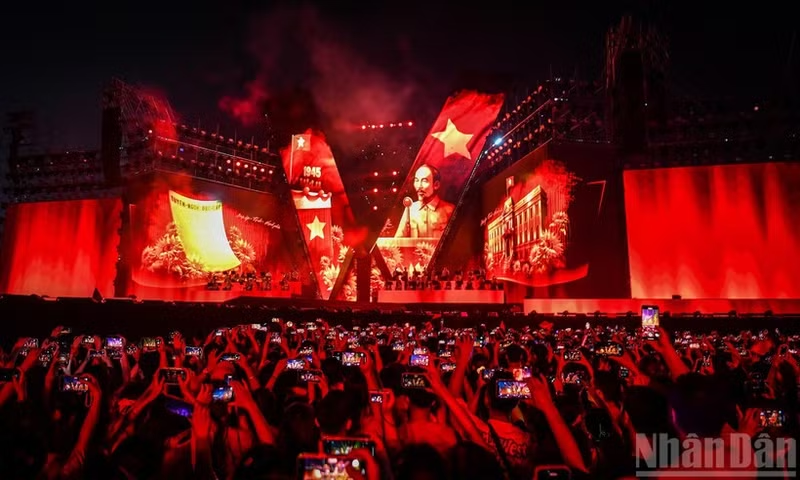
The resolution demonstrates the Party’s high political determination to truly make culture a foundation, a vital endogenous resource, a major driving force, a pillar, and a regulatory system for the country’s rapid and sustainable development.
Creating breakthroughs for cultural development
Resolution 80 sets out the guiding viewpoint that cultural and human development is the foundation, a vital endogenous resource, a major driving force, a pillar, and a regulatory system for the country’s rapid and sustainable development. Continuing to inherit Ho Chi Minh’s thought that culture lights the way for the nation, the resolution emphasises that cultural values must be closely and harmoniously integrated and deeply embedded throughout all aspects of social life, from politics, economics, society, and the environment to national defence, security, and external relations, truly becoming the nation’s soft power in the new era. The resolution regards culture not only as a spiritual foundation but also as standing on a par with politics, economics, and society, and being associated with building cultural security, human security, and digital cultural sovereignty.
The resolution stresses that culture is the cause of the entire people under the leadership of the Party and the management of the State, with the people as the creative subjects and beneficiaries, alongside the important role of intellectuals, artists, writers, cultural workers, and entrepreneurs, while also highlighting the pioneering and exemplary role of cadres and Party members. Investment in culture is investment in the country’s sustainable development and in the future of the nation; the State plays a leading role, closely combining state resources with socialised resources. It calls for a balanced and effective awareness and handling of the internal relationships of culture.
In terms of objectives, Resolution 80 sets out a system of specific and feasible targets, with a long-term vision to 2030 and 2045, aimed at building and developing an advanced Vietnamese culture imbued with national identity, unified in diversity, with a complete system of cultural institutions; a healthy, humane, and modern cultural environment; literature and the arts reaching regional and global stature; cultural heritage preserved and its values promoted; strong development of cultural industries; the formation of a cultural creative start-up ecosystem; and deep international integration. Notable targets include: 100% of two-tier local governments and armed forces having digitised cultural institutions; 100% of nationally ranked and specially ranked cultural heritage sites digitised by 2026; and 100% of pupils, learners, and students in the national education system having access to and regularly and effectively participating in artistic activities and cultural heritage education.
A prominent new feature of Resolution 80 lies in its renewal of leadership and governance thinking, affirming culture as a “regulatory system” for rapid and sustainable development, with a focus on developing cultural industries and international integration in the context of the digital era and globalisation.
Second, the resolution places emphasis on improving institutions to create strategic breakthroughs and unlock resources for cultural development, such as focusing on the formulation of laws on artistic activities, literature, copyright, and cultural industries in a facilitative manner to mobilise resources for cultural development, while also developing, issuing, and implementing a national cultural index and a statistical index on the contribution of cultural industries to economic development in line with international standards.
Third, the resolution sets out specific quantitative targets, such as allocating at least 2% of total annual state budget expenditure to culture, with gradual increases in line with practical requirements; developing cultural industries to contribute 7% of GDP by 2030 and strive for 9% by 2045; and ranking among the top three in ASEAN and the top 30 globally in the national Soft Power Index and the export value of cultural industry products by 2045.
Fourth, the resolution calls for modern cultural governance, taking effectiveness, transparency and creativity as benchmarks, shifting from management to governance, decentralisation, and delegation of authority, while applying digital technology and AI in culture, marking a major step forward to help culture adapt to the digital era. Notably, the resolution designates November 24 as “Viet Nam Culture Day”, a paid public holiday, to enhance cultural enjoyment, encourage creativity, promote a civilised lifestyle, and contribute to building a humane society.
Strong and coordinated implementation required
Resolution 80 demonstrates strong innovation in guiding viewpoints as well as clarity in implementation directions. Associate Professor, Dr Nguyen The Ky, Vice Chairman of the Central Theoretical Council, commented: “This is a constituent resolution within the system of important resolutions issued by the Politburo in recent times to promote comprehensive and robust national development and to be implemented decisively. What I particularly value is that Resolution 80 continues to affirm the great and immortal thought of President Ho Chi Minh at the First National Cultural Conference in 1946: ‘Culture must light the way for the nation.’ At the same time, the resolution clearly states that ‘Vietnamese culture is the crystallisation of the nation’s finest values over thousands of years of nation-building and defence; it is a vital endogenous resource that forges the intellect, soul, spirit, and resilience of the Vietnamese people.’ Culture has always been an endogenous strength, with cultural values deeply permeating all aspects of social life.”
Poet Nguyen Thuy Quynh, Chairwoman of the Thai Nguyen Provincial Association of Literature and Arts, said: “From the spirit of Resolution 80, the responsibility of literature and arts associations and the contingent of artists and writers from the central to local levels can be identified not only in creative activities but also in their role as subjects that shape and disseminate cultural strength in the new period. These include the responsibility to preserve and enrich the cultural value system, to accompany national and local development, to renew creative thinking and methods, to build the cultural environment and artistic audiences, and to integrate and spread cultural soft power.”
Associate Professor, Dr Vu Thi Phuong Hau, from the Institute of Culture and Development under the Ho Chi Minh National Academy of Politics, shared: “For the viewpoints, objectives and tasks of Resolution 80 to truly take root in life, the stage of dissemination and organisation of implementation is decisive. This requires strong and coordinated engagement by all levels and sectors in concretising and effectively implementing the resolution’s contents, ensuring unity, coherence, and feasibility across the entire system.”