This content reflects a new stage of development in strategic awareness, further clarifying the position and role of culture in the cause of the country’s rapid and sustainable development.
Throughout the course of the Vietnamese revolution, especially since the implementation of the renewal process, the Party has consistently affirmed that culture is the spiritual foundation of society, serving both as a goal and a driving force of development. However, in practice, there have been times and places where culture has been viewed merely as a sphere of spiritual significance, not yet truly regarded as an important resource capable of generating added value, promoting growth and enhancing national competitiveness. Therefore, the 14th National Congress’s clear identification of culture as a resource and a driving force for development represents a fundamental change in thinking, placing culture at the centre of the sustainable development strategy.
For many countries, including Viet Nam, culture is an invaluable asset, formed, accumulated and enriched over the course of history. It comprises human capital with its system of values, knowledge, skills, ethics and lifestyles; a treasure trove of tangible and intangible cultural heritage; abundant artistic creativity; and the image, reputation and identity of the nation. Properly recognising and effectively harnessing these values can fully transform them into material strength, making a direct contribution to socio-economic development.
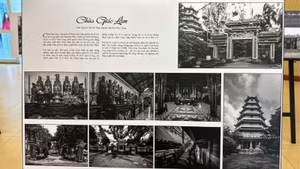
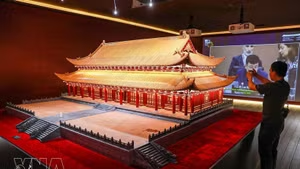
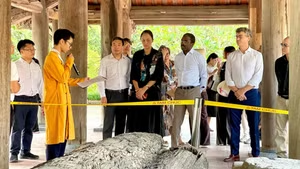
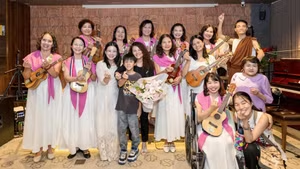
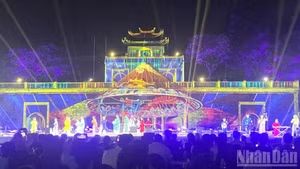
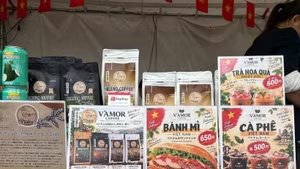
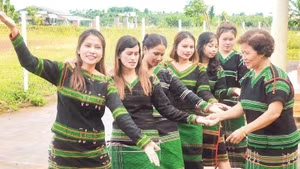
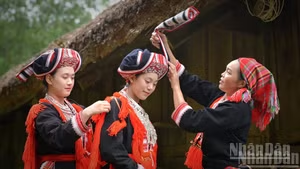
In practice, through cultural tourism, creative industries, digital content industries, cinema, music, design, fashion, cuisine and others, many localities have initially regarded cultural heritage, traditional festivals and distinctive cultural spaces as assets for development, both preserving values and creating sustainable livelihoods for communities.
Cultural resources are most clearly manifested in people. In the context of strong digital transformation, deep international integration and increasingly fierce global competition, the decisive advantage no longer lies in natural resources or cheap labour, but in the quality of human resources, in the spirit of creativity, discipline, responsibility and the ability to adapt flexibly. These qualities cannot be formed without a healthy, progressive and humane cultural foundation.
Not only identified as a resource, culture is also emphasised by the 14th National Congress as a driving force for national development. This approach affirms the proactive and guiding role of culture in the development process. Through value systems and social norms, culture generates strong spiritual motivation for each individual and for the entire community.
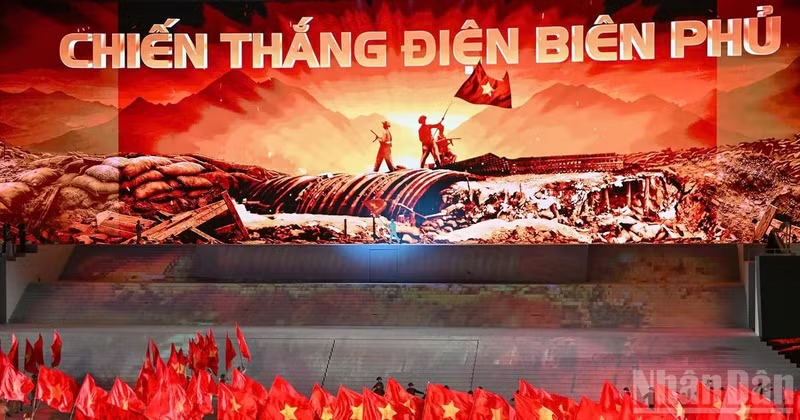
Patriotism, the will for self-reliance, the spirit of solidarity and compassion, and the aspiration to rise are precisely the endogenous drivers that have helped the Vietnamese nation overcome many historical challenges, while continuing to serve as an important spiritual anchor in the current context.
Culture, as a driving force, is also reflected in its capacity to guide development. A culture that upholds integrity, respect for the rule of law, creativity and dedication will help promote institutional reform, enhance the effectiveness of national governance, and build a healthy and transparent development environment.
Conversely, if culture is neglected and deviations from standards are ignored, economic development, even at high growth rates, will be difficult to sustain. Therefore, placing culture in the position of a driving force for development also affirms a viewpoint of comprehensive and harmonious development, with people at the centre.
It is precisely in the combination of “resource” and “driving force” that the breakthrough nature of the Party’s thinking on cultural development becomes evident, regarding culture as a pillar of development with an organic relationship to the economy and politics, thereby proactively unlocking social resources and promoting the roles of the people, enterprises and the creative community.
However, breakthrough thinking only truly has meaning when it is concretised through coherent mechanisms and policies and through decisive action in practice. This therefore requires continued strong renewal of leadership, management and investment approaches for culture; the creation of favourable environments for culture to permeate all areas of life; and the development of the economy in close association with the preservation and promotion of national cultural values.
Together with Resolution No. 80-NQ/TW on the development of Vietnamese culture, which has just been promulgated, the emphasis and clarification by the 14th National Congress of the Party of culture’s role as both a resource and a driving force for development demonstrate a long-term vision and profound confidence in the power of Vietnamese culture and people. This provides an important foundation for inspiring aspirations for development, unleashing endogenous strength, and enabling the country to stride firmly into a new era.