Improving competitiveness
Reducing exploitation, increasing aquaculture, enhancing the value of aquatic products, and converting to green livelihoods for fishermen are the goals that the fisheries industry continued to set in 2025 - the year of acceleration and breakthrough to the finish line of the 5-year fisheries development plan for the 2021-2025 period, while preparing for the industry development plan for the 2026-2030 period.
The fisheries sector has set a target of 9.8 million tonnes of total output by 2030, an increase of 1.5% per year, of which aquaculture output will reach 7 million tonnes, an increase of 4.4% per year, and exploitation output will reach 2.8 million tonnes, a decrease of 3.5% per year.
Deputy Director of the Department of Fisheries under the Ministry of Agriculture and Rural Development Pham Quang Toan said that the specific target set by the fisheries sector in 2025 is a total aquaculture area of 1.33 million hectares, an increase of 2% compared to 2024; total aquatic product output will reach more than 9.6 million tonnes, of which exploitation output will be about 3.6 million tonnes, a decrease of 5.2% compared to 2024; Aquaculture output is more than 5.9 million tonnes, up 3.5% compared to 2024.
The fisheries industry has set a target of reaching 9.8 million tonnes by 2030, up 1.5%/year, of which aquaculture output is 7 million tonnes, up 4.4%/year, and exploitation output is 2.8 million tonnes, down 3.5%/year. Along with the growth of aquaculture, the number of fishing vessels is also gradually decreasing. In 2024, the country has reduced to 84,720 fishing vessels, and according to the roadmap to 2030, the country will have only 83,600 fishing vessels.
With the goal of enhancing marine conservation, protecting and developing aquatic resources, according to the plan by 2030, the country will have 27 marine conservation areas established and operating effectively, 59 aquatic resource protection areas, 63 areas where fishing is prohibited for a certain period of time, and 27 artificial habitats for aquatic species. With the livelihood transformation for the fishing community, the goal is to reduce the trawl and gillnet fishing (which are harmful to resources and ecosystems), convert coastal fishing to other occupations, and reorganise production towards cooperatives and chain linkages...
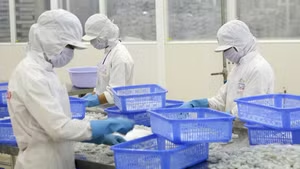
Deputy Secretary General of the Vietnam Association of Seafood Exporters and Producers (VASEP) To Thi Tuong Lan said that greening the entire production, processing and consumption chain of seafood products is a common global trend in the coming time, when more and more countries are aiming to protect the environment, reduce emissions in production sectors, and green imported products.
The demand for sustainable development and green transformation of Vietnamese seafood enterprises is very large, but according to experts, enterprises are still facing three challenges, including capital for implementation, specialised personnel and specific and appropriate technical solutions.
In addition to the biggest difficulty of capital, in the green transformation process, enterprises also face challenges in information, because green policies are numerous in quantity, complex in nature and continuously evolving over time, especially there is no common set of green standards, no unified green transformation roadmap for all types of export goods of enterprises.
To promote green transformation, competent authorities need to provide, update information promptly and issue guidelines for green transformation implementation; coordinate, negotiate and dialogue with trade partners to discuss ways to implement green transformation at enterprises.
For businesses, it is necessary to proactively learn about green agreements, new generation barriers such as fair trade, animal welfare, regularly update green policies related to export products, reduce emissions throughout the entire production process, etc.
Recently, the model of shrimp farming without discharge, using recirculation technology, less water change and biosafety has been invested in and successfully tested by the Department of Science and Technology of Ca Mau province in coordination with the Aquaculture Research Institute II in Cai Nuoc and Dam Doi districts.
The Department of Agriculture and Rural Development of Dam Doi district said that this is a great achievement in the shrimp industry. Recirculation shrimp farming technology without discharge is a new technique that helps reduce production costs, shrimp productivity can reach 60-70 tonnes/ha/crop, on average 6-8 crops can be raised each year, thereby increasing the output per unit of pond area. In particular, the carbon footprint is very low, meeting the future trend of the shrimp industry.
High-tech and environmentally friendly marine farming
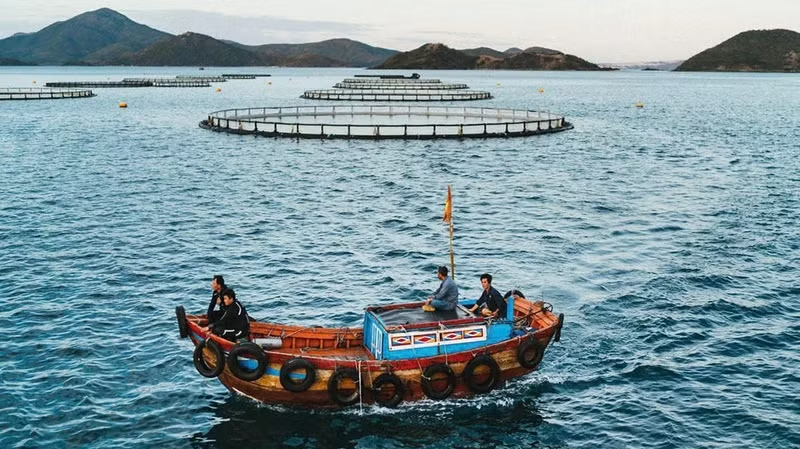
Marine aquaculture is also a sustainable production method, preserving marine resources for future generations. Marine spatial planning, enhancing forecasting capacity, and providing marine insurance are key areas, laying the foundation for the development of offshore aquaculture. Vietnam has identified marine aquaculture as a priority sector, in which sustainability is considered a guiding principle throughout the development process.
The Prime Minister has approved the Project on developing marine aquaculture to 2030, with a vision to 2045. Accordingly, the goal is that by 2025, the marine aquaculture area will reach 280,000 hectares, with an output of 850,000 tonnes, and an export turnover of 0.8-1 billion USD; by 2030, the marine aquaculture area will reach 300,000 hectares, the output will be 1.4 million tonnes, and the export turnover will reach 1.8-2 billion USD.
With many potentials and advantages in the sea, Quang Ninh aims to become the aquaculture center of the North by 2030. Quang Ninh province has planned more than 45,000 hectares of marine area for marine aquaculture with the perspective of comprehensive development in the direction of modernity, high technology, environmental friendliness, increasing value, linking the conservation and development of aquatic resources with tourism development.
The development orientation of the country’s marine aquaculture industry in the coming time is to develop industrial marine aquaculture with advanced technology, strict planning, and modern management methods; develop marine aquaculture in coastal areas, offshore areas, and offshore areas, promoting the biodiversity of tropical regions; integrate economic and technical resources of the oil and gas, shipbuilding, and maritime transport industries, ensuring sustainable development...
The development orientation of the country’s marine aquaculture industry in the coming time is to develop industrial marine aquaculture with advanced technology, strict planning, modern management methods; develop marine aquaculture in coastal areas, offshore areas, offshore, promoting biodiversity of tropical regions; integrate economic and technical resources of the oil and gas, shipbuilding, maritime transport industries, ensuring sustainable development...
Quang Ninh’s marine aquaculture strategy is to take specialised farmers as the core, taking added value as the goal towards multi-value. Taking advantage of the great advantage of the province having a highly developed tourism industry, welcoming tens of millions of tourists each year, the Quang Ninh seafood industry will promote consumption and export right in the locality.
Khanh Hoa province has now established its position as the leading marine aquaculture center of Vietnam, with advantages such as a coastline of more than 380 km, many bays and sheltered coves, and a long tradition in aquaculture and seafood processing.
For decades, traditional wooden cage aquaculture has left many environmental consequences and is not adaptable to climate change. The transition to high-tech, environmentally friendly aquaculture is a major direction that Khanh Hoa province is pursuing to develop a blue marine economy.
According to Director of Khanh Hoa Department of Agriculture and Rural Development Nguyen Duy Quang, the transition to high-tech aquaculture will change people's production methods, protect the environment, beautify the landscape and develop ecotourism.
The province is gradually transforming into a green aquaculture industry; developing the aquaculture industry towards commodity, industrial and advanced production. Khanh Hoa province also sets a goal of converting 100% of traditional aquaculture cages to synthetic plastic cages by 2030, applying high technology and modern management methods.
The General Director of Australis Vietnam Seafood Co., Ltd. (a modern, industrial-scale marine aquaculture company in Van Phong Bay, Khanh Hoa) said: “From now until 2032, we will expand production in the marine areas of Van Phong Bay and other marine areas in the province. The goal is to achieve an output of 40,000 tonnes of fish by 2032.”
In addition, the company will invest in building a modern processing plant in Ninh Thuy Industrial Park, integrating aquaculture development with tourism. The company also aims to cooperate to establish a high-tech aquaculture training center, providing breeds and instructions, and technical support to help local people switch from traditional aquaculture to marine aquaculture using modern, green technology.
Marine farming will increasingly play a particularly important role in developing the marine economy, contributing to making Vietnam a strong marine country, rich from the sea in the century of the sea and ocean. With its potential and advantages in the sea and its strategies for developing green and sustainable aquaculture, in the future, Vietnam can completely become a “sea farming powerhouse” in Southeast Asia.