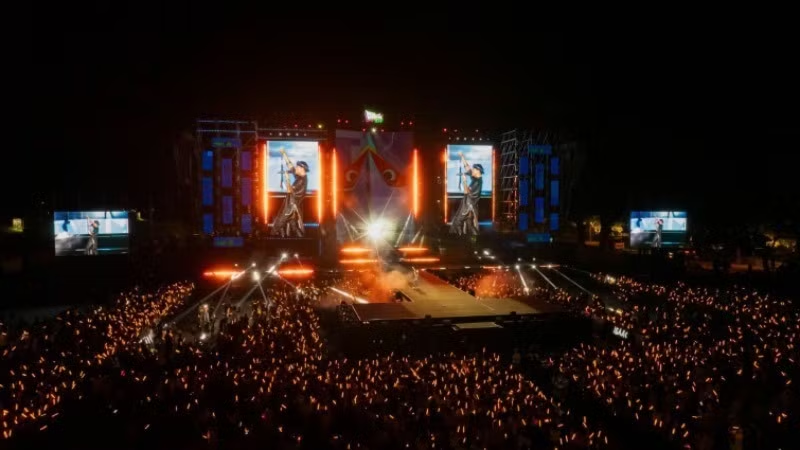
More than just a year of events, Hue has seized the moment to renew its image, elevate its destination profile, and cement its position as a nationally significant centre of culture and tourism.
Positive outcomes
According to Tran Thi Hoai Tram, Director of the Hue City Department of Tourism, Visit Viet Nam Year – Hue 2025 delivered positive results, clearly reflected in strong growth in visitor numbers and tourism revenues. Over the year, Hue is estimated to have welcomed around 6.3 million visitor arrivals, up more than 61% year-on-year, including about 1.9 million international arrivals. Tourism revenue is estimated at over 13 trillion VND, up more than 64%. More importantly, Tram noted, the programme helped raise Hue’s destination standing through image promotion carried out with clear priorities and a focus on target markets.
Activities under the campaign were staged throughout all four seasons, tied to distinctive themes – from heritage, traditional festivals, cuisine and ao dai to arts programmes, large-scale concerts, contemporary performances and night tourism. Hue did not simply retell its heritage story; it gradually experimented with new ways of storytelling that resonate more closely with younger visitors and international markets. Communications were invested in systematically, and promoting Hue on international media channels significantly expanded recognition of the destination.
Building on the 2025 platform, Hue now faces the need to shift from successfully hosting the national tourism year to developing tourism sustainably in the next phase. Nguyen Thanh Binh, Vice Chairman of the Hue City People’s Committee, said Hue continues to identify tourism and services as a spearhead sector, aligned with its orientation to build a heritage, green and smart city.
Accordingly, the city is prioritising improvements in transport and tourism infrastructure, enhancing connectivity at Phu Bai Airport, Chan May Port and key inter-regional corridors, while expanding new service types and tourism products to strengthen destination competitiveness. Hue is also focusing on upgrading human resources, accelerating digital transformation in tourism management, promotion and marketing, and strengthening regional and international linkages.
Solutions needed to go further
Tram said that after Visit Viet Nam Year, Hue is targeting 7–7.5 million visitors by 2026, with international visitors remaining the key segment. This is both an ambition and a pressure that requires sufficiently strong solutions.
In the period ahead, she said local tourism authorities will move quickly to develop mechanisms and policies to attract visitors – such as demand-stimulus measures, considering appropriate fee waivers or reductions for certain attractions, and drawing major conferences and events – while encouraging businesses to build product packages and service combos to boost spending. In parallel, the city will continue developing infrastructure, diversifying services (especially at night), and hosting international-level cultural and sporting activities to create a regular tourism rhythm for Hue.
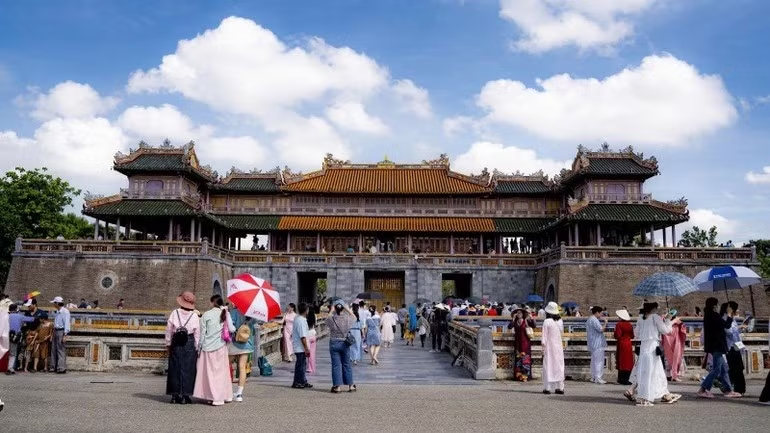
However, alongside the brighter notes, Hue also needs to candidly acknowledge a long-standing reality: an over-saturation of events. Each festival, Hue Festival or mega-concert brings colour, energy and crowds. Yet once the programme ends, the city quickly returns to its familiar, quieter pace.
Visit Viet Nam Year 2025 created opportunities for Hue to build more new images such as culinary spaces, ao dai, performance programmes, mega-concerts and arts shows. However, without a steady flow of visitors and stable purchasing power, these products can easily fall into a loop seen in previous Hue Festival seasons: restoring–building–staging–then packing away. Without a regular audience, the created values have little chance to shine and endure.
This reality suggests the issue is not how many events Hue organises, but how to ensure cultural-and-tourism products have “room to live”, a market, and stronger post-event operations.
A long-running concern
From that story, the biggest challenge remains visitors’ length of stay. For many years, Hue has often been packaged by tour operators as a stop on the central Viet Nam heritage circuit, rather than a final destination where visitors stay for longer.
This issue was recently reiterated by Nguyen Khac Toan, the newly appointed Chairman of the Hue City People’s Committee, during on-site inspections of infrastructure works, where he directed that investment should prioritise entertainment services. He said this is a key factor in retaining visitors, increasing spending and extending stays.
Notably, this requirement has been Hue’s lingering concern for the past 20 years. It is worth recalling that when Vo Phi Hung was Director of the Thua Thien Hue Department of Tourism (now Hue City), the question of “Hue lacking products to keep visitors staying” was raised repeatedly—yet after two decades, average stay durations have not improved markedly.
Infrastructure is necessary, but not sufficient. Hue needs compelling products, night-time entertainment spaces with a clear identity, and a travel sector capable of building tours that make Hue the end point of the journey –not merely a place to pass through.
To achieve that, Hue needs investors with a genuine long-term vision, willing to accompany the city and share benefits with the locality, rather than simply banking on existing advantages. Visit Viet Nam Year created an important push, but that push will only deliver value if followed through with consistent policy, a transparent investment environment, and a determined shift in how tourism is developed.
Hue has proven its ability to organise, innovate and attract as a heritage city. The road ahead is to turn what was built during the national tourism year into long-term momentum – so Hue is not just somewhere people “visit once to see”, but a destination that makes visitors want to stay longer and return again and again.
![[Video] Viet Nam among Top three Asian destinations for return visitors](https://en-cdn.nhandan.vn/images/nyM650OGFWrOVWc-xajqN-rTZ68Rlmc1fiGJOhBRYHErj-E25MBpvJqrpphXazfrpe9t-fYCGuQU4CN0yXo3Rg/du-lich-vietnam.jpg.avif)


![[In Pictures] Nui Chua Rock Park: A million-year-old outdoor museum of landforms on the Khanh Hoa coast](https://en-cdn.nhandan.vn/images/nyM650OGFWrOVWc-xajqNz57td8idIAL_VG9puyG2UZEKOnmq1DVlT1--ZclbO3z2WBaWZhbt6O3e8kjPZqJMWkfEz7RO9qhcwg8o8LQFK8/ndo-br-cao-nguyen-da-moi.jpg.avif)